

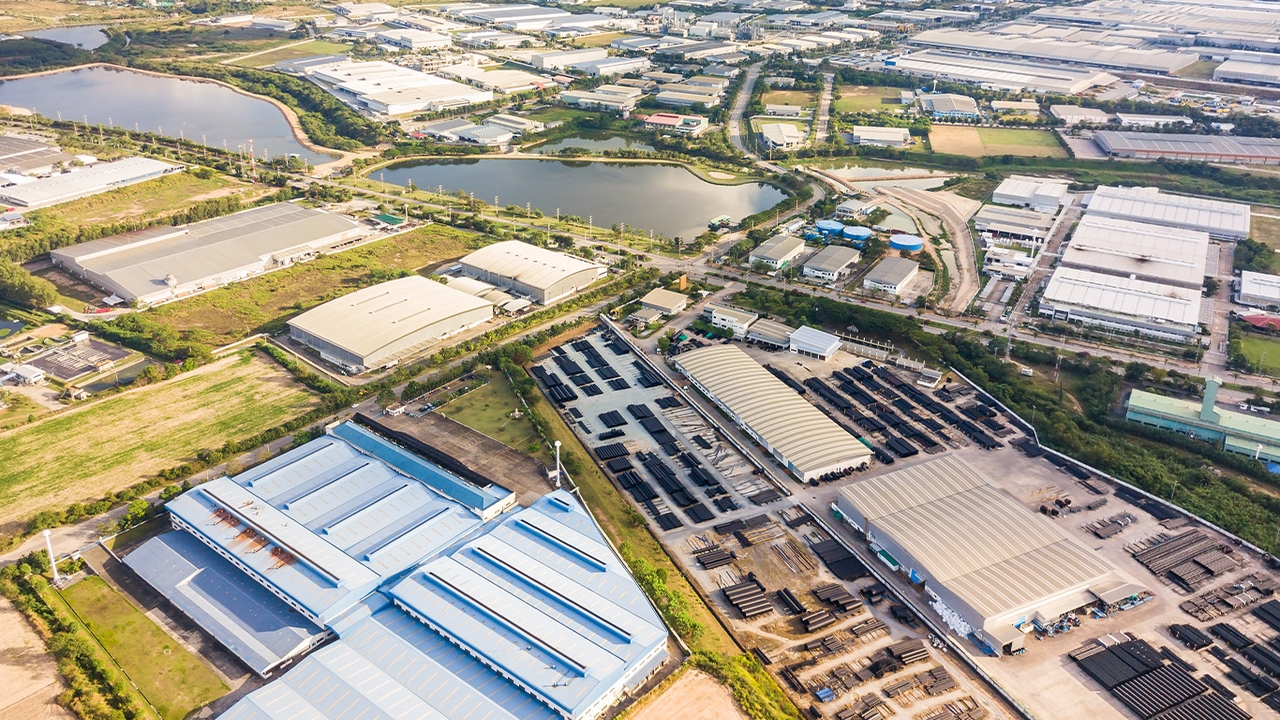
Amidst ongoing debates in Thai society about delaying Data Center project permits in Bangkok to review safety standards, diesel fuel storage near communities, environmental impact assessments (EIA), and zoning regulations,
the discussions mostly focus on the “risks” and “resources” involved, such as the enormous electricity consumption equivalent to 80,000 households or the vast water volumes used for cooling systems.
However, from a business perspective, Data Centers are creating a new phenomenon that is disrupting the pricing structure in the "industrial real estate market" like never before.
a recent research report from Savills (Thailand), a leading real estate research and consultancy firm, reveals a significant shift as technology capital is completely “changing the game” of land transactions in Thai industrial estates.
Pattharachai Taweewong, Senior Director of Market Research and Communications at Savills (Thailand), describes this volatility, noting that the interesting point now is not only the rising land prices but that the market is fundamentally changing how land value is assessed.
In the past, industrial investors focused on location, transport routes, or basic utilities. But for Data Center developers, the decision boils down to just a few key questions: “How much electrical power is available on this plot? And when can it be reliably supplied?”
The factor of Power Availability—the readiness and capacity to allocate electrical power—has become almost the sole indicator of land value, as the electricity that can be provided to these high-tech projects is increasingly limited, while demand from Cloud and AI systems soars rapidly.
the demand outpacing supply of land with "power-ready and connected" status has sparked intense competition for industrial estate land.
Market tracking data from Savills (Thailand) clearly shows that some industrial estate plots in strategic locations with guaranteed power capacity have as many as 4-5 Data Center operators queuing to purchase the same plot.
This concentrated demand on power-ready areas has given industrial estate developers unprecedented bargaining power. Land sale prices in key locations such as the Eastern Economic Corridor (EEC), Samut Prakan, and Phra Nakhon Si Ayutthaya have surged dramatically in a short time:
This price increase of over 50% is something Data Center operators must accept and are willing to pay in exchange for “confirmed sufficient power capacity” aligned with their business timelines.
Looking broadly at Thailand's industrial real estate market at the end of the first half of 2026, Savills (Thailand) reports a total industrial estate supply nationwide of 216,631 rai, with net land ready for sale and lease about 144,736 rai (a 7.39% increase compared to the same period last year).
Meanwhile, the average occupancy rate nationwide remains robust at 82.30%, although net land sales (Gross Absorption) in the first half slowed slightly to about 1,215 rai, entering a balanced phase after a prior surge driven by Chinese capital and export sectors.
Nevertheless, land in strategic areas outside Bangkok has not slowed down accordingly, as new industries like electric vehicles (EV) and advanced electronics, along with Data Centers, fill gaps and continue to push land prices in prime industrial estates to maintain high levels.
Although Data Center investment promotion figures in Thailand look impressive—especially in 2025 with 26 projects valued over 811 billion baht, and forecasts for 2026-2030 investments exceeding 570 billion baht—placing Thailand among the Top 3 Asia-Pacific markets for yield on cost,
reports from the National Economic and Social Development Council and various experts highlight the “other side of the coin” troubling the government. Data Centers are capital and technology intensive but require very little permanent labor, as most systems are managed remotely. Most spending goes to imported machinery, servers, and technology.
Coupled with concerns over competition for electricity and water resources, and Thailand's current lack of a central regulatory body overseeing the sector, as well as legal gaps in zoning and EIA enforcement—as seen in major Bangkok controversies—this makes reviewing and tightening standards an urgent government task.
Savills (Thailand) data conclude that the momentum of AI and Cloud technology has completely transformed the price structure and mindset of the industrial real estate market. “Vacant land” in industrial estates is no longer valued by square wah or road frontage, but by the “megawatts” of electrical power running past the plot.
The key question now is not just how high land prices in industrial estates will climb or who will win the land-buying battle, but how the Thai government can establish regulatory mechanisms, allocate energy resources effectively, and maximize economic and societal benefits from this digital transformation.
Read economic news and government policy with ThairathMoney for your “Better Finance, Better Life” at
Follow the Facebook page: Thairath Money at this linkhttps://www.facebook.com/ThairathMoney