

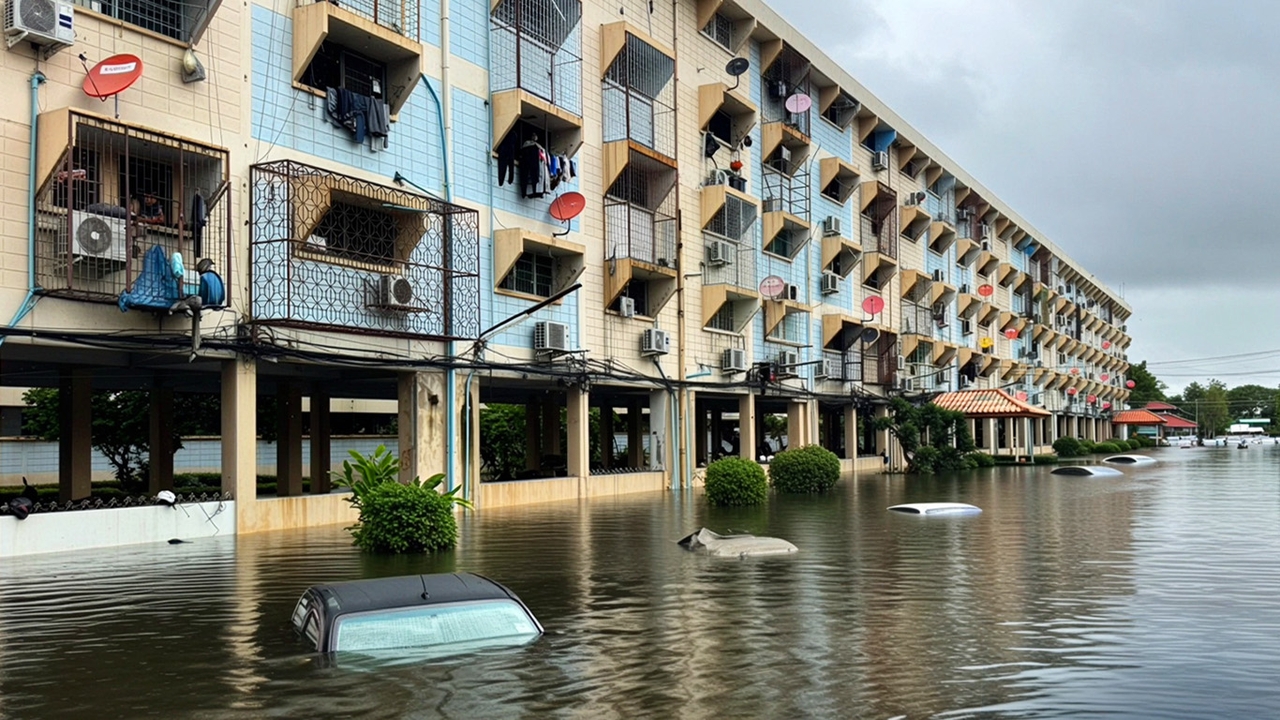
Nearly 50 years ago, Khlong Chan Flats were established as one of the government’s responses to the housing shortage crisis, intended to accommodate thousands of families who came to work and build lives in Bangkok.
Recently, this large vertical community has faced a major test after continuous heavy rains caused flooding within the project to exceed 1 meter, reaching chest height in some areas. Images show many cars parked in rows submerged up to their roofs, while more than 4,000 households were cut off, requiring boat travel or wading through water to enter or leave. Several buildings experienced water and electricity service shutdowns for safety.
The image of people climbing to scoop water from tanks on rooftops reflects not only the unexpected severity of the floods but also the vulnerability of the housing system. While the buildings and upper-floor apartments remained intact, essential services such as water, electricity, transportation, food, and patient care simultaneously stopped.
What lies submerged includes residents’ property, income, savings, and livelihoods. The Khlong Chan Flats crisis thus becomes a case study of who bears the disaster costs as the city shifts burdens onto certain groups.
Back in the 1970s, Bangkok was rapidly expanding. Migrant workers from other provinces flooded into the city to work in industry and services, but affordable housing was insufficient. Slums grew alongside economic growth, prompting the government to establish the National Housing Authority in 1973 to develop housing for low- and middle-income citizens.
The Khlong Chan housing project began development during 1975-1976 in Bang Kapi, then still a suburban area with open spaces and lower land prices than central Bangkok. The project consisted of thirty five-story reinforced concrete buildings with 5,814 housing units, consolidating a large population in one area to enable systematic provision of basic services, communal spaces, and utilities by the state.
Khlong Chan Flats thus represent a product of the country’s major housing policy—a "condominium for city dwellers"—before condominiums along mass transit lines became a dominant real estate market product decades later.
As people from various areas settled, the project gradually grew into a micro-economy with markets, restaurants, small shops, service jobs, and professional networks linked to Bang Kapi district. It became a refuge for working, earning, and supporting families.
Over nearly half a century, Bang Kapi and Khlong Chan transformed from suburbs into dense residential and commercial neighborhoods. Roads, commercial buildings, shopping centers, condominiums, and new projects replaced open spaces and natural water absorption areas. Increased concrete surfaces reduced rainwater infiltration and accelerated runoff into drainage systems.
Meanwhile, surrounding main roads were periodically filled and elevated, making the old project area a low point relative to neighboring structures. Residents and local reports refer to this as a "basin." When heavy rain and high canal levels occur, draining water becomes more difficult than usual.
However, this Bangkok flood was not caused solely by low terrain. Investigations must consider water sources, pipe and pump station capacities, possible backflow from canals, and why almost all were unprepared. Also, why a residential area with over 5,000 units lacked evacuation plans and immediate backup systems. Originally, consolidating many housing units allowed systematic state services, but in disasters, this size complicates assistance.
Flood damage is often described by the number of homes and vehicles submerged. But for low- to middle-income households, motorcycles, cars, phones, appliances, and business equipment are not just conveniences—they are essential income-generating tools.
For motorcycle taxi drivers, delivery workers, or vendors affected by flooding, damage occurs on two levels: first, repair costs or ongoing vehicle payments, and second, lost income while unable to work.
Some salaried workers may request to work from home, but daily laborers, drivers, vendors, and many others have no such option. Meanwhile, costs for food, transportation, repairs, and emergencies increase.
Households without sufficient savings may resort to credit card debt, personal loans, or informal borrowing after the flood. Disasters lasting only days can translate into months or years of debt, especially for lower-income families, where the same damage constitutes a larger share of assets and income.
This is the inequality of disaster impacts, reflected in uneven recovery capacities. Those with insurance, savings, and alternative housing can relocate faster, while others remain amid damages waiting for aid.
Following the event, key questions remain on who will bear restoration costs for common systems—from water pumps, electrical systems, drainage pipes, walkways, and ground floors to building safety inspections.
Public housing buildings face different financial challenges than commercial condominiums. Maintenance fees must remain affordable for residents, but upkeep costs rise with building age. Without sufficient reserves, major repairs depend on government subsidies or pass costs back to unit owners, many of whom are already coping with personal losses.
Meanwhile, Khlong Chan’s land value has increased with urban and transport network expansion. Data shows that years ago, the National Housing Authority proposed mixed-use development on the nearby Bueng Lam Phung pond area but faced community opposition concerned about traffic, environment, and water management. This suggests that when the state lacks funds to repair old housing but land values rise, building new projects might be seen as a solution.
For nearly 50 years, Khlong Chan Flats have provided a stable base for many to work and settle in Bangkok. This crisis underscores the question of how the city will invest in preventing damage before the next disaster or continue to let residents bear repeated costs.
Source: National Housing Authority, Chulalongkorn University
Read economic and government policy news with ThairathMoney for better financial life.
Follow the Facebook page: Thairath Money at this link.https://www.facebook.com/ThairathMoney