

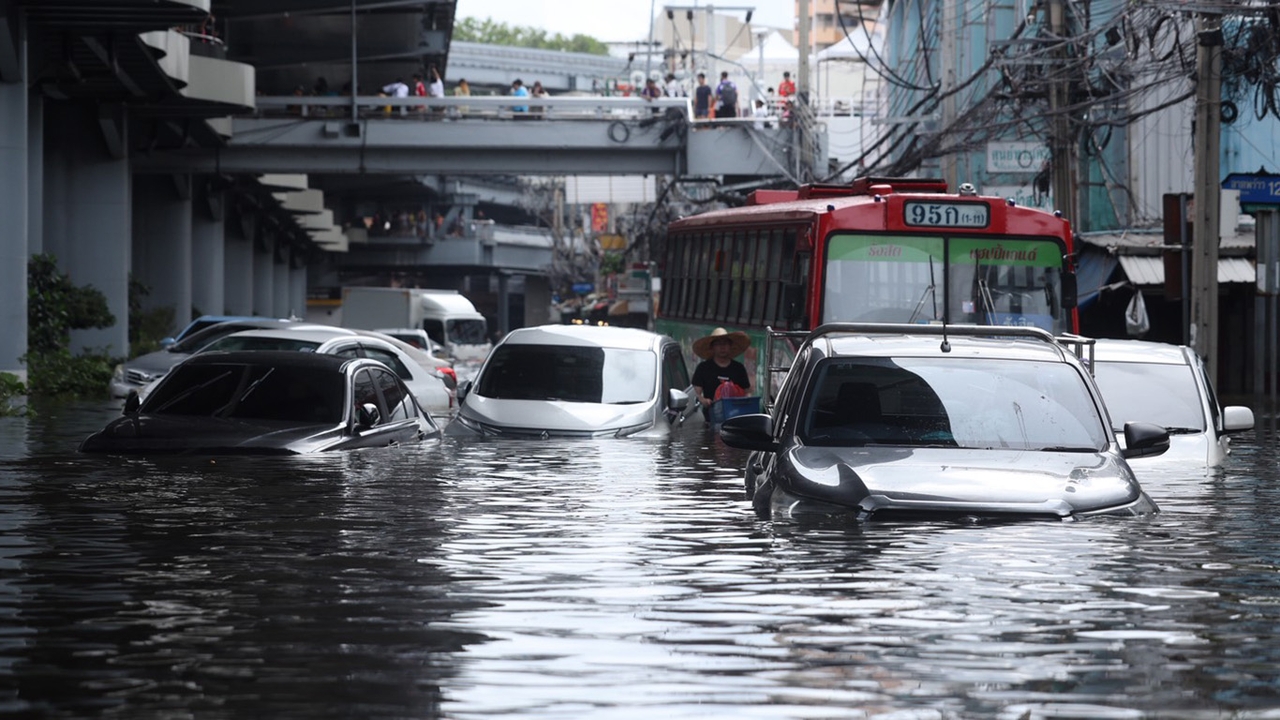
Thailand faces annual flood risks, including the severe 2011 floods, northern region flooding, and 2025 flooding in Hat Yai. Most recently, in late September 2026, Bangkok and 27 provinces endured nonstop heavy rain that overwhelmed drainage, causing the country’s largest flood disaster in years.
Compared to the 2011 damage, how severely will Thailand’s economy be affected, and how much time will the population need to recover?
Thairath Money reached out to Dr. Pipat Luangnarumitchai, Chief Economist at Kiatnakin Phatra Financial Group (KKP) who summarized the situation and impacts, noting that the 2026 floods are not as severe as the 2011 great flood, which caused over 1.3 trillion baht in damages and reduced Thailand's GDP by 3%, with Q4 2011 GDP contracting by 8% from expected growth.
This was because over one trillion baht of damage affected industrial estates, requiring lengthy recovery that impacted production and incomes. Vehicle insurance claims then reached about 6 billion baht.
In contrast, the 2026 flood's economic impact is expected to be no more than 0.1% of GDP due to its short duration, enabling quicker return to work. Vehicle insurance claims are estimated around 2 billion baht. Additionally, reconstruction demand—such as car sales and home or shop repairs—may help economic recovery.
Associate Professor Dr. Thanawut Polvichai, President and Advisory Chairman of the Economic and Business Forecasting Center at the University of the Thai Chamber of Commerce, told Thairath Money that based on data from the Department of Disaster Prevention and Mitigation covering 27 provinces, the economic damage is estimated between 6 billion and 12 billion baht, assuming water recedes within seven days.
Damage specifically in Bangkok and surrounding areas is estimated between 3 billion and 8 billion baht. Overall, a maximum damage estimate of 12 billion baht would impact about 0.06% of GDP, supporting a forecasted Thai GDP growth of 2.2% or higher for 2026.
“The 2026 floods differ from 2011 because the 2011 economic losses of approximately 1.4 trillion baht covered many provinces. Flooding resulted from rain and upstream water discharge, affecting areas outside industrial estates and service sectors like hotels across multiple provinces. Thus, the 1.4 trillion baht damage was the largest economic loss in Thailand’s history,” said Associate Professor Dr. Thanawut.
He also believes that part of the improved outlook for the 2026 floods is due to the World Bank and IMF meetings scheduled from 12-18 October, expecting 15,000 to 20,000 participants from 191 countries, which should help communicate Thailand’s ability to recover quickly.
, Meanwhile, the Kasikorn Research Center estimates the net economic impact to be between 7 billion and 17 billion baht, or roughly 0.03-0.11% of GDP, over a 3–7 day period. Most damage results from temporary economic disruptions, some of which may recover through deferred spending.
Associate Professor Dr. Thanawut views the 2026 floods not as a water management failure but as heavy rainfall exceeding drainage capacity, emphasizing the need to communicate that Thailand is returning to normal quickly.
However, this event underscores the urgency for the Thai government and society to recognize the 'hot world' (Climate Change) scenario, where droughts and floods can occur simultaneously, along with risks like earthquakes. Therefore, long-term disaster preparedness and mitigation strategies must be discussed to reduce future impacts.
Dr. Pipat added that flood and Climate Change impacts often disproportionately affect small-scale individuals or low-income groups due to limited life choices. Although the overall economic impact may be less than in the past, the floods may significantly affect the Wealth Effect for Thais, as savings are diverted to repairs and recovery, impacting consumption and confidence. This may also worsen the plight of those already affected by COVID-19, high household debt, and other issues.
Compared to 2011, when Thailand's GDP was initially growing around 4%, the government implemented various economic stimulus policies such as first-car schemes, rice pledging at 15,000 baht, and 15,000 baht starting salaries for graduates, during a period when household debt was low at 30-40% of GDP.
Today, the situation differs: economic growth in 2026 is weak, household debt has risen to 80% of GDP, and leveraging economic growth through increased borrowing is more difficult. High debt levels reflect low savings among Thais. Consequently, recovery will be challenging; even with credit measures, it is uncertain how much borrowing individuals can undertake. This limits household recovery after repeated shocks from high oil prices, earthquakes, and floods, which become necessary expenses, reducing the Wealth Effect and spending capacity.
Ultimately, although the 2026 economic impact is less severe than in 2011, household wounds from high debt and the Climate Change crisis are worse. Thailand must urgently develop long-term water management plans to prevent recurring losses for vulnerable populations.
Follow economic and government policy updates on ThairathMoney athttps://www.thairath.co.th/money/economics/thai_economics
Follow the Facebook page Thairath Money at this link: https://www.facebook.com/ThairathMoney