

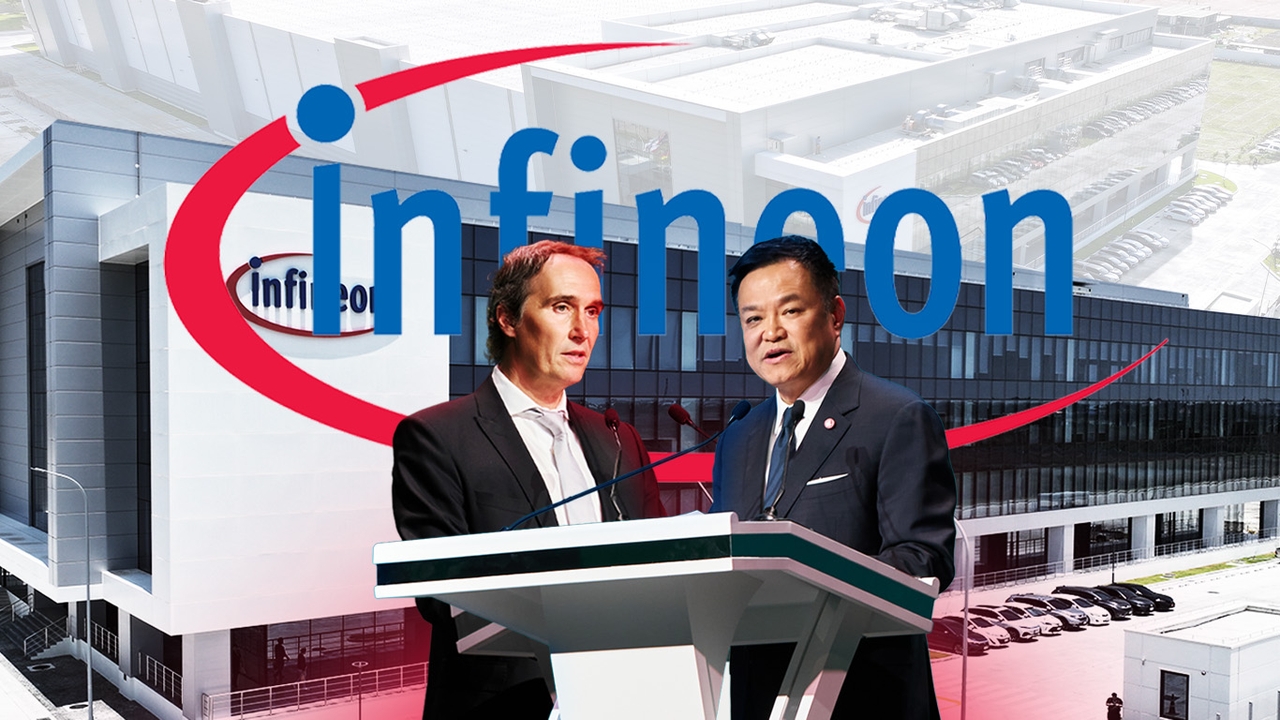
Infineon Technologies, a leading global semiconductor manufacturer from Germany, officially opened a new factory in Thailand on Thursday, 1 Oct 2020 GMT+7, marking Infineon's first chip production plant in the country.
This new factory will serve as a backend semiconductor manufacturing site located in Samut Prakan Province, and will be one of Infineon's 13 key production bases distributed worldwide.
Spanning over 200,000 square meters, Infineon has positioned this new plant as a comprehensive backend production base, handling wafers that have completed frontend processes from Infineon's global centers and partners, through assembly, testing, packaging, and final semiconductor processing.
According to the Board of Investment (BOI), this factory represents an investment exceeding 48 billion baht, covering production of power control chips (Power Modules), integrated circuit (IC) testing, wafer processing, and research. Infineon reports that it has already invested over 100 million euros (more than 38 billion baht) in machinery and equipment for this facility.

Looking ahead, Infineon plans to expand this production base, aiming to make it the company's largest backend manufacturing site. Alexander Gorski, Chief Operating Officer (COO) of Infineon, stated, “This new factory will enhance flexibility, adaptability to change, and future readiness for Infineon's global manufacturing network.”
Infineon Technologies is one of the world's major chip producers, widely recognized as the top global manufacturer of power semiconductors and automotive chips.
The company's main products include microcontrollers, sensors, power management systems, and security controllers, which are used in electric vehicles, renewable energy systems like wind and solar, industrial automation, and IoT devices.
Infineon manufactures semiconductors in both frontend, which involves complex electronic circuit patterning on silicon wafers using chemical and physical processes, and backend stages. The company is expanding its frontend production bases globally as well.

After frontend processing, wafers proceed to backend stages, where they are assembled, tested, and prepared for use. The Thai factory will perform these backend processes, importing wafers from Infineon's centers and partners before distributing finished products to customers.
Alexander Gorski noted that Thailand’s key advantage lies in its unique blend of skilled personnel, industrial capabilities, and a clear commitment to innovation development.
Infineon's arrival aligns with Thailand’s recently approved National Semiconductor and Advanced Electronics Strategy, a long-term plan through 2050 to promote Made in Thailand chips and position the country as a leading semiconductor hub in the region.
At the opening event, Prime Minister Anutin Charnvirakul honored the occasion and said, “Thailand will focus on key industries such as Power, Sensors, and Photonics, which are Infineon's strengths and align with Thailand’s industrial development goals.”
Thailand’s industrial development strategy is built on five pillars:
Infineon also reported that it currently employs 350 people at this plant and expects to create more than 1,400 jobs once fully operational.
A major goal for this plant is to evolve into an Automation Factory, a next-generation production base distinct from existing ones in Malaysia and Singapore.

Wei Khoe Lim, Senior Vice President and Managing Director of Infineon Thailand, explained, “Creating an automated factory means we are building many highly skilled positions within this plant.”
He further elaborated that traditional backend factories usually consist of approximately 50% operators, 30% technicians, and 20% engineers. However, this plant will differ significantly, with technicians and engineers comprising over 80% of the workforce.
In addition to factory construction, Infineon is investing in Thailand’s human capital by collaborating with agencies and educational institutions to recruit talent for internships and jobs, provide overseas training, and attract experts to Thailand.
Currently, only one module of the production base is constructed and operational, but the company has long-term plans to expand to up to five modules, greatly increasing capacity and establishing this as Infineon's largest backend factory.
“For Infineon, this factory is just the beginning in Thailand. The company remains committed to investing, developing personnel, and expanding capacity to support long-term business growth,” Wei Khoe Lim concluded.

For economic news and government policy updates from Thairath Money to help you achieve “Good Finance, Good Life,” visithttps://www.thairath.co.th/money/economics/thai_economics
Follow the Facebook page: Thairath Money at the linkwww.facebook.com/ThairathMoney