

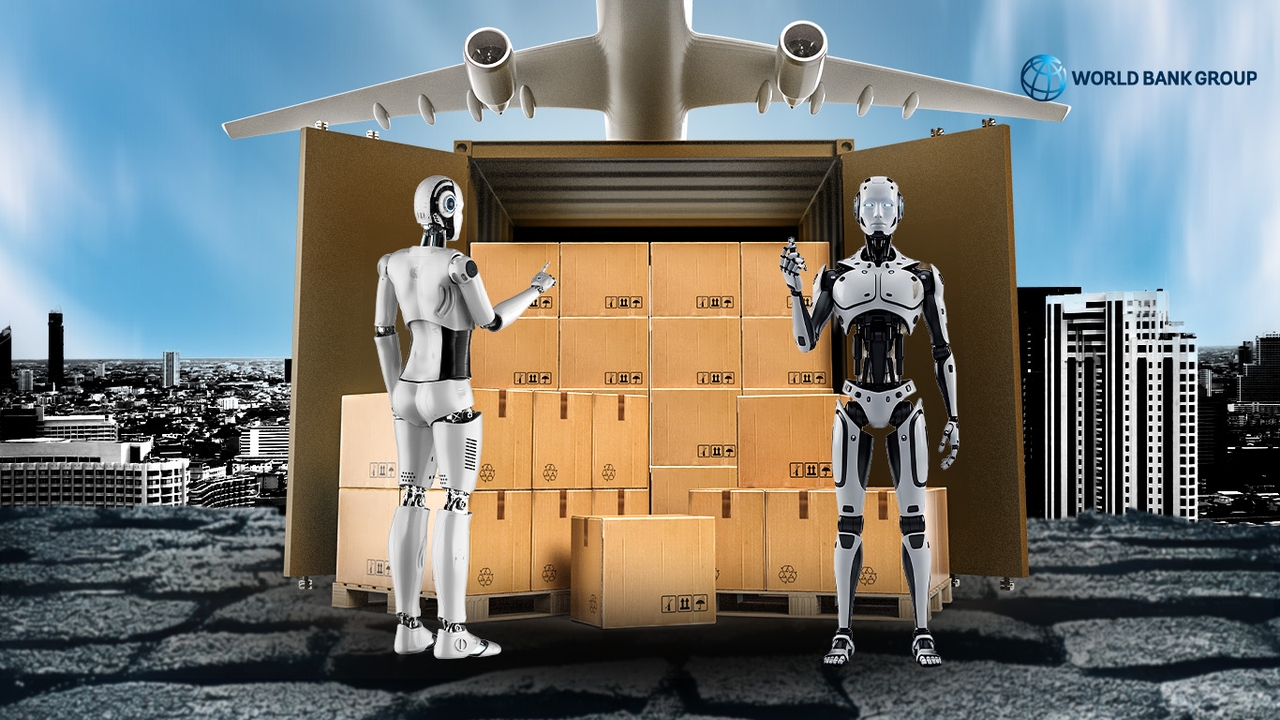
Amid the global surge in AI-driven economies, Thailand's 2026 economy is facing two distinctly different scenarios.
On one hand, Thailand benefits significantly from the rapid growth of AI demand worldwide, especially for AI hardware, with the country serving as an important production and export hub.
On the other hand, the AI momentum has not spread across all industrial sectors, with disparities in business adoption due to high costs and skill shortages, resulting in low productivity.
According to the World Bank's East Asia and Pacific Economic Update of October 2026, Thailand’s economy is projected to grow 2.0% in 2026, an upward revision of 0.7 percentage points from early-year forecasts, with expected growth of 2.3% in 2027 and 2.4% in 2028.
Although Thailand’s real GDP grew 2.8% year-on-year in Q1 2026, growth slowed to 1.9% in Q2. This economic performance highlights a clear divide between the strong growth in advanced technology exports and the sluggish domestic economic activities.
The report shows that Thailand's exports in July 2026 grew nearly 22% year-on-year, with AI-related products driving over 70% of total export growth.
This places Thailand alongside Malaysia, Vietnam, and the Philippines, countries benefiting significantly from global AI infrastructure investment expansion.
Thailand is recognized for its expertise in AI-related products, especially in downstream processes such as assembly, testing, packaging of chips and components, as well as finished hardware production. This strength has doubled the share of computer and component exports in Thailand’s export basket to 8% since 2023.
However, despite strong export figures, Thailand faces structural disparities between the electronics manufacturing sector for exports and the overall industrial sector. Industrial production declined for the third consecutive month (up to June 2026), contracting 3.1% year-on-year, while electrical equipment production grew 8% over the same period.
These figures reflect that although AI-related hardware manufacturing is growing well, this growth has yet to translate into a broad recovery in traditional domestic manufacturing.
Next, despite the country’s strong export performance, domestic AI adoption remains clearly delayed and slow.
Data from the 2026 World Bank Enterprise Survey (WBES) highlight a clear gap: only 12% of Thai organizations use AI technologies, including Predictive AI, Generative AI, or Agentic AI, compared to 43% adoption in the United States.
Furthermore, only 4% of Thai companies pay for AI software licenses, indicating that most Thai businesses are still experimenting informally with free AI tools.
In a World Bank press briefing, it was stated that about 80% of Thai companies expect AI to improve productivity only slightly or not at all in the short term, primarily due to multiple constraints in AI adoption.
Nevertheless, amid these challenges, about 13% of surveyed Thai companies hold a highly positive view of AI’s future, expecting rapid global AI development to boost labor productivity—measured by sales per employee—by at least 20% within three years.
In developed economies like the United States, Generative AI is disrupting the labor market, threatening to replace humans, especially in white-collar office jobs.
By contrast, emerging Southeast Asian economies, including Thailand, are less affected. The World Bank report notes that only 13% of jobs in these emerging markets involve Non-Routine Cognitive Tasks—work requiring complex thinking that AI tools can augment effectively.
Such tasks involve high-level thinking, analysis, and decision-making, where AI can enhance human performance. Developed economies, however, have 39% of jobs in this category.
Consequently, World Bank analysis of online job postings has yet to find significant reductions in AI-replaceable jobs in Thailand since ChatGPT’s launch at the end of 2022.
On another note, data on Thai users’ engagement with Large Language Models shows most employ Generative AI primarily for task automation rather than to augment work capabilities.
Thailand mainly uses AI for automation tasks such as information retrieval, drafting emails, general communication, and structured queries, while more complex augmentation tasks—like solving complicated problems, strategic synthesis, or collaborative design—remain underutilized.
Moreover, Thailand’s ability to leverage AI as a broad economic driver remains limited by other factors including economic and financial vulnerabilities and environmental risks.
The World Bank report states that to transform AI-driven export momentum into broad-based economic development, Thailand must pursue policy reforms in three key areas.
Instead of competing to develop frontier Large Language Models, which require massive investment, a more suitable path for Thailand is to deploy "Small AI" adapted to local conditions.
Small AI refers to smaller, resource-light models designed specifically for particular industries or tasks, including support for local languages and specific national needs. For example, the ThaiLLM project demonstrates that open-weight models can be adapted to Thai language datasets at a fraction of the cost of developing frontier models from scratch.
Applying these tools in labor-intensive sectors such as tourism and agriculture can boost productivity in industries with relatively low barriers to technology adoption.
Thailand is reforming public procurement to enable startups and innovative digital solution providers greater access to the government market.
Leveraging government purchasing power can help stimulate the commercialization and real-world application of domestically developed AI tools, while enhancing public service delivery, especially in local administration and healthcare.
Improving digital and energy infrastructure readiness is fundamental for long-term AI adoption, as data centers and advanced technology manufacturers require large, stable power supplies and reliable fiber networks.
Therefore, Thailand must reduce energy market distortions, shorten grid connection times, and expedite renewable energy installations, particularly solar and wind power. This approach will support digital infrastructure expansion without increasing risks from dependence on volatile imported fossil fuel prices.
Looking at the bigger picture, AI is not replacing the Thai economy but revealing a more complex image. Thailand benefits from the AI boom through exports of hardware, servers, computers, and network devices, yet domestic AI adoption remains low.
The key challenge is not only to establish Thailand as a global AI hardware production base but to ensure AI genuinely improves productivity in Thai businesses, labor, and the domestic economy.
The World Bank suggests Thailand does not need to compete to build the largest AI models but should select technologies suited to its context, invest in infrastructure, develop human skills, and create policies that enable widespread practical AI adoption by Thai businesses.
Read economic and policy news with Thairath Money to help you achieve “Better Finance, Better Life” athttps://www.thairath.co.th/money/economics/thai_economics
Follow the Facebook page: Thairath Money at this link https://www.facebook.com/ThairathMoney