

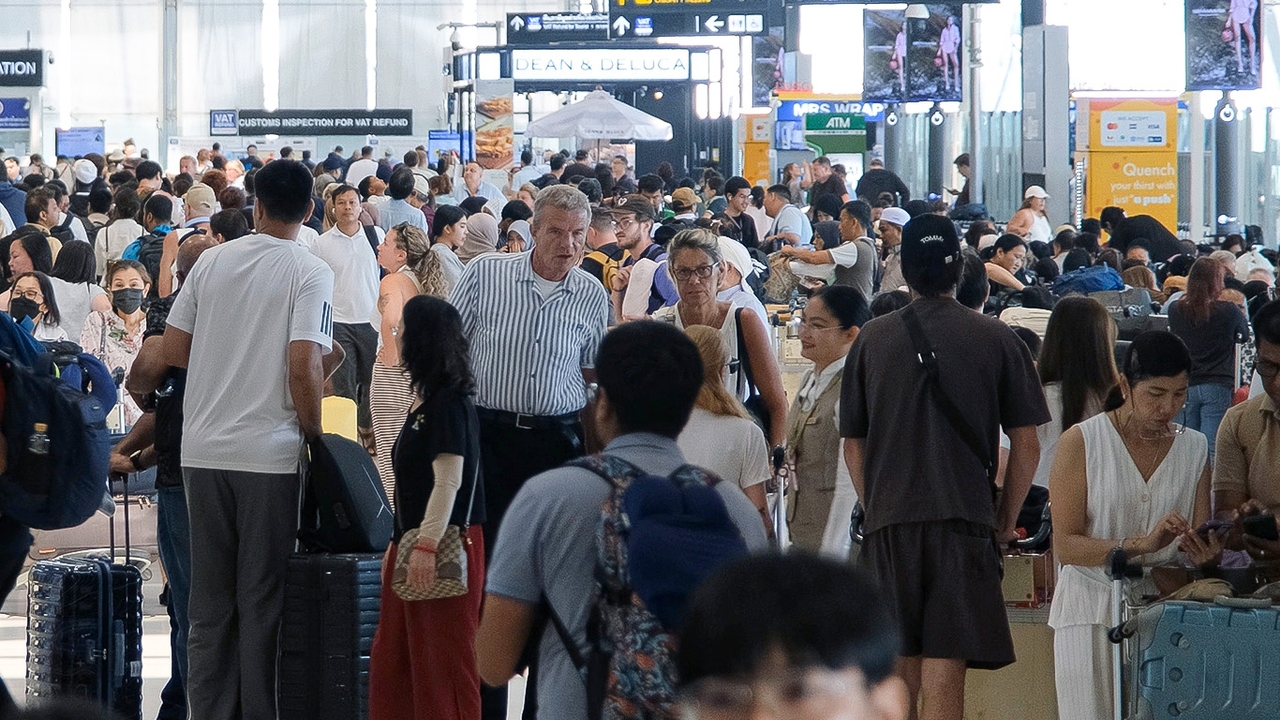
"Do you have to pay when entering Thailand and also when leaving?" [Tags: travel tax, Thailand, tourism policy] This question is becoming a hot topic among travelers, workers, and industry insiders in tourism, sparking widespread debate and concern.
The government has revived the idea of an "Outbound Travel Tax," commonly called the "flight departure tax," charging all travelers of any nationality departing from Thailand. Amid discussions on whether, during a fragile economic recovery, this measure is a "lifeline" to boost state revenue or a "drag" on Thailand's tourism competitiveness, debates are intensifying.
To provide a comprehensive overview covering government viewpoints, private sector concerns, and direct economic effects on consumers, Thairath Money summarizes the 10 main points as follows.
1. Government rationale: augmenting state revenue in a fiscally tight era
The proposal to levy the outbound travel tax originates from the Ministry of Finance’s directive to the Revenue Department to find ways to strengthen fiscal stability. This is due to the country's high public debt level and the government's aim to create fiscal space to better handle future emergencies. However, this measure remains a concept under public and private sector consultation until 29 October 2026, with no actual collection in place yet.
2. Draft law details: who is taxed, how much, and which travel modes are covered?
The new draft law changes key principles from past versions by expanding the tax base from only Thai nationals and residents to all travelers departing Thailand, regardless of nationality. The law caps the tax at 5,000 baht per trip, but initially will charge only 1,000 baht per air travel departure. Land and sea travel are exempt for now. The tax will be added to airline ticket prices during purchase through airlines or agents.
3. Which Thai travel fees are currently collected and which are not?
Confusion often arises between various fees, which actually differ clearly in status. The Passenger Service Charge (PSC) of 1,120 baht per person has been collected since 20 June 2026. Two fees are not yet collected: the 450-baht "Landing Fee" for inbound foreign tourists, currently awaiting cabinet approval, and the 1,000-baht outbound travel tax, which is still under public consultation.
4. Cost example: how much additional expense does a family face?
If all measures are implemented simultaneously, the Thai Hotel Association notes that a foreign tourist flying in and out of Thailand faces total government fees and taxes of up to 2,570 baht per round trip (including PSC of 1,120 baht + Landing Fee 450 baht + outbound tax 1,000 baht). For a family of four, this translates into an immediate increase of 10,280 baht in government fees per trip, excluding airfare, accommodation, and other travel expenses.
5. Historical context: Thailand has previously levied an outbound travel tax
The outbound travel tax is not new in Thailand. Since 1983, a Royal Decree imposed it to prevent excessive foreign currency outflow and maintain the balance of payments. It used to charge 1,000 baht for air travel and 500 baht for land/sea travel. The government phased out the land and sea tax in 1986 and air tax on 1 July 1991. This revival dusts off the old concept and expands it to all travelers regardless of nationality.
6. International models: how do other countries levy travel taxes?
Different countries adopt various travel tax schemes. Japan charges a flat 3,000 yen (about 640–700 baht) outbound tax included in ticket prices. Bali, Indonesia charges foreign tourists 150,000 rupiah for cultural and environmental preservation. Malaysia, Singapore, and many European countries apply tiered taxes based on distance and class of travel to better suit travel characteristics.
7. Economic perspective: why does a flat 1,000-baht tax affect people differently?
Professor Athiphat Muthitajaroen from Chulalongkorn University’s Economics Faculty explains that a flat 1,000-baht tax disproportionately impacts travelers. For example, a low-cost carrier ticket to a nearby country costing 5,000 baht means the tax is 20% of the fare, while a business class ticket to Europe priced at 120,000 baht results in less than 1% tax impact. Thus, a flat tax burdens price-sensitive travelers, short-haul flights, and low-cost airlines the most.
8. Thai Hotel Association’s concerns: fears of weakened competitiveness
The Thai Hotel Association (THA) has formally opposed the draft law, worried that higher combined fees will deter foreign tourists, who may choose cheaper regional alternatives. It also affects two-way tourism since fewer Thais traveling abroad might lead airlines to reduce flight frequencies, making it harder for foreign tourists to visit Thailand and impacting hotel and tourism-related businesses throughout the supply chain.
9. Opposition from ATTA: recommends indefinite postponement, citing disproportionate costs
The Association of Thai Travel Agents (ATTA) also plans to submit opposition, urging indefinite delay of the law. It highlights that international travel by Thais encompasses education, work, and investment, not just tourism. Increasing taxes adds burdens on citizens and small businesses, especially during recovery from natural disasters. Moreover, increased tax revenue may not offset losses from reduced economic activity and employment.
10. Structural recommendations: how should the tax be designed if implemented?
Academics and private sector suggest that if the government proceeds, it should replace the flat 1,000-baht rate with tiered rates based on distance and class of service—for example, lower rates for short-haul economy flights and higher for long-haul or business class. Additionally, exemptions should cover transit passengers who change planes through immigration to preserve Thailand’s role as an aviation hub.
Sources: Revenue Department, Bnomics by Bangkok Bank, Thai Hotel Association, ATTA
Read economic and government policy news with ThairathMoney to improve your financial life.
Follow the Facebook page: Thairath Money at this linkhttps://www.facebook.com/ThairathMoney