

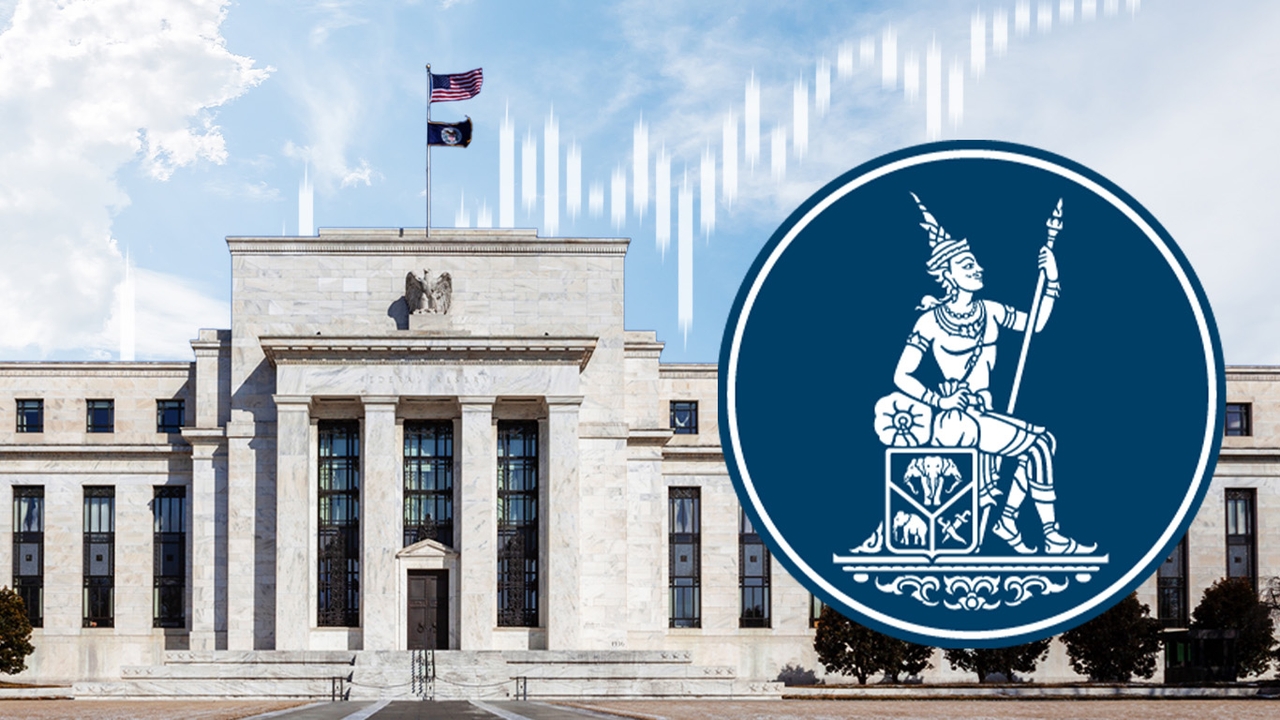
On 28 Oct 2026, the market closely watched decisions by the U.S. Federal Reserve (Fed) and the Bank of Thailand (BOT) regarding policy interest rates. Both institutions decided to "hold interest rates," leading to market anticipation about when changes might occur and how investors will adjust their portfolios.
Starting in the afternoon of 28 Oct 2026, the Monetary Policy Committee (MPC) unanimously voted to keep the policy interest rate at 1.00% per annum. They emphasized that maintaining an accommodative monetary policy remains crucial to supporting Thailand's uneven economic recovery, and monetary policy must be complemented by targeted fiscal measures.
Simultaneously, the MPC revised Thailand's GDP growth forecast for 2026 to 2.4%, up from the previous 2.3%, and for 2027 to 2.1%, increased from 1.8%.
This morning (29 Oct 2026), the Federal Open Market Committee (FOMC) meeting summary from 27-28 Oct 2026 was released, showing a decision to "hold interest rates" at 3.75-4.00%. Two members proposed a 0.25% rate hike, while ten favored holding steady amid a strong U.S. economic expansion and persistently high inflation.
Meanwhile, Kasikorn Research Center noted that the Fed signaled adjustments to its meeting schedule for long-term monetary policy reviews: among eight meetings, there will be no interest rate votes once in 2027 and twice in 2028, allowing the Fed time to consider structural issues alongside routine short-term economic assessments.
Dr. Amorntep Javala, Head of Research Office, CIMB Thai Bank He stated that although the Fed held the policy rate this time, if U.S. inflation remains elevated, the Fed may raise rates again in December, with the market estimating a 70% chance of reaching 4.25%. Additionally, there could be one or two more hikes in 2027.
Regarding Thailand, the Bank of Thailand (BOT) is expected to maintain the policy rate at 1% as long as possible. The main reason is the uneven distribution of Thailand's economic growth. There are also concerns about the impact of the El Niño phenomenon, which could harm Thailand's agricultural sector. Thus, the BOT will continue to assess the situation to support the economy.
Risks Thailand must monitor include a scenario where the Fed continues raising rates, widening the policy rate gap between Thailand and the U.S., potentially triggering capital outflows and weakening the baht somewhat, though it is expected to trade within a 33.5-34.00 baht per U.S. dollar range. Other global risks include oil price trends, global trade policies following the ASEAN summit, high global public debt, and U.S. political issues—such as the risk of a government shutdown after the U.S. midterm elections—that could somewhat affect the U.S. economy.
Kasikorn Research Center observes that financial conditions and credit have tightened following the Fed's September 2026 rate hike, with expectations of another hike in December amid persistent inflationary pressures. For 2027, the Fed is likely to hold rates steady in the baseline scenario, consistent with the Dot Plot forecasts if inflation moderates as expected.
Jirapiboon Rattanapanurak, Head of Wealth Research & Advisory, CIMB Thai Bank He noted that in Q4 2026, investors should watch for oil price volatility, which will influence central banks globally. Given the Fed’s firm stance on inflation management, despite energy price swings and potential political changes in the U.S., this period is an opportunity to adjust investment portfolios.
One growth trend remains strong in U.S. technology investments, driven by AI and other technologies that boost productivity and revenue. Even if markets reduce risk appetite in the short term, this could offer a good base for buying quality assets at lower prices.
For Q4 2026, investment advice includes increasing allocations in equities such as U.S. technology stocks and Asian equities excluding Japan. For Chinese stocks, it is recommended to maintain current weightings for now.
Additionally, increasing allocations in alternative assets is advised, while maintaining exposure to fixed income securities but reducing cash holdings.
However, investment planning should focus on long-term goals, as holding quality assets over time reduces the chance of negative returns. Planning should align appropriately with life goals.
For stock and investment news, visit Thairath Money athttps://www.thairath.co.th/money/investment
Follow the Facebook page: Thairath Money at this linkhttps://www.facebook.com/ThairathMoney