

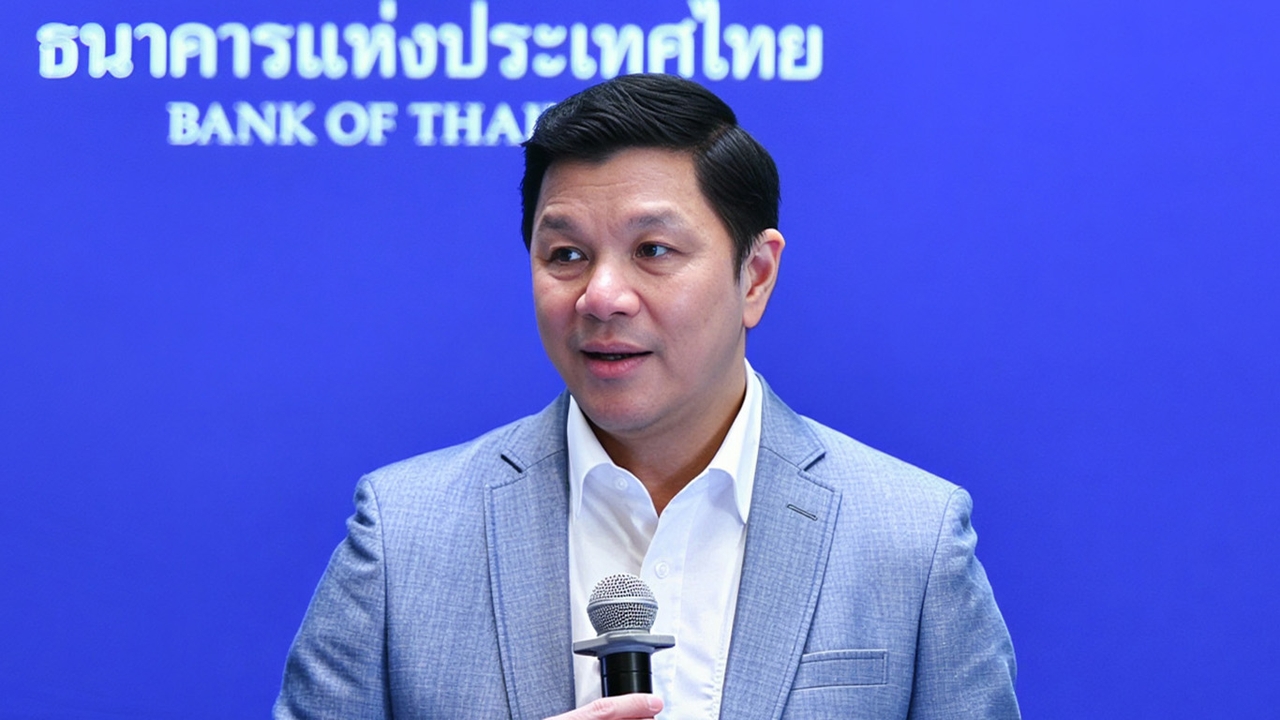
It has been one year since "Vittaya Ratanakorn" assumed the position of Governor of the Bank of Thailand (BoT). This milestone provides a timely opportunity to review what the BoT has accomplished over the past 12 months and to preview the direction for 2027, noting that detailed plans for 2027 must still be approved by the Bank of Thailand's Board of Directors. "Vittaya Ratanakorn" The Governor summarized that over the past year, the BoT has clearly adjusted its organizational strategy and repositioned its role. Previously focused primarily on maintaining macroeconomic stability, it continues to prioritize stability but has added a focus on economic recovery to bring growth back to its potential level.
With economic growth declining continuously, the context has changed, and so have the risks.

He compared that during times when the economy grew around 5%, fluctuations of 4.7% or 5.3% were manageable because nominal GDP, including inflation, provided a sufficient buffer for businesses to earn adequate revenue and for households to cover expenses. However, with growth at only 2% and inflation below 1%, business and household incomes rise very little—less than actual expenses—leading to financial shortfalls for both SMEs and the general population.
The Governor noted that if household and business incomes fail to cover expenses, businesses will close, people will be unable to repay debt, purchasing power will decline, and a vicious structural problem loop will form, eventually threatening stability. Therefore, the BoT decided to broaden its role.
"When economic growth is too low, if household and business incomes do not keep up with expenses, businesses and people will not be able to repay debts, there will be no purchasing power, and this cycle will lead to structural problems. Thus, we have expanded our role to place more emphasis on supporting the economy. Stimulating the economy remains the government's responsibility," Vittaya said.
What the BoT can do is support the economy to grow at an appropriate level and help address structural issues, which have accumulated over time and remain unresolved, requiring cooperation from all parties.
Maintaining the three core stabilities: price, financial system, and payment system.
Regarding price stability, Thailand’s inflation is currently very low. Excluding the recent crisis period, in February 2026 before the Iran conflict, inflation was -0.8%, reflecting a very weak economy and low demand-side inflation. The inflation spike caused by the war was supply-side driven. Therefore, price stability is not a concern.
Regarding the financial system, Thai financial institutions are currently very strong and profitable. The BoT assesses stability not by bank profits but by capital adequacy (BIS Ratio), capital base, and liquidity ratio, all of which remain comfortably healthy.
The payment system is highly stable, especially PromptPay, which is excellent, free to use, and low cost. Going forward, the BoT is developing supervision for THB Stablecoin and the BahtNet Modernization project to upgrade the country’s payment infrastructure, expected to take two years due to its scale.
Interest rates cut twice, currency depreciation supports the economy, and no conflicts with the Ministry of Finance.
Simultaneously, the BoT adopted a more proactive foreign exchange management approach. This does not imply previous methods were poor but reflects changing contexts and risks. Measures to reduce continuous Baht appreciation pressure include regulating gold trading on platforms, money transfers, and US dollar purchases to curb speculation and reduce volatility.
Regarding cooperation with the Ministry of Finance, the Governor assessed that policy coordination has been excellent. There has never been a need for public disputes; disagreements are expressed privately, and both sides work in alignment.
"We have never had to quarrel publicly. Disagreements are voiced but support each other to solve problems together. There is no need to appear opposed or create uncertainty between monetary and fiscal policies," Vittaya said.
In summary, the Governor observed clear economic improvement over the past 12 months, though modest. Inflation increases were due to the war. The Baht depreciated 6.6% since the start of the year, but other regional currencies like the Philippine Peso (-8%) and Indonesian Rupiah (-7.8%) weakened more, while some, like the Vietnamese Dong, appreciated by 1.6%, and the Malaysian Ringgit weakened only about 0.7%.
Therefore, supporting the economy through current policy interest rates and a moderately depreciated exchange rate helps ease pressure, promote growth, and aid exporters.
Addressing four structural problems through 18 measures.

However, the BoT’s actionable areas include four issues: resolving household and SME debt; improving SME and microcredit access (with SME credit contracting for 17 consecutive quarters); promoting fairness in financial services regarding interest rates and fees; and managing the shadow economy and corruption flowing through the financial system.
He stressed the need for ongoing action and collaboration, hoping all agencies will assist so the BoT is not working in isolation due to limited capacity.
He believes solving these issues will improve the economy, increase fairness, and reduce inequality. The 18 measures enacted in his first 12 months as Governor are as follows (see accompanying image).
Resolving household and SME debt: Rapidly closing small debts to support small borrowers.

"These are 300,000 lives freed from debt," said the Governor.
Additional measures include lowering credit card minimum payments to 8% and the “You Fight, We Help” program, allowing installment retention and extended asset repurchase periods, preventing debtors from losing assets prematurely.
Improving SME credit access: Credit Boost aims for 80 billion baht by year-end.
The BoT also introduced SMEs Secure Plus, offering land-secured loans with relaxed income verification. The Governor candidly admitted this program has not been very successful, with loans disbursed around 4-5 billion baht, but it remains an effort to assist SMEs.
Fairness: Reducing 19 bank fees and providing two free credit bureau checks annually.
The BoT also authorized free credit bureau checks twice per year, approved by the Credit Data Protection Committee (CDPC), and plans further fee reductions in December 2026. The Governor hopes these steps create fair costs rather than excessive profits, as credit check costs currently disproportionately burden low-income borrowers and SMEs.
He emphasized the credit bureau’s critical role as a monopolistic core infrastructure and desires its expansion.
"The credit bureau earns 380 million baht annually, totaling 3.6 billion over 15 years, with a 250 million baht investment. It is core infrastructure, but credit check fees are high, imposing significant costs on the poor, low-income individuals, and SMEs. We want NCB to ensure costs are fair," the Governor said.
Shadow economy and corruption: System-wide containment to increase difficulty and costs for offenders.
A clear example is regulating online gold trading platforms capped at 50 million baht, as gold trading significantly influenced Baht appreciation.
The Governor explained that on some days, 50-60% of US dollar sales to buy Baht, which strengthen the Baht, came from gold shops. The BoT implemented a maximum transaction limit of 50 million baht, adjustable downward if needed, and required reporting of gold bar withdrawals over 2 kilograms from platforms. This reduced gold bar withdrawals by 80%, hinting at shadow behaviors. Similar controls applied to cash withdrawals around the February 2026 election.
The BoT also regulated foreign exchange trades via Money Changers to a maximum of 800,000 baht per person per day, aiming to combat the shadow economy and reduce currency volatility, while enhancing KYC/CDD/EDD standards for suspicious accounts or transactions, making account openings more difficult.
Another controversial measure is the 5 million baht cash withdrawal limit implemented on 1 April 2026, which the Governor admitted received significant criticism.
However, he questioned, "Who needs 5 million baht in cash when you can transfer or pay by check?"Following this measure, monthly cash withdrawals exceeding 5 million baht, which previously totaled about 100 billion baht, dropped by 50%, excluding normal withdrawals of tens of thousands. In early October, the BoT extended these rules to cash deposits and exchanges above 5 million baht.In Q3, after 6-7 months of negotiation, the BoT defined 24 suspicious transaction patterns. While the Anti-Money Laundering Office (AMLO) law requires financial institutions to manage suspicious transactions, no standard definition existed, leading to inconsistent enforcement. The BoT identified patterns such as overnight round-number deposits immediately withdrawn, typical of online gambling, clarifying shadow economy and mule account management. It also enhanced Know Your Merchant (KYM) standards and established a framework to safeguard the financial sector from illicit activities across 11 regulated institution types."We may not have arrest authority, but we create difficulties and costs, bottlenecks that make wrongdoing harder," Vittaya said.
Shadow economy and corruption: The task is not to arrest but to make the system inhospitable.
The Governor added that tackling the shadow economy inherently addresses corruption, as corruption is a form of shadow money. It involves systemic misallocation of capital, diverting resources and reducing tax revenues. The BoT is developing a three-legged ecosystem:
First, account opening, which was once easy, now tightened through KYC, expanded to Customer Due Diligence (CDD) and Enhanced Due Diligence (EDD).
Third, limiting cash withdrawals above 5 million baht without declared purpose, requiring reporting of deposits over 5 million baht, and restricting conversion of cash to assets like gold, foreign notes, and USDT, in collaboration with AMLO.
Future measures may include requiring transfers instead of cash for gold purchases exceeding 10 million baht and banning cash acceptance at gold shops. These have reduced suspicious transactions and halved high-value cash withdrawals, indicating a decline in irregular cash use. While the Governor acknowledged uncertainty if offenders switch methods, at least the BoT has increased costs and difficulties.
When asked if politicians and officials never engage in corruption, the Governor replied that he does not know, as it is not the BoT’s role to arrest. The BoT’s duty is to make the financial system unfavorable to shadow money and corruption by increasing costs and obstacles.
USDT and THB Stablecoin: Regulatory and systemic options.
A new area in the BoT’s agenda is THB Stablecoin, reflecting the need to keep pace with rapidly evolving financial technology. The Governor clarified that THB Stablecoin is unrelated to shadow economy concerns. Regarding USDT regulation, the BoT cooperates with the SEC, noting unusually high USDT trading volume in Thailand, exceeding that of cryptocurrencies like Bitcoin and Ethereum, necessitating scrutiny of possible illicit uses.
He explained that cryptocurrency sellers now receive proceeds not in cash but in digital form without a traditional bank deposit. To address this, the BoT plans to issue a THB Stablecoin pegged 1:1 to the baht, providing an alternative for crypto sellers to convert holdings into baht without using USDT, avoiding money supply expansion—an important systemic development.
Five new measures: cash gold trading, BNPL, credit bureau, money changers, and THB Stablecoin.
The Governor revealed that beyond the 18 existing measures, five additional ones are under consultation or preparation. The 19th measure involves regulating cash gold transactions exceeding 10 million baht to require transfers or checks for traceability, with detailed issues delaying the announcement to November 2026.
Other initiatives include the SMEs Credit Portal, expected to launch in January 2027.


Data indicates 45% of young people borrow first via BNPL, while regulated personal loans have interest caps of 25% and Nano Finance loans 33%, requiring improved oversight.
2027 focus: household debt, shadow economy, SME support, and enhanced Non-Bank regulation.
The Governor stated that the core work framework remains, emphasizing three priorities next year: household debt resolution, ongoing shadow economy management, and SME support. Monetary policy will adapt to circumstances, with further details to be announced early next year.
On household debt, he reflects daily on the issue. Although household debt-to-GDP declined from 95% to 85.9%, this results from inflation-driven GDP growth rather than improved living standards. Low-income groups still devote most income to debt repayment. He focuses on individuals at the lower end rather than aggregate ratios.


Regarding the shadow economy, controls will tighten further. The Governor cited examples like cash transported in pickups to purchase Phuket villas worth 100-200 million baht. The BoT plans to close channels using gold, foreign exchange, and USDT to launder money before bank deposits.
For SMEs, four main measures are planned for 2027. The aim is not universal credit access but access for quality SMEs, currently at about 21%. Initiatives include establishing an SMEs Credit Portal as a marketplace, a permanent five-year credit guarantee mechanism releasing 100 billion baht annually (totaling 500 billion over five years), and a Data Exchange project with the Ministry of Finance and Thai Bankers' Association to use alternative data for credit assessment of informal or non-salaried traders, potentially transforming retail credit provision. This is a long-term project to increase competition and reduce credit costs.
The Governor emphasized that the BoT cannot accomplish this alone and requires cooperation from all agencies, ministries, state banks, commercial banks, and the National Economic and Social Development Council.
Another major initiative is upgrading Non-Bank supervision. Since the 1997 crisis, the BoT focused mainly on deposit-taking institutions, with limited Non-Bank oversight.
In 2027, the BoT will restructure for the first time in decades by creating a new division under the Deputy Governor for Non-Bank supervision, covering all Non-Banks, including credit providers, payment services, Money Changers, Money Transfers, and Asset Management Companies. The focus will be on market conduct and consumer protection to address issues like excessive interest and fees, including interest-on-interest charging.
Year two intent: Maintain original focus, emphasize execution and outcomes.
Asked about goals for year two, whether continuing balanced economic growth focus, the Governor said his intent remains the same: emphasize execution as an operator and achieve results of improved economy, poverty reduction, and stronger SMEs.
Regarding self-assessment over the past year, he said he focuses on domestic issues and recognizes changing contexts and risks. Together with deputy governors, assistants, and management, the BoT has significantly adjusted organizational focus over 12 months, including economic stability, structural problem-solving, policy coordination, stakeholder cooperation, and staff management. All efforts are ongoing and aligned with plans. He prefers others to evaluate his performance.

https://www.thairath.co.th/money/economics/thai_economics
Follow the Facebook page Thairath Money at https://
www.facebook.com/ThairathMoney