

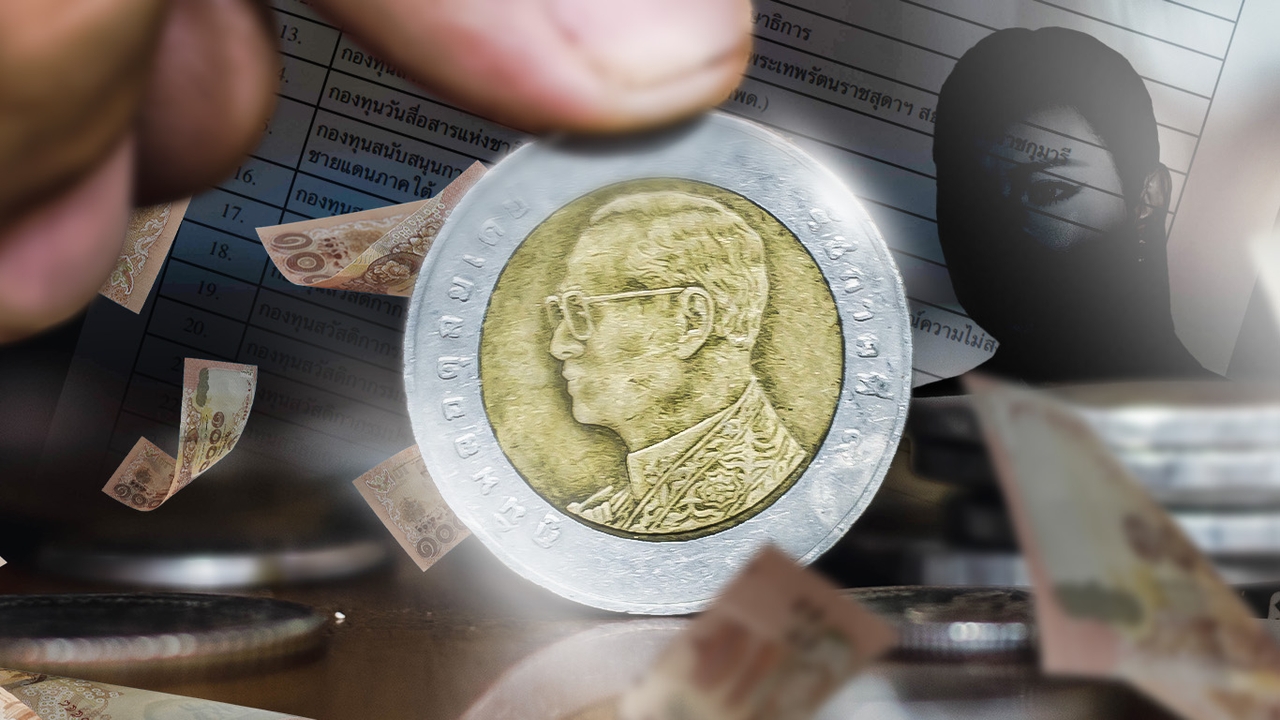
Images of large amounts of donated goods abandoned in warehouses contrast with nearly one billion baht in cash flow under investigation, revealing transfers used to build luxury pool villas in Phuket and land in Nong Suea District, Pathum Thani Province.
In the case of the “Good Deeds Foundation,” headed by Boon Panadda Wongpudi, the Economic Crime Suppression Division (ECD) police are scrutinizing financial transactions and preparing to press three serious charges.
These charges include public fraud, money laundering, and violations under the Computer Crime Act. Although she claims to have been deceived by close associates and denies involvement, this has become a major lesson showing how "Thai kindness" is increasingly exploited amid outdated laws struggling to keep pace with the digital era.
Many believe that any organization with “foundation” in its name has been thoroughly vetted by the state and that donations can be deducted from taxes—but this is a significant misconception.
Digging deeper into data from the Department of Provincial Administration under the Ministry of Interior, there are over 10,000 active foundations nationwide. Establishing a foundation in Thailand is relatively easy—requiring only 200,000 to 250,000 baht in a dormant bank account, three board members, and a 210-baht fee submitted through district or local offices. Once approved, the organization gains legal entity status and can officially use the “foundation” title.
However, only about 1,200 organizations nationwide have been officially recognized by the Ministry of Finance as "public charity organizations" under the Revenue Code, allowing donors to claim tax deductions. These include hospitals, educational institutions, religious places, associations, and foundations that have passed rigorous financial and public expenditure assessments by the Revenue Department over several years.
This means that over 80-90% of foundations operate by submitting just an annual paper report to local registrars, whose staff rarely have time to examine bank accounts in detail, making it easy for donations to escape government oversight.
Comparing international fund accounting standards and global charity rating bodies like Charity Navigator reveals that in reality, a 1-baht donation in relief work never fully reaches the needy. Expenses such as fuel, meal boxes for the team, warehouse storage, and accounting fees must be covered.
Highly transparent organizations internationally maintain program expense ratios of 65-75% of total expenditures and cap administrative and fundraising costs at 25-35%.
For example, in a reputable organization, 1 baht would be spent on actual aid for about 70 to 80 satang, with the remaining 20 to 30 satang covering administration and publicity to sustain operations, all subject to certified public accountant audits for transparency.
But in organizations lacking controls or intentionally exploiting loopholes, only 20-30 satang—or less—of that 1 baht may reach beneficiaries, or it may be impossible to track where the money went. If emphasis is placed on social media hype without proper record-keeping, donated goods become discarded waste, while cash often ends up in personal pockets, inflated commissions, or is circulated in private businesses controlled by those in power.
The reason for these widespread gaps is that Thailand still relies on the “Fundraising Control Act of 1944,” drafted during World War II and in force for over 80 years.
The original intent was to regulate street fundraising, carrying collection boxes, using loudspeakers, or printed materials. It does not cover modern fundraising tools—there is no mention of “Facebook pages,” “live streaming,” or “QR code scanning apps.”
Worse, the maximum fine for unauthorized fundraising is only 200 baht, an amount trivial compared to today's donation flows that reach tens to hundreds of millions per transaction.
Furthermore, the law permits registered foundations to fundraise merely by notifying authorities in writing. Thus, the “foundation” label has become a convenient legal façade some exploit to collect trust money.
Amid escalating problems, the Department of Provincial Administration, Ministry of Interior, has issued warnings to both donors and recipients to prevent kindness from turning victims of fraud.
For the public, before transferring donations, some simple but critical rules must be memorized.
Meanwhile, anyone planning to raise funds to help society—whether celebrities, influencers, or foundations—must obtain prior official permission.
At the same time, society may need to shift its perspective from relying on “popularity and personal trust” in charitable giving to emphasizing concrete governance and accountability mechanisms. Without strict monitoring, donors’ goodwill can be diminished, and repeated losses may continue indefinitely.
Sources: Department of Provincial Administration, Revenue Department, Rangsit University, Nititham Law Institute, Office of the Council of State.
Read economic and state policy news with ThairathMoney to help you "manage finances well and live well".
https://www.thairath.co.th/money/economics/thai_economics