

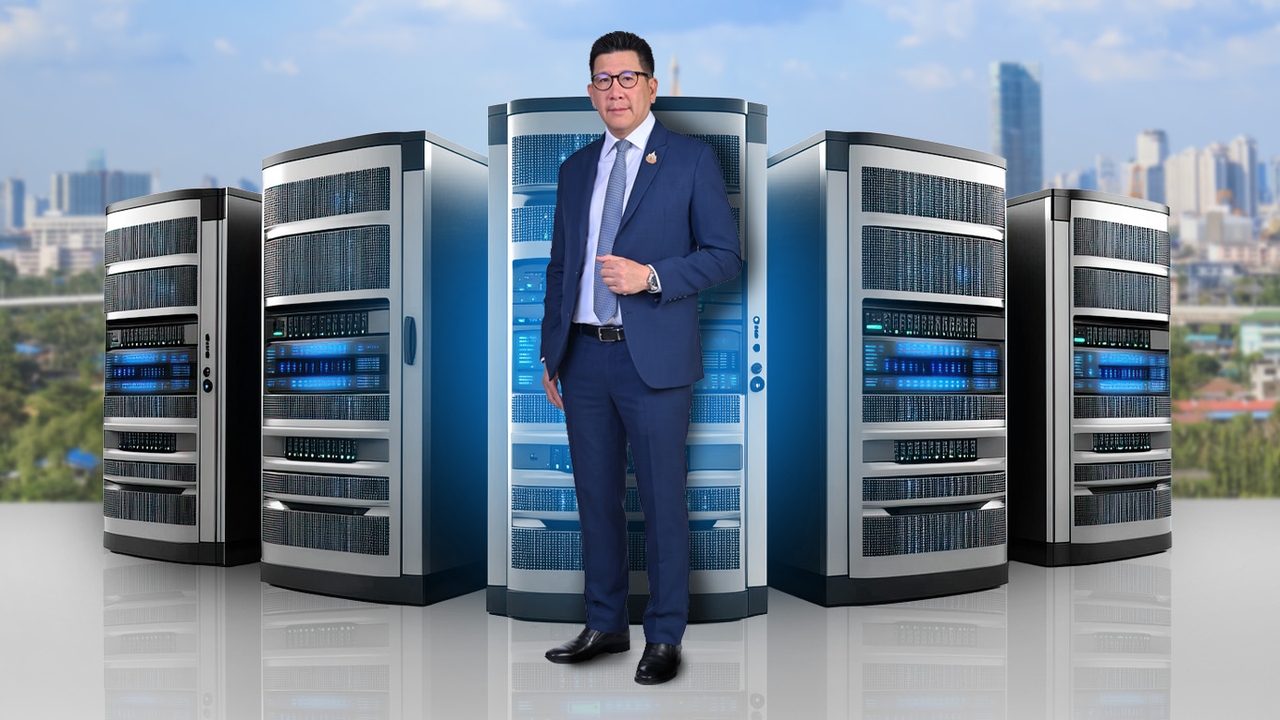
The Cabinet has organized regulations for Data Centers in Thailand seriously, establishing clear investment and operational guidelines to balance investment growth while protecting citizens and the environment, alongside setting up a One Stop Service to monitor both existing and new projects and to screen groups hoarding electricity.
The growth of AI technology and the digital economy has made Data Centers or data hubs, one of the essential infrastructures attracting global investors, including Thailand where investments in this sector are steadily increasing.
However, Data Centers are businesses that consume large resources, especially electricity and water for computing and cooling systems. Thailand currently lacks clear regulatory frameworks for this industry, causing issues such as advance applications for electricity and water rights and licensing requests intended for resale without real investment intentions.
Most recently, on 10 November 2026, the Cabinet approved policies to regulate Data Centers by setting clear investment and operational criteria covering resource use, environmental impact, site selection, and benefits Thailand gains from such investments.
Dr. Akniti Nitithanprapas, Deputy Prime Minister and Minister of Finance, and Chair of the Data Center Policy Committee, revealed that the government aims to balance investment promotion with citizen and environmental care, while adding value to the Thai economy.
The government has set three main goals:
Danucha Pichayanan, Secretary-General of the National Economic and Social Development Council (NESDC), explained that the new criteria classify Data Centers into seven levels based on electricity usage, covering operations using 0.5 megawatts (MW) or more.
For Data Centers using less than 0.5 MW, mostly internal data centers within organizations like banks or agencies, they are exempt from regulation by the One Stop Service under this policy.
The levels of Data Centers are detailed as follows:
The key differences lie in project location requirements and regulatory strictness. Data Centers at levels 2 to 4, using less than 20 MW, can be located in commercial areas but must comply with environmental standards or the Code of Practice (CoP) to control operational impacts. Data Centers at levels 5 to 7, using 20 MW or more, must be situated in industrial zones only, as large-scale projects with high electricity and water demands require stricter oversight.
These criteria are minimum standards set by the government, with detailed regulations to undergo further public consultation before implementation. No EIA required but controls on noise, heat, and water use apply. An important aspect of the new measures is setting environmental standards for the business.
The government states that
do not require Environmental Impact Assessments (EIA) because their main equipment consists of computers and servers, not heavy industrial production processes. Nonetheless, operators must follow the Code of Practice (CoP), which sets controls on key issues:
Noise level: Limits noise from equipment and backup generators to a maximum of 70 decibels A-weighted (dBA) at the project boundary. Heat: Controls heat dissipation from Data Center systems, restricting ambient temperature increases at monitoring points to no more than 1-2 degrees Celsius. Water usage:
Cooling systems must recycle water and ensure water quality is checked before discharge.
These projects received construction permits or BOI investment promotion approval before 14 August 2026, the date of related regulations published in the Royal Gazette. They will be audited for license validity and environmental standards; compliant projects can continue, while non-compliant ones have one year to adjust to new standards. Group 2: Operators applying after 14 August 2026. They must undergo screening by the One Stop Service committee to verify readiness and genuine investment intent, especially to prevent brokers who apply for electricity and water rights in advance to resell. Group 3: New operators.
Upon approval, agencies such as BOI, the Electricity Authority, the Waterworks Authority, and construction licensing bodies will fast-track permits to expedite qualified projects. Electricity usage requests reach 30,000 MW but only one-quarter are genuine investors. One reason for government regulation is the problem of advance resource requests, especially electricity reservations for projects without clear real investment plans. Data shows more than 110 Data Center applications total a demand for up to 30,000 MW
But only about a quarter of applicants are genuine investors. This partly results from duplicate electricity requests and intermediaries reserving electricity and water rights to resell later. Therefore, the government has established an investment screening committee and financial guarantee requirements to separate real investors from resource hoarders; projects failing screening cannot proceed under the new licensing system.
BOI has approved 57 Data Center projects, preparing them for inspection.
stated that future investment promotion for Data Centers will shift from solely considering investment value to emphasizing benefits Thailand gains, adopting a model similar to Singapore's investor proposal evaluation. This means operators wishing to invest in Thailand must demonstrate how their Data Center projects will benefit the economy and Thai people beyond construction. Benefits include employing Thai workers, developing skilled personnel, knowledge and technology transfer, building related domestic businesses and industries, and prioritizing clean energy and efficient resource management.
The government will consider these factors in project assessments to ensure Data Center growth, a key infrastructure for AI and digital economies, aligns with national resource capacity and delivers long-term economic benefits. Read economic and government policy news with Thairath Money to help you achieve “Good Finances, Good Life” at https://www.thairath.co.th/money/economics
Follow the Facebook page: Thairath Money at
https://www.facebook.com/ThairathMoney