

If AI has already changed how people worldwide work, the next phase—Quantum Computing—is opening new possibilities for solving problems too complex for current computers to handle. Analyses indicate that entering the Quantum Computing era will speed up discovering new drugs, optimizing transport routes, and managing financial risks.
However, as this technology advances rapidly, it may challenge security systems, making Quantum both a business advantage opportunity and a security challenge that organizations must prepare for before these machines become fully operational.
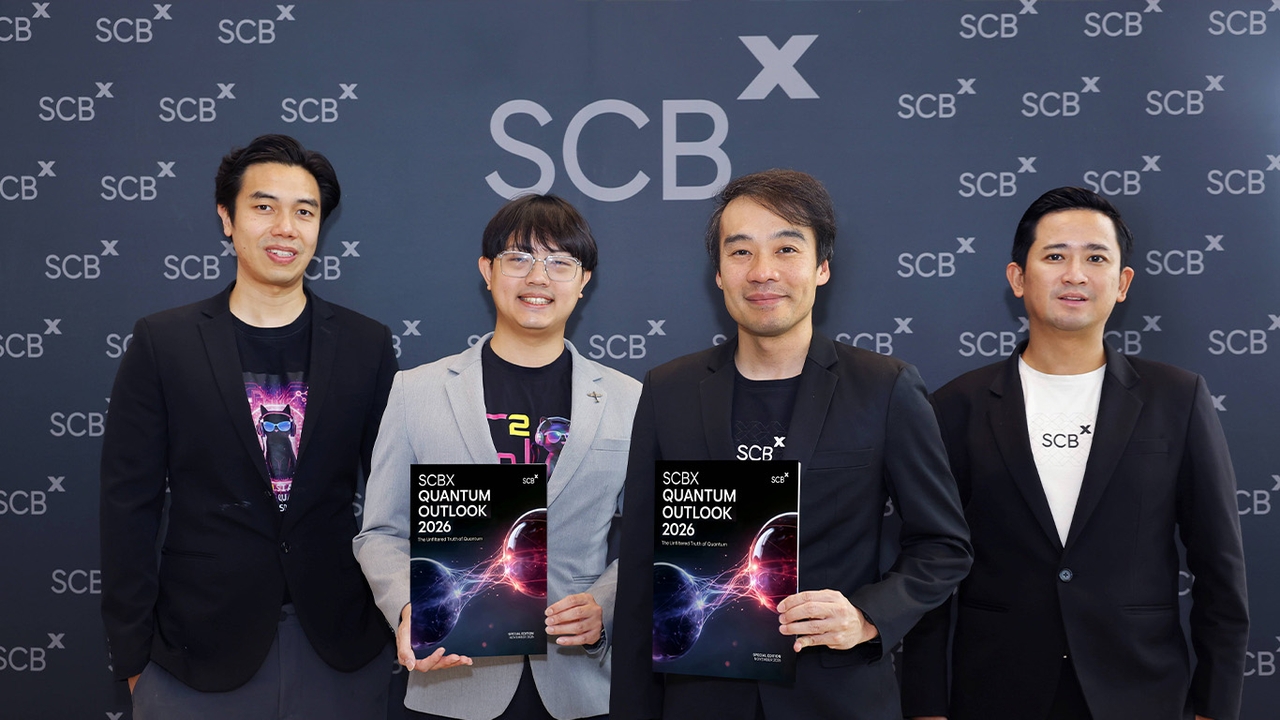
/ SCBX Quantum Outlook 2026 Data from the SCBX report presentation on 12 November offers a comprehensive view of this technology—its real progress, economic opportunities, and remaining hurdles. Although quantum has great potential, having a working machine is different from deploying it to generate real business returns.
Quantum here refers to physics laws describing behavior of very small particles like atoms and electrons, which have properties unlike everyday objects. Researchers harness these properties to develop technologies in computing, communication, and sensing, leading to Quantum Computing that applies these principles to data processing.
Conventional computers use bits with values 0 or 1 for processing, whereas quantum computers use "qubits" (Quantum Bits) that can exist simultaneously as 0 and 1 in a superposition state. They also utilize properties like entanglement—interdependent correlations between qubits—to aid computations.
However, superposition doesn't mean the machine tries every answer and automatically outputs the best one. Because measurement collapses superposition, not all answers can be read at once. Researchers design algorithms to create "interference" that increases the chance of desired outcomes and decreases incorrect ones.

/ Dr. Suphanat Thanasin, Physics Department, Faculty of Science, Chulalongkorn University, compared this transition to switching from checkers to chess, explaining that rules and piece movements differ, so skill in the old game doesn't guarantee success in the new one. Similarly, using quantum requires new knowledge, problem framing, and programming methods.
Quantum computers are likely specialized tools for specific tasks, working alongside conventional computers rather than replacing all existing machines.
According to SCBX Quantum Outlook, functional quantum computers exist with demonstrations of specialized computational abilities, but widespread use for large-scale business problems hasn't arrived, nor is there clear proof they outperform the best classical methods.
A major obstacle is qubits' fragility and susceptibility to errors. Simply increasing qubit numbers isn't enough if the machine can't perform accurate sustained calculations.
A key focus is Quantum Error Correction, which uses multiple physical qubits working together to form a more reliable Logical Qubit. The goal is machines capable of continuous complex computations while controlling error accumulation to keep results valid.
The report notes leading developers' plans suggest serious practical applications might emerge by the late 2020s to early 2030s, though these timelines remain targets dependent on hardware and algorithmic progress.
Quantum's economic value lies in better solutions for high-cost problems such as designing drug molecules with desired properties, optimizing transport to reduce fuel use, or balancing investment portfolios against numerous risks and constraints.
For large businesses, even small cost reductions or efficiency gains can be enormous. If quantum improves decision-making, benefits will cascade through production costs, product development time, and competitiveness.
McKinsey estimates quantum computing could unlock $0.9 to $2 trillion in economic value by 2035 across energy, materials, pharmaceuticals, finance, travel, transport, and logistics industries.
This figure represents opportunities to increase revenue, cut costs, boost productivity, or reduce risks for businesses adopting the technology, not revenues for quantum tech companies, and assumes development and adoption proceed as expected.
Another impact is competitive advantage; early adopters may develop skilled personnel, specialized algorithms, and partnerships ahead of others, enabling faster innovation when quantum machines become available.
Kaviwut Tempuwapat, Chief Innovation Officer of SCBX and CEO of SCB 10X, explained that organizations must prepare despite uncertain timing, as the bigger risk is rapid technological advancement arriving before readiness.
“SCBX focuses on readiness today through research, partnerships, and talent development, aiming for Thailand to enter the quantum era as co-developers of technology, not just users,” Kaviwut Tempuwapat said.
Their relationship has two directions: using quantum to enhance AI, and using AI to improve quantum computing.
The first involves quantum computers assisting machine learning tasks like data classification, pattern recognition, or generating training data, especially for molecular and material data hard for classical computers to simulate.
However, the report notes loading massive classical data into quantum systems may negate computational advantages. Some tasks once thought quantum-favorable now have improved classical methods catching up.
Thus, there is insufficient reason to conclude quantum will replace GPUs for training large language models; more likely, quantum will handle specific sub-tasks within AI systems that primarily run on classical computers.
The second direction, currently showing clearer results, is AI assisting quantum computing by tuning qubits, designing systems, and detecting errors. An example cited is AlphaQubit, from Google DeepMind, which uses neural networks to identify errors in quantum processors.
AI is thus a crucial tool potentially accelerating quantum readiness, while quantum's benefits to AI still require problem-specific validation.
The closest quantum impact may be on data security, as many digital services rely on encryption to ensure confidentiality, authenticate users, and verify transactions.
Large, reliable quantum computers could use Shor's algorithm to break certain public key encryption schemes like RSA and ECC, which underpin digital trust. However, the report notes no quantum computer has yet performed such attacks.
Preparation is needed because of the “Harvest Now, Decrypt Later” risk: attackers might collect encrypted data now and wait until powerful quantum tools can decrypt it, especially for secrets needing long-term confidentiality.
The countermeasure is Post-Quantum Cryptography (PQC), encryption designed to resist attacks from both classical and quantum computers and operable on current systems.
Organizations face the tough task of auditing where encryption is used—from websites and digital certificates to authentication and payment systems—and planning transitions without service disruption, a process that may take years.
In SCBX's case, Kaviwut Tempuwapat said the organization is surveying systems and assets to identify encryption points and assess risks, exemplifying how businesses can prepare for quantum without needing to own quantum machines yet.

The report gives examples where quantum could underpin services we use, even if consumers don't directly interact with quantum machines.
Personalized investment portfolios are one SCBX research topic with Chulalongkorn University, addressing the challenge of balancing return, risk, budget, and asset allocation constraints simultaneously.
Current work focuses on incorporating these conditions into quantum calculations, though it is not yet proven whether quantum portfolios outperform existing methods or guarantee investor returns.
Fraud detection is another SCBX research area, exploring whether quantum can identify complex anomaly patterns in transaction data. If successful, it could enhance fraud alert systems but requires proving accuracy, cost-effectiveness, and data input feasibility.
More efficient goods transport is illustrated by trials at the Port of Los Angeles, using hybrid quantum-classical computations for cargo handling scenarios, reportedly reducing crane travel distance by about 30%. Ford Otosan tested hybrid calculations for production scheduling, cutting scheduling time to under five minutes. These are specific experiments and do not confirm quantum's superiority in all cases.
New drugs, vaccines, and materials also have potential since molecules follow quantum rules. The report cites Moderna's collaboration with IBM studying mRNA folding into functional structures, an early small-scale experiment. Longer term, precise chemical simulations could aid drug development, battery materials, and catalysts for manufacturing.
Quantum's proximity depends not on everyone owning machines, but on banks, factories, transport firms, and drug developers applying its capabilities to transform services and costs linked to daily life.
For Thailand, opportunities start with developing talent and working on real business problems with researchers to find areas likely to benefit, comparing them with current methods using solid evidence. Meanwhile, encryption system upgrades can begin now, as preparation may take longer than expected.
Read economic and government policy news with Thairath Money to help you "Manage Money, Live Better" athttps://www.thairath.co.th/money/economics
Follow Facebook page: Thairath Money athttps://www.facebook.com/ThairathMoney