

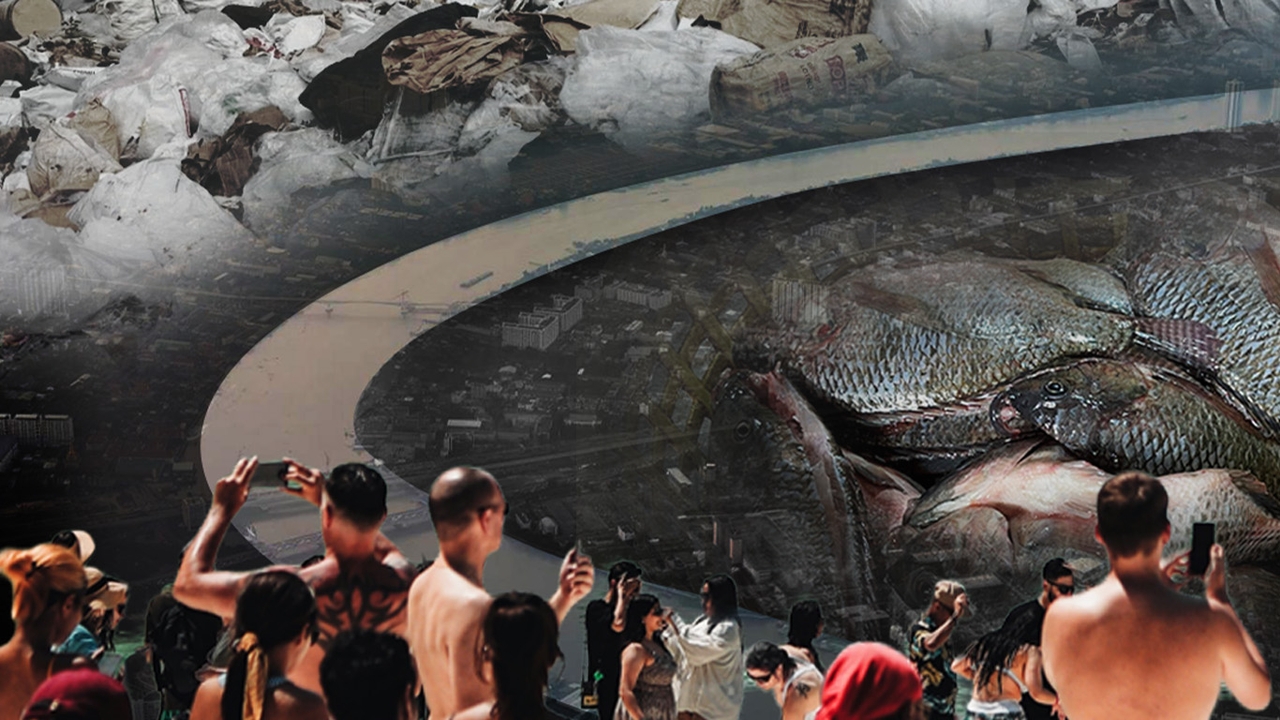
If success is measured by investment inflows, Thailand is currently in a notable upswing. Investment promotion applications to the Board of Investment (BOI) in 2025 reached a record high of 1.8 trillion baht, continuing into the first nine months of 2026 with actual investment exceeding 796.54 billion baht.
This aligns with the national vision to position Thailand as a comprehensive global economic center (Global Hub) spanning multiple sectors: Tourism Hub, Wellness & Medical Hub, Agriculture & Food Hub, Aviation Hub, Digital Economy & AI Hub, Financial Hub, and World Class Event Hub.
However, examining the other side of the coin, the 2026 Environmental Performance Index (EPI) by Yale University reveals a stark contradiction.
Thailand ranks 74th out of 177 countries, with concerningly low scores in environmental infrastructure across several categories.
Similarly, in the 2026 World Competitiveness Ranking by the IMD Institute, although Thailand improved to 26th out of 70 economies, its "Health and Environment" category languished at 56th place.
These figures raise critical questions about the national strategy: how can Thailand become a global economic hub if its basic ecological systems supporting life and business remain fragile?
The latest data on "toxic contamination in rivers" underscores how Thailand's water pollution problem has escalated from an environmental issue to a full-blown economic and food chain risk.
Research from Kasikorn Research Center shows a toxic contamination crisis in freshwater sources across four key provinces in two river basins: Chiang Rai and Chiang Mai (Kok, Ruak, and Sai Rivers) in the north, and Prachinburi and Chachoengsao (Prachinburi River) in the east, with risks spreading to major rivers like the Mekong and Bang Pakong.
These four provinces produce a natural freshwater aquatic yield of 4,256 tons, valued at 252.4 million baht annually, directly affecting 44,731 freshwater fishing households, or 7.1% of all such households nationwide.
Although direct losses to freshwater fisheries in the hundreds of millions baht may seem small compared to the national economy, Kasikorn Research Center warns the true impact is incalculable as toxins have infiltrated ecosystems and production chains broadly.
An equally clear contradiction is Thailand's declaration as a Medical & Wellness Hub and Digital-Financial Hub to attract high-spending tourists and skilled workers globally.
Meanwhile, Thai citizens still endure annual PM2.5 pollution cycles; as winter arrives in mid-November 2026, particulate levels in Bangkok, its vicinity, and the eastern region spike sharply. Overall, Thailand's air quality remains many times worse than WHO recommended levels every year.
Economically, PM2.5 dust acts as an "invisible tax" severely eroding national competitiveness. Kasikorn Research Center estimates opportunity costs exceeding 5 billion baht from 2014 to 2018 alone, considering tourism impacts and household dust prevention expenses.
The World Bank estimates Thailand's economic losses from PM2.5 at 45.3 billion USD annually, equivalent to 3.89% of GDP, while Thai academic household cost research estimates damages as high as 2.173 trillion baht per year.
At the same time, the industrial sector's "backyard" faces a governance crisis, exemplified by the November 13, 2026 government crackdown on illegal electronic waste facilities and industrial waste dumping.
After inspecting 752 factories, violations were found in 375 sites, nearly 50%. This aligns with data from the Ecological Restoration Foundation showing 153 illegal wastewater and industrial waste dumping incidents in the eastern region during 2017-2026, concentrated heavily (104 incidents) in the Eastern Economic Corridor (EEC).
Legal loopholes force the government to manage consequences, such as the illegal toxic waste warehouse in Phachi District, Ayutthaya Province, where the Department of Industrial Works spent over 54 million baht in emergency funds in 2025 to remove and treat over 7,574 tons of hazardous chemical waste, similarly accelerating clearance of toxic waste at the Win Process factory in Rayong.
Attraction of investment worth hundreds of billions, establishment of chip, PCB, or data center factories, and rising international tourist arrivals all serve as short-term indicators of attractiveness.
But in the new economic era, global investors increasingly prioritize ESG (Environmental, Social, and Governance) criteria as core conditions for investment decisions, making safe environments and transparent governance not optional but a mandatory "License to Operate" for countries seeking progress.
For example, Singapore equates water, waste, and air quality management with economic infrastructure, combined with strict transboundary law enforcement, securing its top global ranking in sustainable competitiveness.
In contrast, Thailand remains mired in delays reforming key laws, such as the Clean Air Act draft, which lost critical mechanisms like the Pollutant Release and Transfer Register (PRTR) in the Senate, necessitating a joint parliamentary commission and postponed implementation.
Ultimately, Thailand's ambition to become a global economic hub will only be sustainable if it proves that "economic growth" and "basic quality of life" can advance together; no high-quality investor wants a long-term base in a country with leaking toxic waste governance, no health tourist wishes to recover amid haze, and the "Kitchen of the World" cannot endure on land and waters tainted with toxins.
Sources: Kasikorn Research Center, Pollution Control Department, Bangkok Metropolitan Administration, BOI, Ministry of Finance, TDRI, Puey Ungphakorn Institute for Economic Research.
Read economic and government policy news with ThairathMoney to help you "Better Finance, Better Life" at
Follow the Facebook page: Thairath Money at this linkhttps://www.facebook.com/ThairathMoney