

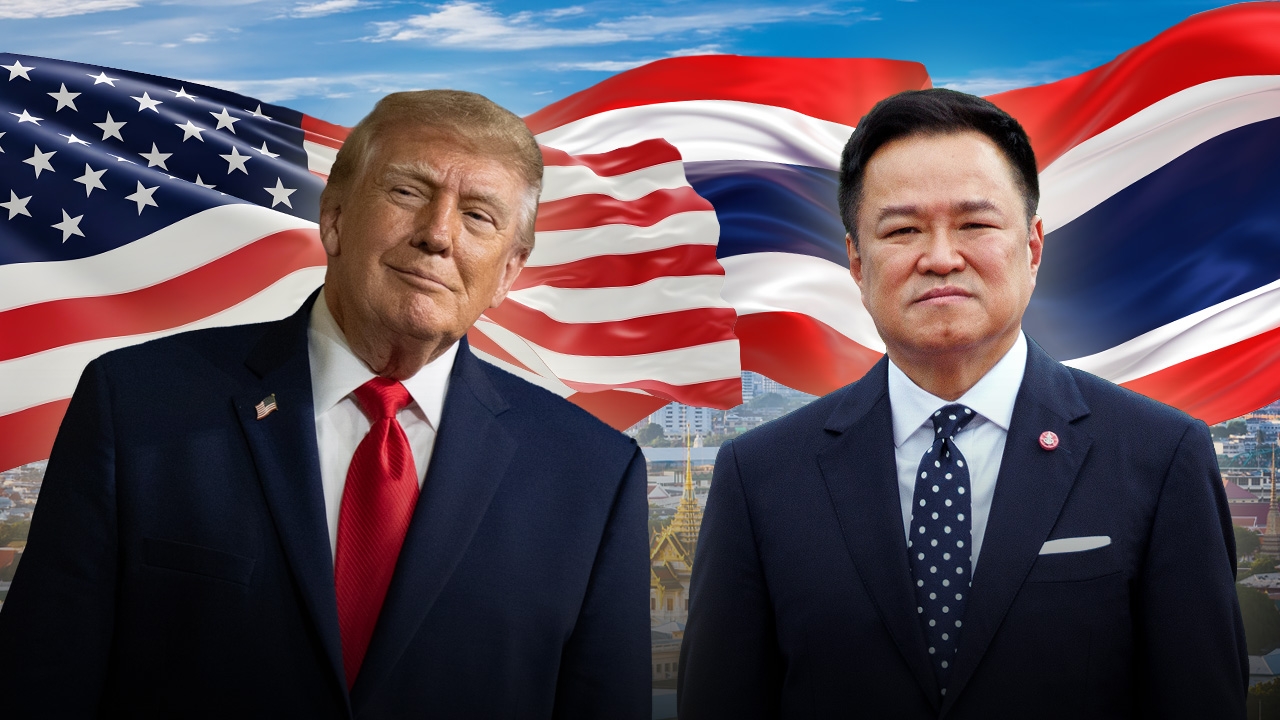
The Thailand-US trade deal has become a focal point for economic and investment circles after both countries signed the “Joint Statement on an Agreement on Reciprocal Trade” (ART) during the ASEAN Summit in Manila, Philippines, on 17 November 2026.
This move marks a significant milestone for the “Team Thailand” negotiators, aiming to preserve the US market—the top export destination for Thailand. In 2025, Thailand exported approximately 2.37 trillion baht to the US, supporting around 1.25 million jobs domestically.
Thailand has consistently maintained a trade surplus with the US, rising from the 11th position among US trading partners when negotiations began in July 2025 to 7th during the first Anutin Charnvirakul government.
Most recently, in the first half of 2026, Thailand advanced to 5th place, creating significant pressure to accelerate negotiations to sustain competitiveness and avoid falling behind neighboring countries.
However, under the term “reciprocal trade,” there are both gains and concessions for Thailand. Amid demands from the private sector and political groups for full transparency, Thairath Money summarizes the overall “pros and cons” and key facts that entrepreneurs and Thais should know as follows.
The core of this deal is establishing clarity on tariffs. Previously, Thailand faced risks from US import duties and Section 301 measures—a mechanism allowing the US to investigate and retaliate against trade practices deemed unfair.
The Ministry of Commerce stated that Thailand secured principles and commitments from the US that it will not face higher tariffs than neighboring or competing countries that have already reached ART agreements.
Currently, Thailand is subject to a 12.5% Section 301 tariff related to forced labor issues, while Cambodia, Indonesia, and Malaysia—which have ART agreements—are at 10%. Thailand is negotiating to reduce this to 10% effective immediately upon agreement. The overall tariff ceiling will not exceed 19%, though actual rates depend on further US measures.
Meanwhile, many Thai products—such as integrated circuits, hard disk drives, aircraft parts, natural rubber, tapioca starch, and pineapples—already enjoy additional exemptions under Section 301. About 72% of Thai exports are exempt from Section 301 and 232 tariffs, while the remaining 28% require further negotiation.
Nevertheless, uncertainty over US tax policies is a factor foreign investors consider. This leadership-level conclusion may help reassure that Thailand remains a competitive production base for exports to the US market.
Regarding domestic investment, data from the Department of Business Development (DBD) shows that in the first 10 months of the year (Jan–Oct), 1,057 foreign entities were permitted to operate in Thailand under the Foreign Business Act B.E. 2542 (1999), a 22% increase from the previous year. Total investment reached 321 billion baht, up 45 billion baht or 16%, with 6,653 Thai jobs created by licensed investors, a 24% increase.
By country, Singapore led investments with 92.3 billion baht (28.7%), followed by Japan at 60.7 billion baht (18.8%) and China at 47.8 billion baht (14.8%).
US investors ranked second in number with 179 entities (16.9%) investing about 7.24 billion baht (2.2% of total). Most investments (51% or 534 entities) were made through the Board of Investment (BOI), accounting for roughly 78% of total value at 251.1 billion baht.
However, the government and Ministry of Commerce clarified that the joint statement signed on 17 November confirms only that substantive agreement has been reached, not a finalized ART agreement, and it is not yet legally binding. The Ministry emphasized that US import tariffs have not been immediately reduced.
Next, legal teams from both countries will finalize the draft agreement wording, expected to take about two months. Then, Thailand must submit it to the Cabinet, conduct public consultations, and present it to Parliament for approval, which may take several more months before enforcement.
Under reciprocal trade terms, Thailand is likely to open its market and reduce US import tariffs according to product-specific commitments, although the government stresses not all tariffs will be lowered.
The Ministry of Commerce indicated that market openings will be limited to products that Thailand cannot sufficiently produce or are critical for food and energy security, supported by quota mechanisms, import restrictions, or relief measures for domestic producers.
No official list of sensitive products has been disclosed yet, but sectors to watch for increased competition from US imports include agricultural and livestock products such as animal feed corn, soybean meal, and meat.
Within the cooperation framework agreed since July 2025, Thailand will also be required to import approximately $2.6 billion worth of US agricultural products, alongside purchases of energy and aviation goods and services.
Additionally, structural issues monitored by the business sector that the US may request Thailand to adjust include key points revealed in October 2025 negotiations:
1. Easing investment restrictions to allow more foreign, particularly US, equity participation in Thai service and telecommunications businesses.
2. Digital economy and trade in services rules aimed at liberalizing and reducing trade barriers in services and digital sectors between the two countries.
3. Rules of Origin enforcement to prevent transshipment from third countries, which while addressing counterfeit exports, may increase documentation and regulatory costs for Thai exporters directly.
Thus, the overall Thailand-US ART deal can be seen as “buying certainty” to preserve Thailand’s vital export market amid rising global trade barriers.
However, the actual tariff rates and conditions remain to be closely monitored as Team Thailand continues negotiations.
This is to ensure that opening doors to US goods and capital does not adversely affect domestic farmers and small entrepreneurs.
Sources: Ministry of Commerce, Department of Business Development
For economic news and government policy updates from ThairathMoney to help you achieve “Good Finances, Good Life,” visithttps://www.thairath.co.th/money/economics/thai_economics
Follow the Facebook page: Thairath Money at the linkwww.facebook.com/ThairathMoney