

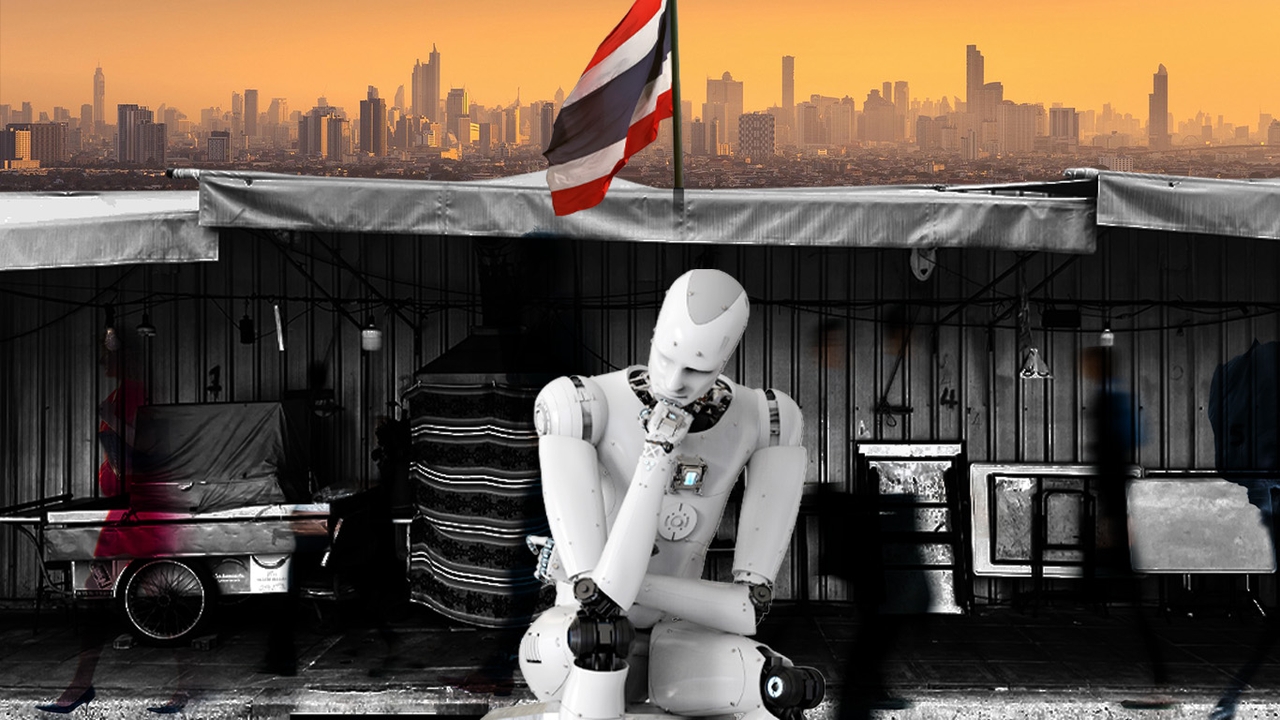
In the past, Thailand was once one of the "Asian Tigers." But today it is metaphorically described as a "sick cat" facing multiple economic storms, including declining investment, shrinking population, weakening competitiveness, and problems in capital allocation that fail to effectively reach businesses with growth potential.
Amid this situation, a question raised repeatedly over recent years is: Where is Thailand's new economic engine? And will the arrival of artificial intelligence (AI) be the answer to reigniting Thailand's growth?
However, an interesting perspective from the lecture titled "Thailand’s New Production Function: AI, Productivity and the Future of Work" by Dr. Napath Chatusripitak, Founder & CEO of Siametrics Consulting (SMC), is that Thailand may be asking the wrong question. Instead of spending time searching for a new economic engine, greater focus should be on reviewing how ready the current economic system is to build and sustain such engines.
Although AI is a technology capable of greatly increasing productivity in the economy, simulations of the Thai economy over three years show the economy might grow in size while labor income significantly declines. Benefits from growth may flow more to capital owners than workers, and inequality could widen not only between businesses but also within the same organization.
Thailand's major challenge in the AI era is therefore not just how to grow the economy but how to ensure that growth benefits are broadly shared among the population.
looking back at Thailand's past economic growth, the country expanded quite well through two basic economic production factors: capital and labor.
Thailand was able to continuously inject capital into the economy through bank loans and capital raised via the stock market. At the same time, labor shifted from agriculture into industry and manufacturing, which increased productivity and economic value added.
However, over time, the factors that supported Thailand’s growth gradually weakened. To illustrate this problem, Dr. Napath used the concept from the book "How an Economy Grows and Why It Crashes" comparing Thailand's economy to that of an island whose main economic activity is fishing.

If the islanders want their economy to grow while population and time remain constant, they need to find ways to catch more fish, such as creating more efficient nets or fishing tools.
These nets are made possible by allocating surplus fish (similar to savings and capital) to people capable of developing new tools. As tools improve, the islanders can produce more without proportionally increasing labor.
The key question is how well Thailand's system can allocate capital to those with the potential to create new tools or businesses.
Before the 1997 economic crisis, Thailand experienced large inflows of foreign capital, but imbalances led to a major crisis that shaped the country’s regulatory approach to capital and credit markets to this day.
Since then, investment has declined, the ability to develop tools and innovation domestically has weakened, some capital has flowed out to foreign investments, and demographic challenges have intensified with a shrinking labor force—the fundamental production factor.
Meanwhile, the remaining capital in the economy tends to concentrate in large companies that already have access to funding, while SMEs and new entrepreneurs face limited credit access.
This situation reflects not only an aging society but also an "aging economy" where population structure, business structure, and capital allocation systems do not favor the emergence of new players.
Ultimately, with fewer workers, less investment capital, and capital unable to fully reach potential business creators, it's unsurprising that Thailand struggles to find a new economic engine.
Amid Thailand’s economic constraints, AI is like receiving a large fishing net that could help increase productivity despite a shrinking workforce.
What sets AI apart from past technologies is not just intelligence level but also development speed, scope of tasks it can perform, and depth of knowledge it accesses and applies.
AI is not merely a tool for writing emails, answering questions, or basic tasks; it is becoming what the speaker calls a "Human Knowledge Calculator," processing vast knowledge to handle complex work.
For example, business direction analysis, which traditionally required personnel with 10-20 years’ experience to understand business units and large organizational structures, can now mostly be done by AI within two minutes.
Similarly, software and application development that once required hundreds of thousands of baht and teams of developers can now be created by AI based on user descriptions, connecting databases and deploying systems in practice.
This transformation means AI should no longer be viewed as just IT technology or an organizational system but as a key resource and production factor in the economic system.
For Thailand, it may not be necessary to develop all types of AI itself since access costs to foreign AI models are decreasing, although developing specialized models with deep understanding of Thai language and context remains valuable.
However, reliance on foreign AI resembles importing energy resources like oil—Thailand can use these resources to boost productivity but does not directly control their development or pricing.
To understand AI’s macroeconomic impact on Thailand, Dr. Napath developed an economic model simulating 200,000 workers and 2,000 companies over three years.

The model assumes AI affects the economy through three key mechanisms:
The model considers three levels of AI development: gradual progress, AI with increased autonomy and data access, and highly capable AI broadly replacing human work including robotics, compared against a baseline where AI capability stops at October 2026 levels.
Results show that under modeled conditions, the economy could grow approximately 8.5% compared to baseline if businesses effectively adopt AI and increase productivity.
However, labor income faces a risk of declining by about 20-30% within three years, a level that could severely affect many people's livelihoods and constitute a crisis for some groups.

Economic gains from productivity do not disappear but tend to flow increasingly to capital owners, business owners, and shareholders.
Importantly, these results are model simulations under assumptions, not economic forecasts, and do not guarantee 8.5% growth in three years. They highlight the possibility of growth driven by technology alongside many workers not benefiting from it.
Another notable point is that AI's labor market impact may not always appear as mass layoffs.
From a business perspective, many companies may not want to lay off existing staff and try to maintain employment of current personnel as long as possible. But at the macroeconomic level, this may lead to another problem: closing the door to new labor market entrants.
Companies might replace entry-level positions with AI, while jobs vacated by retirees or resignations may be eliminated without replacement. Thus, the impact tends to fall on new graduates and young workers entering the labor market, even if layoffs are not visibly increasing.
The model also allows workers to pursue self-employment or start their own businesses, a key mechanism to mitigate labor market impacts. However, not all workers have equal opportunities to do so.
Under model assumptions, those in sales or service roles may have more flexibility to become self-employed, while specialized workers with long tenure might face difficulties switching to other types of work.
Thailand therefore needs to build an economic system that supports freelancers and new entrepreneurs, enabling these occupations to become formalized and have better access to capital.
Another challenge is that AI technology and human labor operate on different time scales. The model assumes AI takes about 18 months to reach a high level of automation, while organizations may need up to 60 months to train and develop workforce skills broadly.
This gap could lead to new inequalities—not only between capital owners and labor or between large companies and SMEs but also within the same organization.
Typically, companies begin AI adoption by selecting a group of employees as AI Champions or experts, since this controls costs and delivers faster results. But as these employees become much more productive, their output may outpace colleagues who haven't received training.
From management's perspective, productivity differences could influence decisions on which employees to retain and which jobs to reduce or replace with AI. Employees with early AI access tend to benefit and adapt better, while those without may face greater job loss risks.
To reduce these impacts, AI skills development must be widespread, not limited to a small group. Training need not always be classroom-based but should create environments encouraging continuous self-learning and skill development among staff.
As AI changes economic productivity, Thailand must revisit its production function. Previously, growth came from more capital and labor; AI adds a new production factor enhancing human capabilities and compensating for labor shortages.
However, the most important variable for Thailand may not be AI itself but 'Allocation'—the efficiency of resource distribution—because AI capabilities will improve continuously and access costs fall, driven mainly by the U.S. and China.

Thailand may have limited influence over global AI development direction but can determine how to allocate capital, labor, and resources to maximize economic benefits.
Using the Production Possibility Frontier (PPF) concept, Thailand may not have operated at maximum efficiency, with some capital allocated to less productive businesses, small firms unable to grow, concerns over 'zombie companies,' and low business turnover rates.
These issues relate to a lack of new business listings in Thai capital markets since potential entrepreneurs may not receive sufficient resources from the start. AI can expand the country's production capacity, allowing more goods and services in existing industries and new industries to be created.
But expanding production capacity does not guarantee Thailand will reach that point if resource allocation problems persist and AI adoption remains 'people-led'—driven by individual employees—rather than 'firm-led'—driven by organizational strategy. Thailand might fail to fully harness AI’s potential.
Under Thailand’s new production function, Dr. Napath proposes three key approaches that government, regulators, financial sector, and businesses must jointly pursue.
Thailand should start studying and planning policies now to address AI’s labor market impacts, as policymaking and implementation take years. Waiting until clear labor impacts emerge may be too late to respond effectively.
Considerations include compensation and support for affected workers, opportunities for career restarting, debt management strategies, and fiscal readiness to implement such policies.
Without economic security systems, people may hesitate to change careers, start new businesses, or take risks—all essential for future economic restructuring.
The financial sector and regulators need to review credit allocation approaches, especially lending to businesses and individuals with potential but no prior access to capital. Today’s technology allows financial institutions to access diverse data reflecting borrower creditworthiness beyond traditional financial documents.
Examples include using alternative data for credit assessment or supply chain financing that evaluates business partners and invoice data.
With appropriate risk management, financial institutions could experiment and innovate lending more, enabling capital to flow to potential value-creating entrepreneurs previously excluded by traditional finance.
Businesses must look beyond AI speeding up existing tasks to reevaluate organizational structures, workflows, and personnel roles.
Organizations should consider how to reallocate staff to new business activities once AI replaces certain tasks and explore opportunities to leverage knowledge and personnel to create new businesses or spin-offs.
Though difficult and requiring time and transparent communication, these processes are crucial for minimizing negative impacts and maximizing AI benefits.
Ultimately, Thailand’s new economic engine may not be a single industry chosen by the government but new businesses that emerge and grow in an efficient economic system.
A system where people have enough security to take risks, entrepreneurs can access capital, and organizations can restructure to allocate resources toward new economic activities.
At the same time, Thailand must reconsider risk management ideas inherited from the 1997 crisis, as excessive caution and reluctance to take risks or drive change could become risks themselves in a rapidly evolving technological world.
Thailand has limited resources, so maximizing their efficient use is critical, ensuring growth benefits do not concentrate with only a few.
Above all, Thailand should not assume there is time to wait or see the changes as someone else’s responsibility. Addressing the AI-era economy is a shared challenge for academics, executives, entrepreneurs, financial sectors, and regulators.
AI may help Thailand’s economy grow again, but the ability to allocate resources and distribute growth benefits will determine whether the country truly regains strength.
For more economic news and government policy updates, visit Thairath Money to help you achieve "better finance, better life" athttps://www.thairath.co.th/money/economics
Follow the Facebook page Thairath Money athttps://www.facebook.com/ThairathMoney