

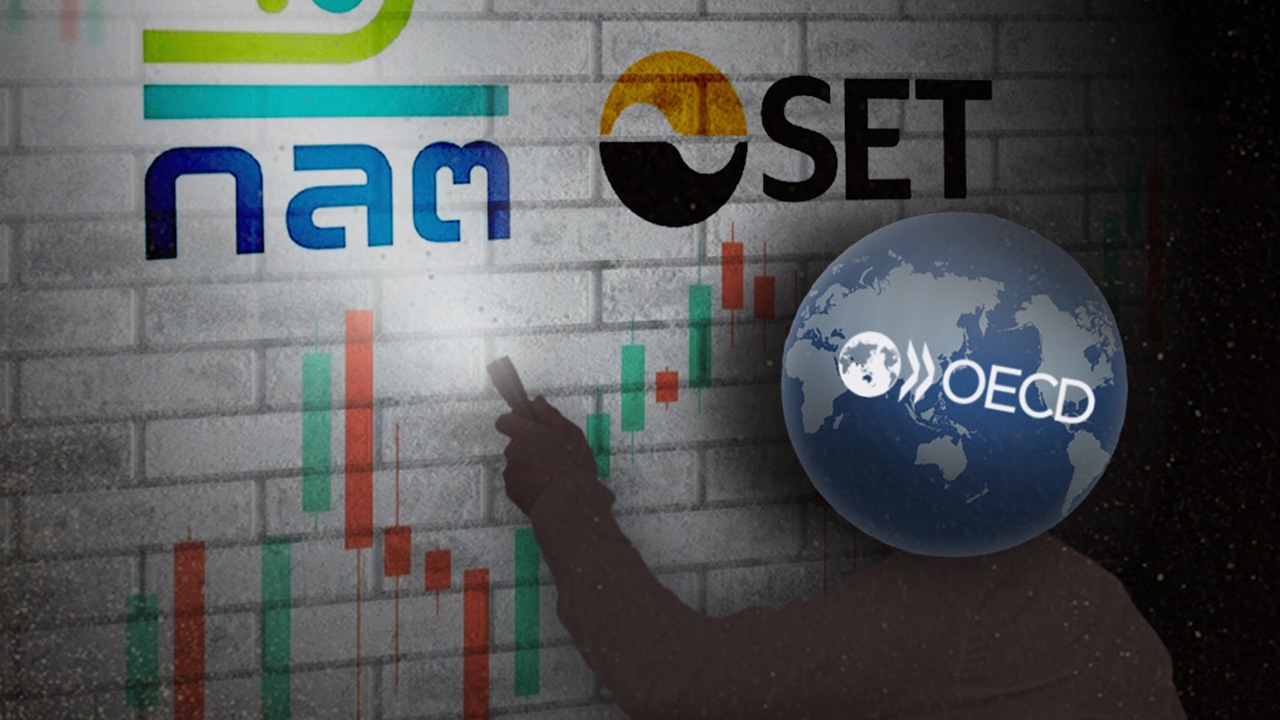
It is undeniable that 2025 was a year of unprecedented decline in investor confidence in Thailand's capital market, as evidenced by complaints in online trading rooms and comments on stock, finance, and investment pages, including those on the official pages of the Securities and Exchange Commission (SEC) and the Stock Exchange of Thailand (SET).
Restoring investor confidence is a necessary mission because the capital market is both a vital source of funding and savings for the country. Currently, among ASEAN countries, Thailand's stock market is the second largest after Malaysia, measured by market capitalization relative to GDP, with the Thai stock market valued at about 96% of GDP, second only to Malaysia's 102%. Meanwhile, Thailand's corporate bond market is the largest in ASEAN, with a value of 22% of GDP.
One "shortcut" to restoring investor confidence is to reform institutional structures and regulations related to the capital market to meet international standards as much as possible. This is because Thailand's capital market competes globally in an increasingly borderless world. Among reports identifying gaps between Thailand's capital market and international standards, with comprehensive and concrete recommendations, the 2025 OECD Capital Market Review of Thailand stands out as one of the most thorough the author has ever read.(OECD Capital Market Review of Thailand 2025)This review covers various dimensions of Thailand’s capital market as part of the country’s process to join the OECD member countries.
The OECD report contains extensive data and recommendations useful for reforming and improving the capital market. Here, the author highlights certain points under "institutional structure and corporate governance mechanisms" because these are critical issues that urgently need addressing, as they have significantly undermined investor confidence over recent years.
The OECD notes that the government should reform both the SEC and the SET to enhance their independence. Political cycles often shift policy priorities, so greater autonomy for regulatory bodies would help maintain long-term stability, which is essential for consistent rules and supporting market expectations. The OECD's key recommendations on this, which the author agrees with, include:
Extending the term of SEC commissioners and limiting or removing the government’s power to dismiss SEC and SET board members from their positions.
Improving the selection committee under the Securities Act by including more independent representatives with greater authority. Currently, the committee consists of former senior civil servants or former SEC expert board members and lacks autonomy in nominating expert members independently, relying only on names proposed by the SEC board.
Separating the SET’s regulatory duties from its commercial functions to increase regulatory independence and reduce conflicts of interest. One possible approach is establishing or restructuring the regulatory division within the SET as a subsidiary company dedicated solely to market oversight and compliance.
The author adds that all these recommendations, especially the third, would be a significant step toward genuinely restoring investor confidence. Globally, separating regulatory functions from commercial ones is common—for example, Singapore Exchange Regulation (SGX RegCo) operates independently from the Singapore Exchange (SGX), which manages commercial activities.
The author further suggests going beyond the OECD’s recommendations by first demutualizing the SET—transforming it into a public company with a majority of shares held by retail investors—following the practice of most stock exchanges worldwide.
(The issue of demutualizing the SETwas a minor topic in society over a decade ago,but the discussion eventually faded away. The author wrote a series of articles on this topic in 2008 while serving as an advisor to the SET's Capital Market Research Institute. Interested readers candownload these articles from the following link:)
The OECD report reveals that Thailand’s securities offering approval process takes longer than in many ASEAN countries. For example, Malaysia clearly states that screening should not exceed three months, and the Philippines sets a 45-day target, although actual times may be longer. The OECD notes that Thailand uses a hybrid regulatory framework combining merit-based and disclosure-based systems. In fully disclosure-based systems, issuers, boards, intermediaries such as underwriters, auditors, credit rating agencies, and financial advisors bear legal responsibility for the accuracy and completeness of information and conduct thorough due diligence.
However, market participants told the OECD that Thailand’s system leans more toward merit-based regulation, with close monitoring of high-risk areas. This partly explains why Thailand’s approval process takes longer than in many other countries.
While this merit-based approach may protect investors, the OECD warns it can weaken market discipline by shifting responsibility from market participants—such as listed companies and financial advisors—to regulators. Consequently, investors tend to hold regulators accountable for verifying the integrity of listed companies, while boards and executives rarely face shareholder-driven accountability mechanisms, such as lawsuits initiated by retail shareholders.
The OECD also observes that although the current Securities Act stipulates fiduciary duties for boards and executives of listed companies, this provision is underused as a tool to protect investors.
Based on these findings, the OECD recommends empowering the SET, investors, and other market players by clarifying and improving the IPO and subsequent securities offering approval processes. This means that responsibility for the accuracy and completeness of disclosures would primarily rest with company boards, executives, auditors, and underwriters more than before. Simultaneously, the SEC should clearly communicate to investors that approval does not imply endorsement of the securities’ quality, encouraging more thorough investor due diligence. These improvements would foster a culture emphasizing market discipline, transparency, and shared responsibility among issuers, intermediaries, and investors, rather than concentrating it solely on regulators.
The OECD shares the author’s observation (see the articles “CG Reporting Compared to ASEAN Corporate Governance Standards” and“How Can Thai Corporate Governance Go Beyond Paper?””) that Thailand last updated its Corporate Governance Code for listed companies eight years ago in 2017, while international standards have advanced significantly since then. The OECD identifies several areas needing improvement, including problems with Non-Voting Depository Receipts (NVDRs), related party transaction regulations, qualifications of independent directors, and enhancing retail investors’ rights.
Regarding NVDRs, the OECD notes that Thailand’s system was initially well-intentioned—introduced in 2001 to allow foreign investors access to the Thai stock market without violating foreign ownership limits. However, after more than 20 years, NVDRs have produced several undesirable outcomes: they have worsened the already high concentration of shareholdings by enabling major shareholders to sell economic benefits while retaining full voting power; and they separate economic interests from governance participation, as NVDR holders have no voting rights or influence on board decisions, undermining corporate governance. Therefore, the OECD recommends reforming or gradually phasing out NVDRs.
Another recommendation to increase retail investors’ rights is lowering the minimum shareholding threshold required to call an extraordinary general meeting from the current 10% to 5%, aligning with most OECD countries. The author adds that the current 10% requirement is almost impossible to meet in a market where the free float—the portion of shares available for retail trading—is only about 15%.
On related party transactions (RPTs), a critical issue given the concentration of major shareholders, the OECD found that individual founders are the largest shareholders in 51% of listed companies, while in 45% of others, the largest shareholder is a company with an average holding of 40%. Consequently, the OECD suggests stricter RPT oversight, such as extending the aggregation period for transactions with the same related party from six months to one year (as in Malaysia and Singapore), reducing or eliminating exemptions from shareholder approval, and setting clear fair pricing criteria.
Regarding independent directors, although Thailand’s regulations are similar on paper to neighboring countries, many market players told the OECD that many independent directors lack true independence, being appointed based on personal connections and networks with major shareholders rather than qualifications and genuine autonomy. Furthermore, about one-third of independent directors have served more than nine years, a tenure that may compromise independence due to increasing closeness with the company. The OECD recommends strengthening mechanisms to enhance board independence through formalized selection processes, term limits (e.g., no more than nine years), and improving director qualifications via targeted knowledge development programs.
The author believes all these OECD recommendations are valuable and, if implemented, would mark a significant step toward restoring investor confidence, enabling Thailand’s capital market to efficiently and sustainably channel household savings into productive investments in the real economy over the long term.
For updates on economic data and government policies, follow ThairathMoney athttps://www.thairath.co.th/money/economics/thailand_econ
Follow the Thairath Money Facebook page at this linkhttps://www.facebook.com/ThairathMoney