

The year 2026 is not one of hope but a year of systematic survival. Purchasing power has yet to recover, costs continue to rise, and the economy is slowing more deeply than many want to admit. Business today is not just about confidence but about establishing a firm foundation, adapting quickly, and making decisions based on truly strong structures.
In this context, the phrase “No growth is not an option” best reflects the reality of 2026, because in an increasingly tough competitive environment, standing still means immediately falling behind.
I had the opportunity to speak with Mr. Nat Wongpanich, CEO of Central Restaurants Group (CRG), a subsidiary of Central Group managing 21 leading restaurant brands with over 1,453 outlets nationwide. He assessed that the Thai economy this year faces multiple pressures, with many forecasts expecting GDP growth of only around 1.6%.

This reflects purchasing power constrained by household debt, while businesses must bear rising labor, raw material, and energy costs amid competition from foreign players, especially Chinese brands.
Regarding the food business, he clearly sees this year as one of “filtering for strength.” Surviving organizations must be lean to use resources efficiently, agile to decide quickly and change direction swiftly, and must create value innovation so consumers feel they are getting “worthwhile value,” not just “cheapness.”
Another key point is that the food business can no longer rely solely on dine-in; it must rapidly expand into digital, delivery, and CRM systems to deeply understand customers, while viewing Chinese brands both as competitors and as sources of learning in technology and AI to build new growth engines long term.
Looking at the competitive landscape, Mr. Nat explained clearly that the food business does not compete for shelf space like consumer goods but for “Stomach Share” — the consumer’s stomach share — because food cannot be stockpiled. Once full, the meal is done; the number of meals per day does not increase, but the number of restaurants grows annually, intensifying competition automatically.
This explains why many shopping centers add more food outlets but average sales per store do not grow, sometimes even decline. If a brand cannot expand or increase dining frequency, it will steadily lose market share.
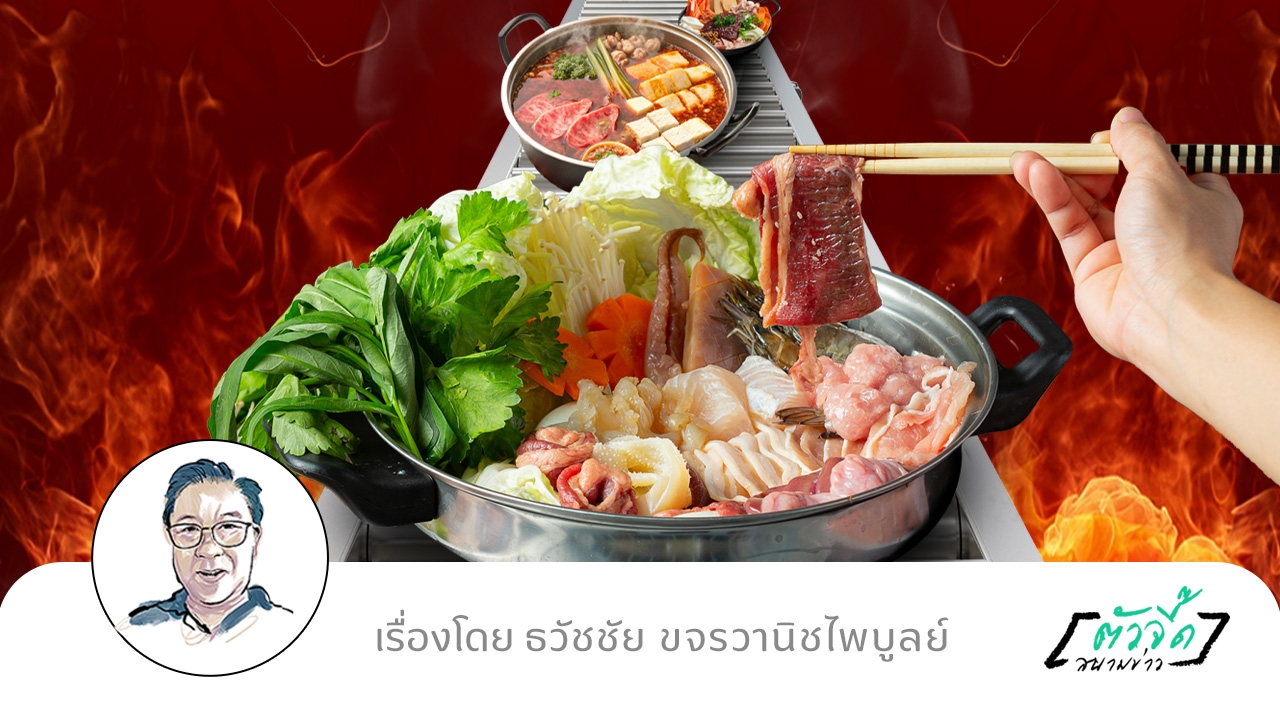
This became clear when CRG decided to invest over 940 million baht to acquire a 40% stake in Lucky Suki, entering the fast-growing Budget Suki market within the hot pot segment worth more than 25 billion baht. The deal took years of study and negotiation before execution.
This was not a fresh start but a choice to partner with a proven player, after CRG’s lesson from Suki House, which failed to meet targets. What changed was recognizing Lucky Suki’s potential for rapid branch expansion within three years and revenue reaching 1 billion baht.

The core point here is that the potential of the Budget Suki market has not been sufficiently acknowledged.
Structural assessments show this market can support more than 400 branches nationwide—not just one brand but the total market size—meaning this is no longer a niche market but transforming into a fully mass market.
With branches spreading from city centers and secondary cities to suburbs, the game is no longer about who makes better broth but simply,
“Who is closest to the customer... when they are hungry?”
At this point, CRG is confident in its strength as part of Central Group, with the capability to expand branches closest to community customers. Its supply chain management will help Lucky Suki succeed, aiming to expand to 100-120 branches and achieve 5 billion baht in sales within three years.
More branches directly reflect economies of scale: the more outlets, the lower the costs. Bargaining power over raw materials, logistics, and backend systems naturally consolidates with large players, while smaller competitors without such structures start at a disadvantage before even cooking a pot.
Therefore, the Budget Suki arena is not about being the cheapest but about speed in network expansion and cost control. Whoever builds the network first gains advantage. This is a game dominated by three giants: Teenoi, Lucky, and Bonus, who will steer the market direction.
For CRG, budget suki is not a side dish but an engine supporting growth during tough economic times. It is a business that generates steady traffic and cash flow and marks a careful return to the suki market after costly lessons in the past.
This is why Budget Suki is not just a food trend.
In a weak economy, growth is not an option but the only condition for survival.