

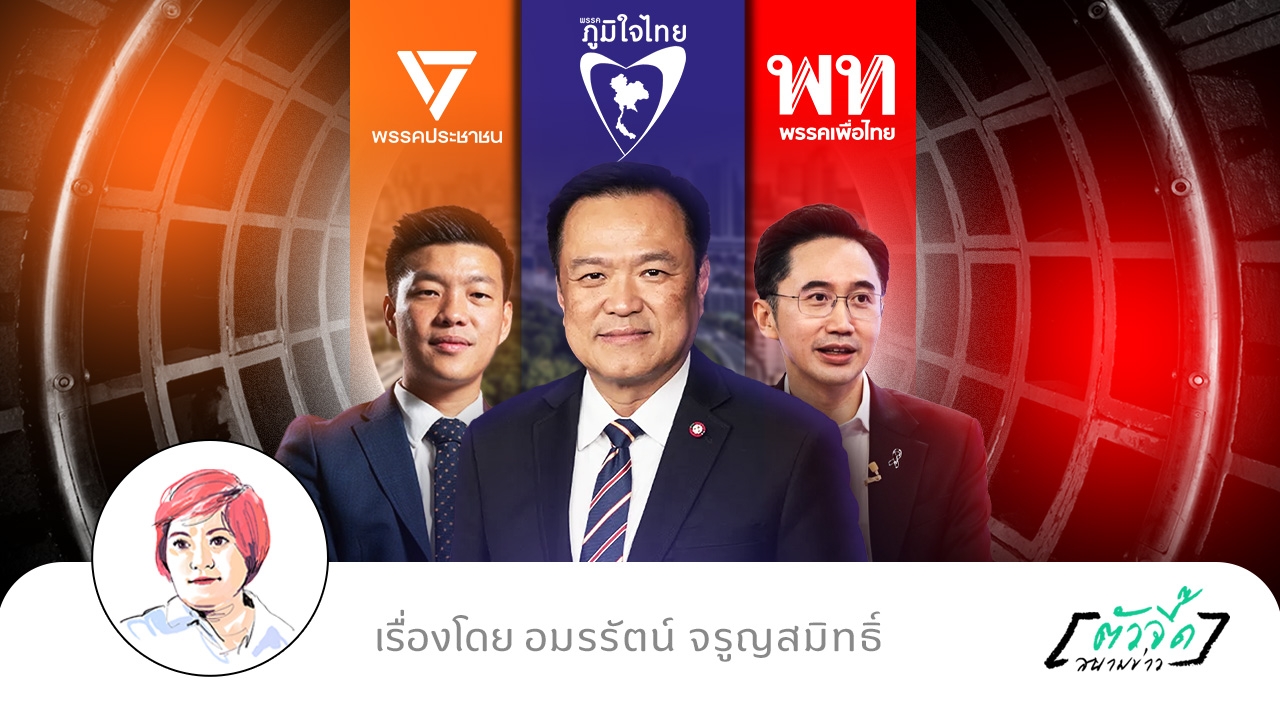
Ahead of the 8 Feb 2026 election, competition over economic policies intensifies, especially among three political parties—Bhumjaithai, Pheu Thai, and Prachachon—each aggressively campaigning with "livelihood policies." Recently, Pheu Thai announced "Thailand Without Poverty," upgrading the co-payment scheme to have the state cover 70%, leaving citizens to pay only 30%. This clearly reflects a fierce populist contest with no party yielding ground to another.Tags: [election, economic policy, political parties, populism, Thailand]
This moment is appropriate to delve deeply into "Three Parties, Three Economic Choices": who will inject money, who will clear debt, who will distribute universal benefits, and the key differences to know, providing the public with a clear overall picture before deciding how to cast their ballot for their own and the nation's future. The focus is on presenting policies from the three main parties likely to form the next government.Tags: [economic policy, political analysis, election 2026, government formation]
Bhumjaithai promotes the slogan "Promises Made, Promises Kept Plus," advancing economic policies focused on "the realities of small-scale individuals" such as daily wage workers, farmers, small entrepreneurs, and low-income groups. Their approach involves injecting liquidity through tangible projects and systematic debt relief, giving people the chance to regain financial footing.Tags: [Bhumjaithai Party, economic policy, small businesses, debt relief]
A key highlight is the upgrade of the "Co-Payment Plus" program, increasing funding and expanding target groups to stimulate local spending, alongside the "State Welfare Card Plus" which continuously adds funds for vulnerable groups. Additionally, there are plans to promote Thai goods and services through the "Made in Thailand SMEs Plus" initiative, using government procurement to support small enterprises in competition.Tags: [Bhumjaithai Party, co-payment program, welfare card, SME support, government procurement]
Regarding debt, they propose a three-year debt moratorium for debts up to one million baht within the system, with the state covering interest on behalf of debtors. They also plan to issue "Thai Power Bonds" to raise funds from savers to sustainably support this policy, supplemented by unsecured emergency loans of 50,000 baht and establishing a state AMC to manage non-performing loans, allowing debtors to recover and restart financially.Tags: [debt relief, financial instruments, emergency loans, asset management company]
Another important move is stimulating the economy through investments such as the land bridge project connecting the Gulf of Thailand and the Andaman Sea, green transportation systems (EV buses priced under 40 baht), free rooftop solar panels, and affordable electric motorcycles with installments as low as 100 baht per day.Tags: [infrastructure investment, green transport, renewable energy, electric vehicles]
Furthermore, they promote community-level quality of life policies including free clean drinking water in every village, increased allowances for health volunteers, establishing a life insurance fund for the elderly, and a major goal to attract 80 million foreign tourists generating 6 trillion baht in revenue by 2027.Tags: [community welfare, health volunteers, tourism, elderly support]
Overall, Bhumjaithai positions itself as a "pragmatic party" that does not focus on universal handouts but emphasizes liquidity injection, debt management, and investment to build a stable foundation for the public in the long term.Tags: [Bhumjaithai Party, economic strategy, pragmatism, long-term investment]
Pheu Thai advances its economic strategy for the 2026 election with the pledge "Thailand Without Poverty," emphasizing major goals to raise incomes, reduce debt burdens, and create broad economic opportunities, adhering to three core principles: "increase income, reduce expenses, expand opportunities."Tags: [Pheu Thai Party, anti-poverty, economic goals, income support]
A highlight is upgrading the previous co-payment scheme to "State Covers 70%" so citizens pay only 30%, named "Thailand Without Poverty." This is designed to stimulate the grassroots economy, reduce living costs, and rapidly inject liquidity, focusing mainly on vulnerable and low-income groups. Simultaneously, the party promises that if anyone’s income falls below the poverty threshold of 36,000 baht per year, they will subsidize up to that level so that "no one in this country will have to be poor anymore."Tags: [co-payment scheme, poverty alleviation, grassroots economy, social subsidies]
Pheu Thai also proposes "debt unlocking" for the most concerning groups, including student loans, civil servant debts, farmer debts, teacher debts, and credit card debts within the system. Utilizing funds or creditor negotiations, they offer debtors a chance to re-enter the system and start anew without accumulated interest burdens that undermine lives. For labor, they target a minimum wage of 600 baht per day by 2027 and a starting salary of 25,000 baht for university graduates.Tags: [debt relief, labor policy, minimum wage, student loans]
The "Digital Wallet 10,000 Baht" flagship program has been scaled back to conditional distribution based on income or household criteria, no longer offered universally, and is grouped with cost-of-living reduction measures such as 20 baht flat-rate electric train fares and expanded "30 Baht Universal Healthcare" coverage.Tags: [digital wallet, targeted subsidies, healthcare, transportation fares]
Overall, Pheu Thai aims to present itself as a populist party that does not merely give handouts but strategically "injects" support with clear goals in income, debt, and living costs.Tags: [Pheu Thai Party, populism, targeted support, economic strategy]
Prachachon opens its economic campaign with the vision "Thailand Not Grey, Thailand Equal, Thailand Modern," positioning itself as a party seriously promoting universal welfare aimed at reducing inequality, increasing incomes, and establishing a sustainable economic structure.Tags: [universal welfare, equality, sustainable economy, political vision]
The starting point is creating a "basic income" through a universal old-age allowance of at least 1,000 baht per month, expanding welfare comprehensively for all age groups without requiring poverty proof. Simultaneously, they propose a "living wage" policy that immediately raises the minimum wage by 4% and adjusts it automatically each year according to the cost of living, along with guaranteeing a minimum 30% profit for small-scale farmers.Tags: [basic income, old-age allowance, living wage, agricultural support]
To assist small businesses, the party proposes "Co-Payment" coupons for SMEs to help with rent and accounting costs, along with the idea of an "SME Receipt Lottery" where citizens can win prizes each time they support small vendors. Meanwhile, SMEs would receive special tax privileges such as VAT exemption for income up to 3.6 million baht and a reduced VAT rate of 2.1% on a flat-rate basis.Tags: [SME support, tax incentives, stimulus measures, small business aid]
The party does not focus on direct debt relief but suggests "debt reduction through development," such as converting risky agricultural land into forest or irrigation areas and having the state reduce debts proportionally to farmers’ participation. They also propose a "crop insurance" system where the state compensates fully if production is lost or prices fall.Tags: [debt management, agricultural policy, crop insurance, rural development]
Regarding economic structure, the party announces a "New Economy" model covering eight areas, including waste management, nationwide potable water within eight years, creative tourism, digital economy, and advancing Thailand into the chip industry supply chain. Infrastructure investment totals 630 billion baht nationwide, such as integrated public transport tickets costing 8–45 baht across all routes. On tax structure, Prachachon proposes a "stepped VAT" reducing taxes on essentials, increasing taxes on luxury goods, exempting the first 40,000 baht per month of personal income from tax, and pushing land tax consolidation to distribute land ownership and increase local budgets via governor elections in every province.Tags: [economic model, infrastructure investment, tax reform, public transport]
Prachachon's policy is to "create security so everyone has a place to stand" through inclusive, equitable welfare designed to reform the economic system from the ground up.Tags: [welfare policy, economic reform, social security, equality]
The 2026 election is not just about parliamentary seats but a battle for economic trust from the entire nation. Bhumjaithai, Pheu Thai, and Prachachon each deploy distinct strategies. Before casting their ballots, voters should clearly evaluate which party addresses their economic future and how realistically those policies can be implemented if the party forms the government.Tags: [election analysis, economic trust, political strategy, voter decision]
Follow economic information and government policies with ThairathMoney atTags: [economic news, government policy, ThairathMoney]https://www.thairath.co.th/money/economics/thailand_econTags: [economic news, website]
Follow the Facebook page: Thairath Money at this linkTags: [social media, economic news]https://www.facebook.com/ThairathMoneyTags: [Facebook, economic news]