

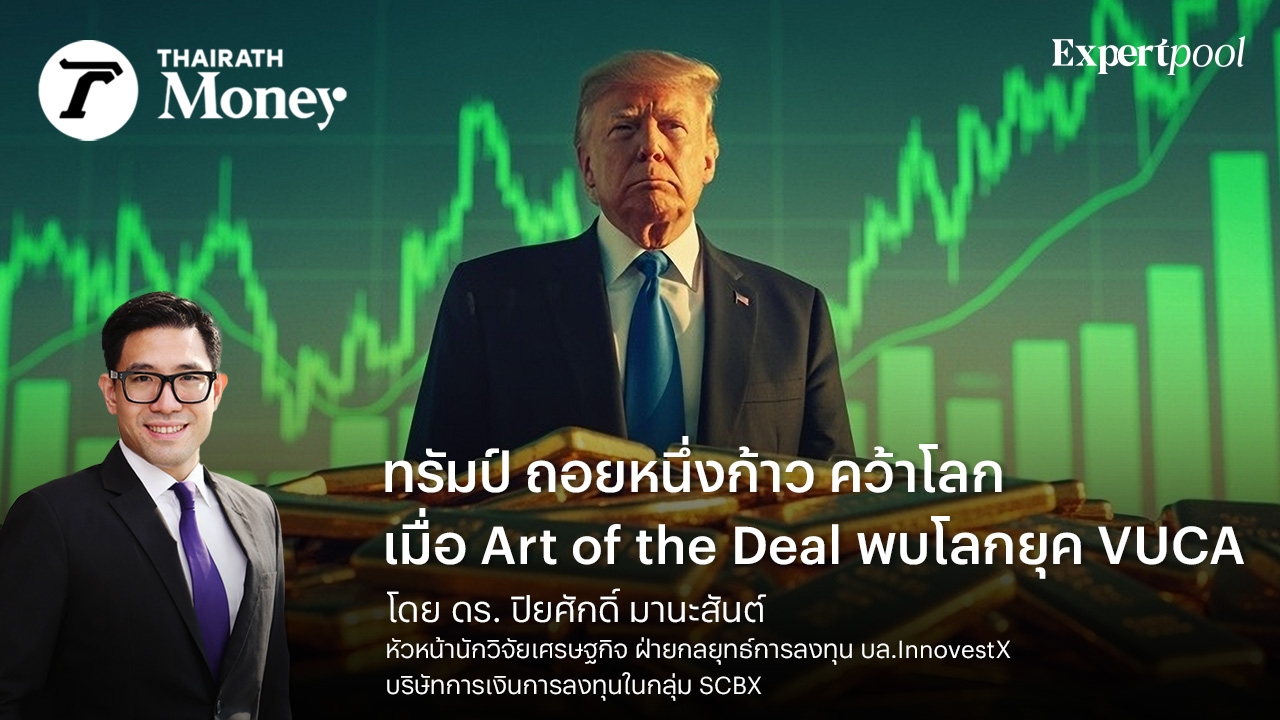
If anyone wonders why gold prices have surged past $4,700 per ounce and silver has touched $90 per ounce, the answer lies in Trump’s speech at Davos last week. Amid a world fully entering the VUCA era (Volatility-Uncertainty-Complexity-Ambiguity), Trump’s announcement that he would “not use military force” to seize Greenland and his suspension of tariff measures against Europe is not a retreat but a “strategic calculation” with multiple hidden implications.
First, to ease financial market concerns. The declaration of “no use of force” helped prevent global stock and bond markets from plunging due to geopolitical uncertainty. Yet Trump did not back down; he emphasized the “between-the-lines” message that the U.S. possesses “unstoppable” power, as shown in Venezuela where the new government ceased attacks and made deals immediately after a show of force. This was a smart perception management tactic that calmed markets in the short term while maintaining pressure on Europe.
Second, to send a signal to the Supreme Court. Highlighting the case of Switzerland, which faced a 30% tariff but negotiated it down to 15%, and France, threatened with a 100% wine tariff, established a “new norm” that tariffs are a “trade balancing tool” rather than arbitrary power. This will enable Trump to fully leverage tariffs as bargaining tools if the Supreme Court listens.
Third, to send a message to the Federal Reserve. Boasting that “core inflation is at 1.5% but growth is 5.4%” signaled to the Federal Reserve that his policies are not creating inflationary pressure, allowing the Fed to cut interest rates further. This was coupled with the announcement of appointing a new Fed chair soon, expected to be someone “who understands his policies.”
And finally, fourth, to express confidence in the economic team. When asked about the budget deficit, Trump casually replied, “Growth is what matters,” showing confidence in Treasury Secretary Scott Bessent, who is managing market perceptions closely. This aligns with supply-side economics, which believes growth will increase tax revenue to offset deficits.
After the speech, Trump met with NATO Secretary General Mark Rutte and reached a “framework of a future deal” concerning Greenland and the Arctic region, resulting in the suspension of tariffs scheduled to start on 1 February.
Denmark’s foreign minister said the situation “ended better than it began” but emphasized that Greenland remains Danish territory, while Trump described the deal as a “very long-term agreement” with U.S. involvement in “mineral rights” without providing details.
This is Trump’s Art of the Deal style: starting with high demands (seizing Greenland), showing strength (Venezuela), using economic tools (tariffs), then negotiating to gain “privileges” without using force. It is likely the U.S. will expand its military bases, access rare minerals, and participate in infrastructure development in exchange for security guarantees and tariff relief for Europe.
The bigger picture is that the world is fully entering the VUCA era. In just the first half of the year of the Fire Horse, we have seen bloody protests in Iran (over 3,000 deaths), a political crisis in France failing to pass the budget, sudden elections in Japan and Thailand, and China entering a deflation spiral with the slowest new credit growth since 2018.
Most concerning is the shaken credibility of the U.S. Even though December’s CPI inflation came out at 2.7%, lower than expected, the reliability of the data is in question due to a government shutdown causing incomplete data collection. Our analysis suggests inflation is closer to 3.0%, especially food prices rising 0.7%, the highest since October 2022.
Even more worrying is the erosion of Fed independence, with the Department of Justice issuing subpoenas to the Fed and the Supreme Court potentially ruling on 21 January to allow the government to remove Governor Lisa Cook. Jamie Dimon warned that intervening in the Fed will increase the inflation premium in bond markets, undermining the credibility that the world has relied on for over half a century.
This explains why gold prices keep surging—not just a normal safe-haven flight but reflecting structural concerns over the global financial system. Gold jumped 4% after the Venezuela event and is likely to reach $5,000 per ounce, driven by three factors: ongoing interest rate cuts, severe geopolitical tensions, and reduced central bank independence.
More importantly, the U.S.’s arbitrary use of power is pushing countries to reduce reliance on the dollar, supporting gold as a long-term alternative asset not tied to any currency.
Short term (1-3 months): Expect the SET index to fluctuate between 1,250-1,345 points. Monitor 4Q bank earnings, pre-election campaign policies before 8 February, and geopolitical volatility. Recommended strategy is “Selective Buy” in:
Earnings Play: Stocks with 4Q profits growing over 10% (ADVANC, BGRIM, CHG, GPSC, GULF, OR, PRM, TRUE).
Quality Dividends: To generate cash flow and reduce volatility (AP, DIF, KTB, PTT, TISCO, BAM, KBANK, SAT, THANI, TLI).
Election Rally: Stocks benefiting from campaign funding (CPALL, BJC, CPN, GFPT, OSP, MTC, SAWAD, TIDLOR).
Medium term (3-12 months): Increase weighting in gold and silver as risk hedges. Gold has the potential to test $5,000 this year. Thai investors might consider gold mutual funds or Gold ETFs for easy investment and liquidity.
Long term: The world is shifting from Pax Americana to a multipolar power structure. Investors should diversify portfolios more, increase safe assets, and be cautious about assets dependent on political stability.
Remember, in the VUCA era, volatility is not a threat but a normal state to learn to live with. Those who are prepared and adapt quickly will be the winners in this game.
Wishing investors good luck.