

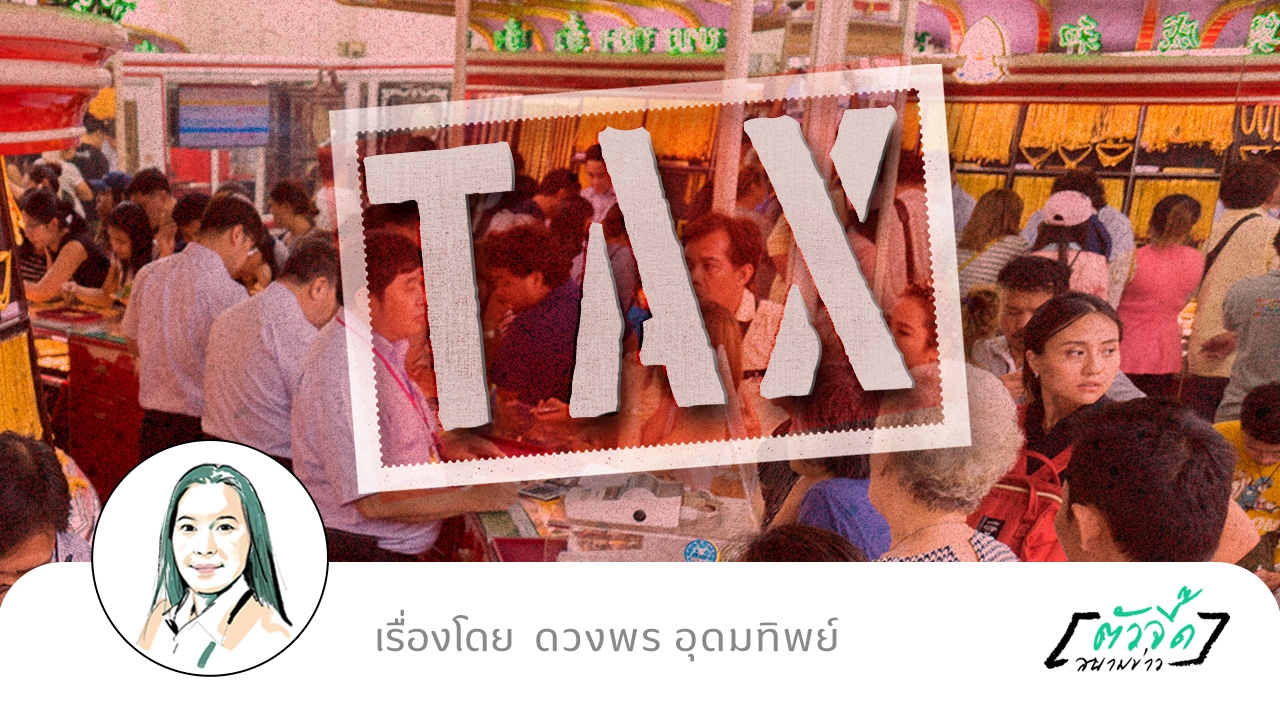
The "gold business," although lacking a dedicated regulatory body like the Stock Exchange overseen by the Securities and Exchange Commission (SEC) or banks regulated by the Bank of Thailand (BOT), must strictly comply with laws from the BOT, the Revenue Department, the Department of Business Development, and the Anti-Money Laundering Office (AMLO). Additionally, there are various regulations imposed by the Gold Traders Association.
Currently, the gold business already pays taxes; for example, gold shops with annual revenue exceeding 1.8 million baht must register for Value Added Tax (VAT). Regarding VAT exemption on gold bars, gold bar traders with 96.5% or higher purity must file tax form Phor.Por.01.3 with the Revenue Department to qualify for VAT exemption. As for specific business tax, if a gold shop accepts pledges or provides loans, it must pay a special business tax at a rate of 2.75% on the interest earned.
Specifically, the Ministry of Finance and the BOT have proposed implementing a Special Business Tax on gold. They have instructed the Revenue Department to study the possibility of taxing gold transactions, which is expected to be no more than 3% on gold trades conducted via online platforms.
At the same time, online gold trading platforms must report transaction data to the Revenue Department. Currently, the Revenue Department is consulting with online gold trading operators to develop a data submission system, which is expected to take up to one year to complete.
Therefore, at this time, there is no "gold tax" being collected until the Revenue Department finalizes the system and sets the specific tax rate.
Nevertheless, the government is attempting to regulate the gold trading business due to its impact on the appreciation of the baht and to prevent money laundering.
This is because the current value of gold trading exceeds that of the stock market, with average daily gold trades at 65,937 million baht and peaks reaching 255,566 million baht, whereas the stock market's daily trading value averages 42,417 million baht with a maximum of 74,437 million baht.
According to the World Gold Council (WGC), global gold investment in 2025 reached a peak value of 555 billion U.S. dollars.
Meanwhile, Thailand's gold investment surged to its highest level since 2018, setting a 12-year record at 6 billion U.S. dollars.
Efforts to control gold trading have been ongoing continuously since late December 2025.
Recently, the BOT issued a notification as the exchange control officer regarding rules and procedures for currency exchange, effective from 1 March 2026.
For domestic gold trading conducted online with payments made in Thai baht, the following procedures apply.
If the daily gold trading volume does not exceed 50 million baht per person per online platform, no special procedure is required. However, for trades exceeding 50 million baht per day per person per platform, a request must be submitted to the exchange control officer using the prescribed form and documents available on the BOT website.https://www.bot.or.thThe exchange control officer may request additional supporting documents as necessary.
For gold trades involving payment or receipt in foreign currencies, a request for exemption must be submitted to the exchange control officer.
Those holding gold in their trading accounts exceeding 50 million baht prior to 31 January 2026 may sell such gold to buyers operating online platforms without any transaction limit.
Going forward, the gold business must be closely monitored, as despite an upward trend, it will experience high volatility—so vigilance is essential.
Follow economic information and government policy with ThairathMoney athttps://www.thairath.co.th/money/economics/thailand_econ
Follow the Facebook page: Thairath Money at this linkhttps://www.facebook.com/ThairathMoney