

The Futures market is characterized by volatility, speed, and leverage. The Futures and Options team at Bualuang Securities noted that what traders need most is not to "predict market direction" but rather a tool that helps define a rational decision-making framework.
Fibonacci Retracement has become a common language used by professional traders worldwide to interpret price charts. Although Fibonacci originates from mathematics, its application in financial markets astonishingly reflects "human behavior," as price retracements, fear of missing out (FOMO), and profit-taking repeatedly manifest at familiar price levels.
The 61.8% ratio, or Golden Ratio, is central to Fibonacci Retracement because it is a level where short-term investors often re-enter the market. Medium-term traders view it as a "pullback before continuation," while contrarian traders begin closing positions.
To use the Fibonacci Retracement tool, one draws from the highest point to the lowest point in a downtrend or from the lowest to the highest point in an uptrend before the trend reverses. This helps identify price levels where a recovery or retracement is likely to occur.
One advantage of Futures is the ability to speculate on both rising and falling prices. Therefore, Fibonacci Retracement is not limited to finding support for opening Long positions in uptrends but also helps identify resistance for Short positions in downtrends. When Futures prices retrace or recover to levels such as 61.8%, 50.0%, and 38.2%, price movements tend to be volatile because Futures traders focus heavily on these levels. This often results from simultaneous buying and selling pressure that increases price volatility, creating profit opportunities. This tool answers the crucial question: "If the price continues, where should profits be taken?" This is vital in the Futures market where greed can quickly turn gains into losses.
To use Fibonacci effectively, price levels should be converted into a "trading plan," not just lines on a chart, and applied on daily or higher time frames.
This approach gives Futures trading structure and clear entry and exit plans, avoiding emotional decisions and enabling portfolios to generate long-term returns. To illustrate clearly, the author presents the following example.
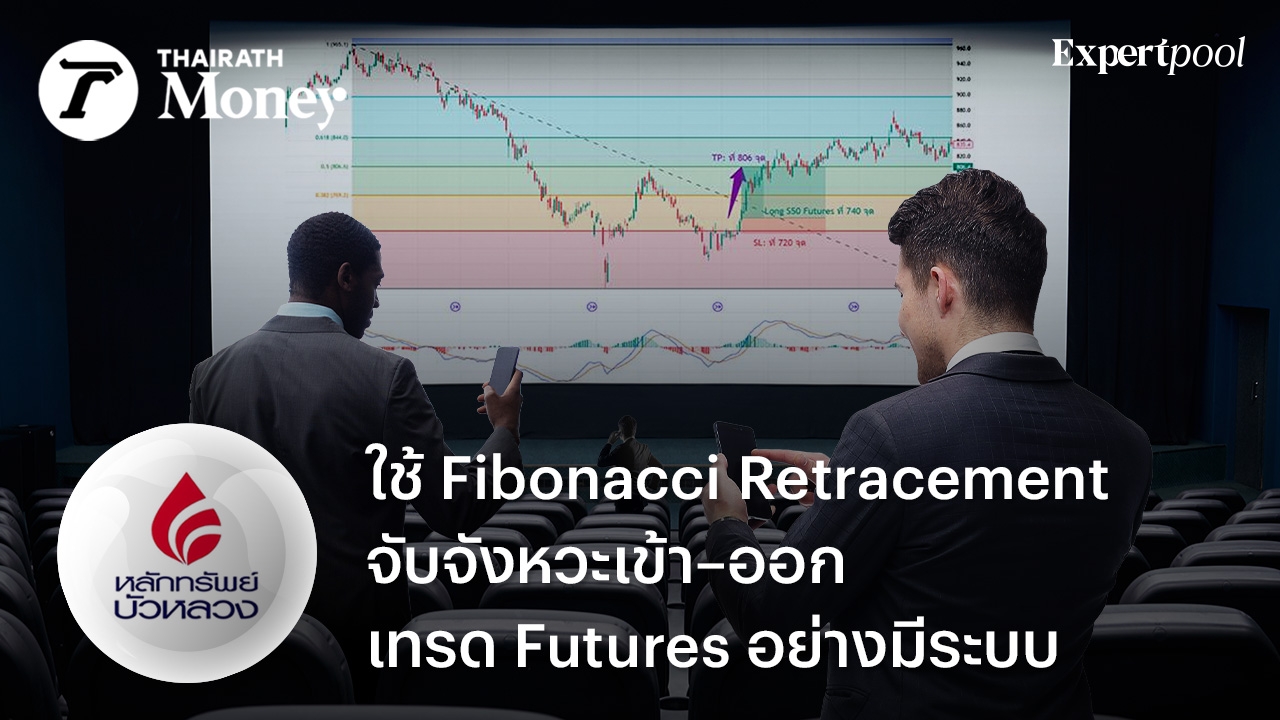
Example: A trader observes a reversal candlestick pattern signaling an uptrend in S50 Futures along with MACD crossing above zero, indicating a positive trend shift. They open a Long position on 2 contracts of S50 Futures at 740 points, placing a Stop Loss at 720 points (slightly below the 23.6% Fibonacci level).

The first Take Profit is set at the 50.0% Fibonacci level around 806 points, and the second at the 61.8% Fibonacci level near 844 points.
The trade follows the strategy, closing the first position at 806 points with a profit of (806-740) x 200 x 1 = +13,200 baht.
Subsequently, the price continues to rise, and the second position is closed at 844 points, earning (844-740) x 200 x 1 = +20,800 baht.
Thus, after completing the trades, the portfolio gains a total profit of 13,200 + 20,800 = 34,000 baht (excluding fees).
The most important aspect is that Fibonacci does not predict the future with absolute certainty but helps organize a trader’s thinking to better understand market structure, know when to enter and exit, and improve risk control.
In the Futures market, where every decision directly affects capital, having a "trading framework" is more important than constantly seeking new indicators. Fibonacci Retracement transforms market volatility into opportunity when used with discipline and an understanding of trend context. The Fibonacci lines become not just chart markings but a map guiding traders toward systematic and sustainable decision-making.
For stock and investment news, visit Thairath Money at
Follow the Thairath Money Facebook page at the link below