

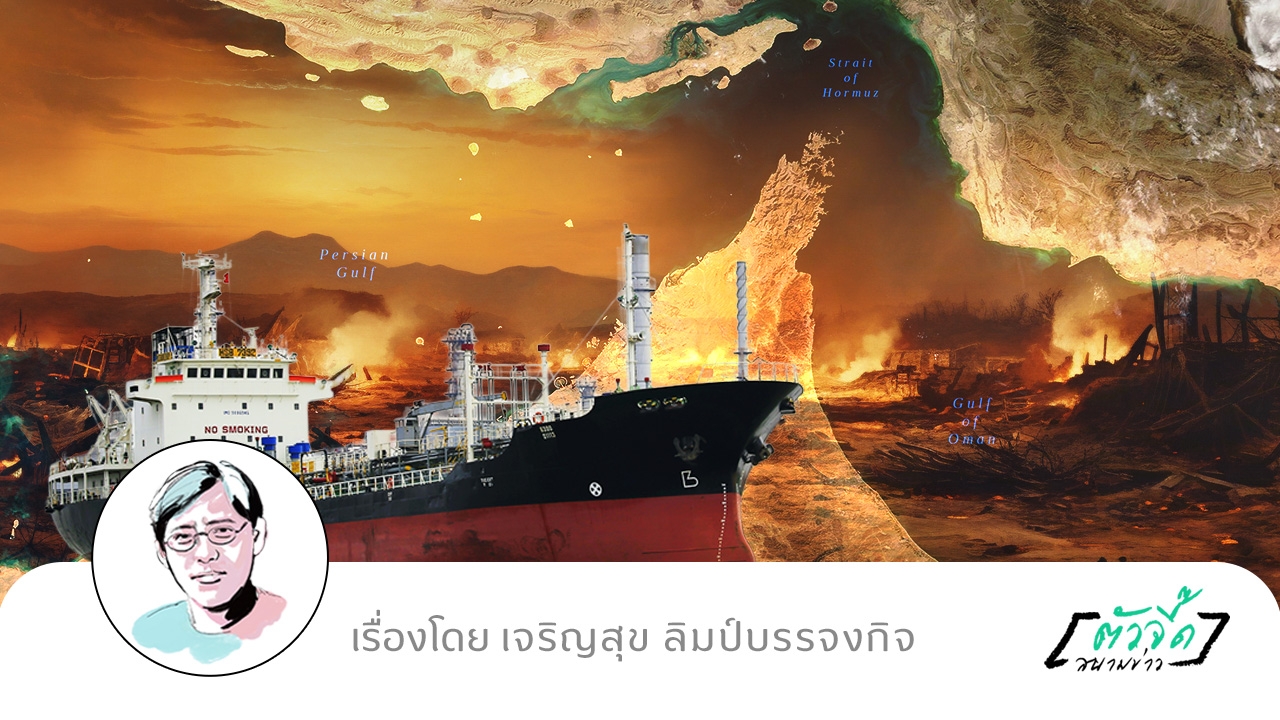
In today's globalized world, where countries are deeply interconnected, gunfire in a distant land can unexpectedly affect lives on the other side of the world. The conflict between Iran, the United States, and Israel that erupted in late February 2026 clearly reflects this reality.
The military event known as "Operation Epic Fury" not only severely heightened tensions in the Middle East but also triggered shocks spreading throughout the global economy—from energy markets and international trade routes to the tourism industry. Although Thailand is thousands of kilometers away from the conflict zone, the ripple effects inevitably impact its economy.
Almost immediately after the conflict began, global energy prices became highly volatile. As geopolitical risks increased, oil markets reacted swiftly, with Brent crude oil prices soaring above 80 U.S. dollars per barrel, up from around 70 dollars previously.
At the same time, liquefied natural gas prices in Europe surged more than 40 percent, while Asian markets saw increases exceeding 20 percent within just one day.
The main cause was concern over disruptions to energy production and the risk of closure of the Strait of Hormuz, one of the world's most crucial oil transit routes. This strait acts like a major artery supplying the global energy system; even a temporary blockage could shake the entire world economy.
For Thailand, energy price volatility is a major risk factor because the country relies on net energy imports for about 70 percent of its needs, especially crude oil—over 60 percent of which is imported from the Middle East via that route. When global energy prices rise, domestic costs inevitably follow, affecting electricity, fuel prices, and cooking gas—basic costs for both businesses and households. The result is increased inflationary pressures and rising living costs for the population.
Several economic analysts have begun assessing this crisis's impact on Thailand’s economy. If the situation resolves quickly, the effects may be limited. However, if the conflict lasts more than three months, average oil prices may remain high, significantly slowing Thailand’s economic growth.
The National Economic and Social Development Council estimates Thailand’s economy may grow only about 1.3–1.6 percent in 2026, down from an earlier forecast of around 2 percent—marking the lowest growth rate in several years. Though these figures may seem like mere statistics, they translate into weaker purchasing power, higher business costs, and widespread uncertainty across the economy.
Energy price pressures directly impact many industrial sectors. Energy-intensive businesses—such as electricity generation, transportation, hotels, fisheries, textiles, chemicals, and steel—have energy costs accounting for roughly 10–33 percent of total expenses. Rising energy prices increase these burdens. If businesses cannot raise product prices accordingly, they may face reduced profits or need to postpone future investments.
On another front, the conflict significantly affects the global trade system. Although the Middle East is not a primary export market for Thailand, it accounts for about 3–4 percent of total exports. For some products—like automobiles, rice, and processed seafood—the region represents over 10 percent of exports. Prolonged conflict would raise transportation and war insurance costs, inevitably reducing orders.
Meanwhile, the crisis has forced rapid adjustments in global logistics. Many shipping lines are avoiding routes through the Red Sea and the Suez Canal—the main trade paths between Asia and Europe—opting instead for the longer route around Africa. This detour adds about 10–15 days to transit times and sharply increases freight rates. There is also the risk of container shortages, as many containers may become stuck within the global logistics system, disrupting container circulation, similar to the crisis during the COVID-19 pandemic, which drove shipping costs to record highs.
For Thai exporters, these issues mean higher costs and uncertain delivery schedules. Some operators are reconsidering strategies, such as returning containers to their origin country rather than leaving goods at destination ports, to avoid potentially steep storage fees if the situation prolongs unexpectedly.
Beyond trade and production, Thailand's vital tourism industry has also been affected. Airspace closures in several Middle Eastern countries have forced many airlines to cancel or reroute flights, causing fares on some routes to increase several times over.
Furthermore, airports in the Middle East serve as key hubs connecting flights between Europe, America, and Asia. Disruption of these hubs inevitably impacts long-haul travelers heading to Thailand, particularly tourists from the Middle East—a high-spending group playing an important role in Thailand's medical tourism sector.
At the macroeconomic level, higher energy prices affect Thailand’s economic stability. For every 10-dollar increase per barrel in global oil prices, Thailand’s current account deficit could widen by several billion dollars due to higher energy import costs. This tends to weaken the baht, while the U.S. dollar usually strengthens during crises as investors seek safer assets. These factors increase challenges for Thailand’s economic policies, both in controlling inflation and maintaining financial stability.
Nevertheless, despite the uncertainty, Thai government and private sectors have begun continuously preparing countermeasures. The Ministry of Energy confirms that Thailand holds enough oil reserves for approximately 95 days and continues to source oil from alternative suppliers. It is also using the fuel fund mechanism to help stabilize diesel prices in the short term. Additionally, plans are underway to increase the use of renewable energy, biomass, and domestically sourced natural gas to reduce exposure to global energy market volatility.
Businesses are also adapting by managing costs, adjusting shipping routes, and diversifying export markets to other regions. Meanwhile, the government sees opportunities amid the crisis, such as strengthening Thailand’s role as a center for food security and medical services, which could attract foreign investment and cooperation in the long term.
This Middle East conflict highlights a key truth of the modern global economy: a tightly connected world where events in one region can quickly ripple across others. Though Thailand is not directly involved militarily, its economy is still impacted through energy prices, trade, tourism, and financial stability.
However, if Thailand carefully manages risks and uses the opportunity to restructure and strengthen its domestic economy, this crisis could become an important lesson that helps the country stand more resilient amid future global volatility.
Follow the Facebook page: Thairath Money at the following link -