

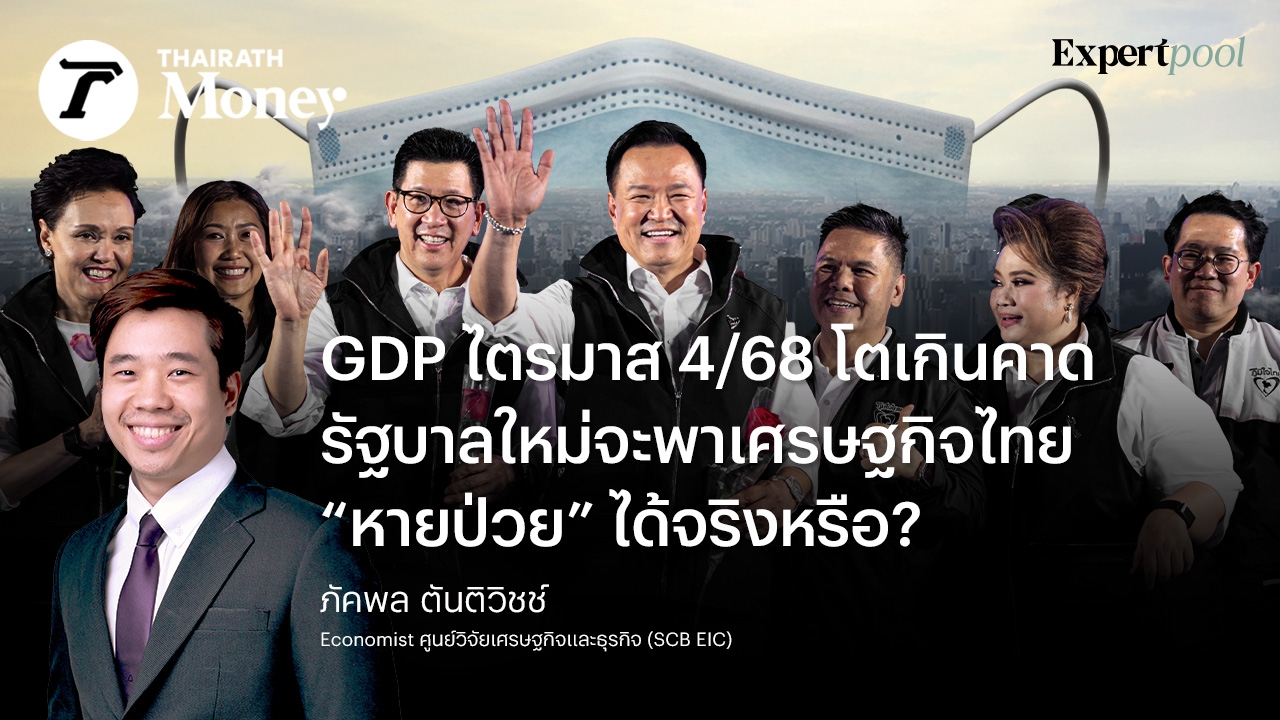
Shortly before the release of Thailand's Q4 2025 Gross Domestic Product (GDP) figures, the country was dubbed “The Sick Man of Asia” by the global media outlet Financial Times, due to Thailand's economy showing the slowest growth forecast among Southeast Asian nations in 2025. However, the actual Q4 2025 figure was much higher than expected, at 2.5% year-on-year, resulting in a full-year growth of 2.4%, exceeding market and analyst forecasts of around 2%, according to surveys by Asia Pacific Consensus Forecasts and SCB EIC. This helped foster a much more positive economic outlook for 2026.
However, a crucial question arises: does the higher-than-expected GDP growth in 2025 truly indicate that Thailand's economy has overcome its crisis and left the ICU? Is the economy recovering robustly from being ‘sick’? Or is this merely a temporary effect of stimulus measures that improve short-term results without fundamentally changing the economy's long-term growth potential?
Within this economic context, the new government, likely still led by the Bhumjaithai Party, aims to continue and promote the Big Win policy package as the '10 Plus' initiative. This is designed to combine short-term economic stimulus measures like the 'Half-Half Plus' scheme with longer-term structural solutions such as 'Equal Education Plus' and 'Investment Plus.' However, although many 10 Plus policies attempt to address Thailand's structural problems, the majority of the budget remains concentrated on subsidy projects that mainly support short-term economic relief. This raises doubts about how effectively the policy package can address long-term structural economic issues.
This article analyzes Thailand's economic recovery in the final quarter of 2025, the strengths and limitations of the 10 Plus policy, as well as fiscal and economic stability challenges in the long term. It concludes with policy recommendations aimed at balancing short-term economic stimulus with sustainable long-term structural reforms.
Thailand’s economy in 2025 grew stronger than expected at 2.4%, with Q4 accelerating sharply to 2.5% year-on-year from 1.2% in Q3. Examining GDP components reveals that this high growth was primarily driven by 1) increased private consumption, supported by government purchasing power stimulus measures and improved consumer confidence through the Half-Half Plus program, which eased living costs and boosted household spending short-term, including accelerated electric vehicle purchases ahead of the EV 3.0 scheme's end; 2) private investment expanding at its fastest rate in 13 quarters, led by vehicle, machinery, and construction sectors; and 3) government spending growth, fueled by accelerated budget disbursement and stimulus measures.
Additionally, while merchandise exports continued to grow strongly, some slowing occurred due to declines in certain agricultural and industrial goods amid intense global price competition. Export growth this year relied more on cyclical factors than improvements in Thailand's industrial competitiveness and was offset by equally high imports. Meanwhile, service exports continued to contract, reflecting an incomplete recovery in tourism. Overall, the economy's growth was mainly supported by domestic demand, boosted by cash injections and temporary stimulus measures. However, these measures have not significantly enhanced productivity, competitiveness, or established new long-term growth foundations for Thailand's economy.
Growth patterns like those in Q4 2025 may lack sustainability, as stimulus effects will gradually fade when programs end before year-end. Without new drivers to improve productivity, competitiveness, and create long-term economic value, Thailand's economy risks returning to low growth. This is a major current challenge.
The 10 Plus policy package is Bhumjaithai Party's flagship platform promoted through websites and rallies, helping the party win the highest votes in the 8 February 2026 election and maintain leadership in government formation. Its goal is to drive Thailand's economic growth beyond 3%, focusing on reducing living costs and increasing liquidity to address urgent economic recovery needs and ease citizens’ financial burdens, while restructuring the economy for sustainable long-term growth amid ongoing external vulnerabilities and longstanding structural issues.
However, observations note that 1. there remains significant inconsistency between the policies promoted during Bhumjaithai's campaign and those submitted to the Election Commission (EC). For example, the Investment Plus policy and the large-scale Land Bridge infrastructure project worth over 990 billion baht, frequently cited during the campaign, are absent from the official policy documents and budget framework submitted to the EC, which covers only about 148 billion baht across eight main policies.
2. The budget framework submitted to the EC may not fully encompass the total funding required if the government seriously pursues the entire 10 Plus agenda. In particular, large infrastructure investments like the Land Bridge project are likely to require additional substantial funding beyond the EC-submitted budget in the future.
3. Thailand’s increasing fiscal constraints could limit government policy implementation, especially populist measures, as public debt is projected to approach the 70% ceiling within one to two years. This is reflected in credit rating downgrades by two of three major agencies. If this trend continues, further downgrades could raise financing costs for both public and private sectors and restrict the government’s ability to implement economic stimulus measures.

4. Regarding long-term structural problem-solving among the eight policies reported to the EC, the budget allocation still heavily favors short-term demand stimulation over enhancing national productive capacity and addressing structural issues. Seventy-three percent of the budget supports subsidies and cost-of-living relief, such as the Half-Half Plus program and electricity subsidies, aimed at boosting consumption and short-term economic confidence. Twenty-five percent targets employment and income generation, particularly for military and nursing professions. In contrast, policies with potential for long-term growth, like investments in education, workforce skills, and human capital development under Equal Education Plus, receive only 0.5% of the total budget.
5. Given these structural and fiscal constraints, policies focused mainly on stimulating spending may help 'sustain' the economy short-term and temporarily improve growth figures but are insufficient to 'change the trajectory' of long-term growth potential sustainably. Without strategic investments in human capital, technology, innovation, and digital infrastructure, the goal of 3% annual economic expansion may remain a policy aspiration rather than an achievable reality.
Nevertheless, the government must seriously rebalance policy priorities from mainly 'sustaining the economy' towards investments that enable 'structural transformation,' increasing emphasis on human capital, technology, and productivity alongside appropriate short-term stimulus. Achieving this balance will be key to maintaining short-term economic stability while raising long-term growth potential to the 3% target sustainably.
The unexpectedly strong Q4 2025 GDP figure is a positive short-term confidence booster but cannot be interpreted as Thailand’s economy having truly 'recovered.' The year-end acceleration was mainly driven by short-term stimulus and cyclical factors rather than systematic structural adjustments.
The main challenge for the new government is not just to sustain short-term GDP growth but to plan and implement policies that 'fully heal' Thailand’s economic ailments. This requires balancing stimulus policies with long-term structural reform investments. While such reforms may not immediately reflect in GDP growth figures, they are essential to building the country’s long-term stability and prosperity. If policy balance is maintained consistently, Thailand has the opportunity to overcome the low-growth trap, shed its label as the 'Sick Man of Asia,' and embark on a path of stable, sustainable, and inclusive growth in the future.
Follow the Facebook page: Thairath Money at this link -