

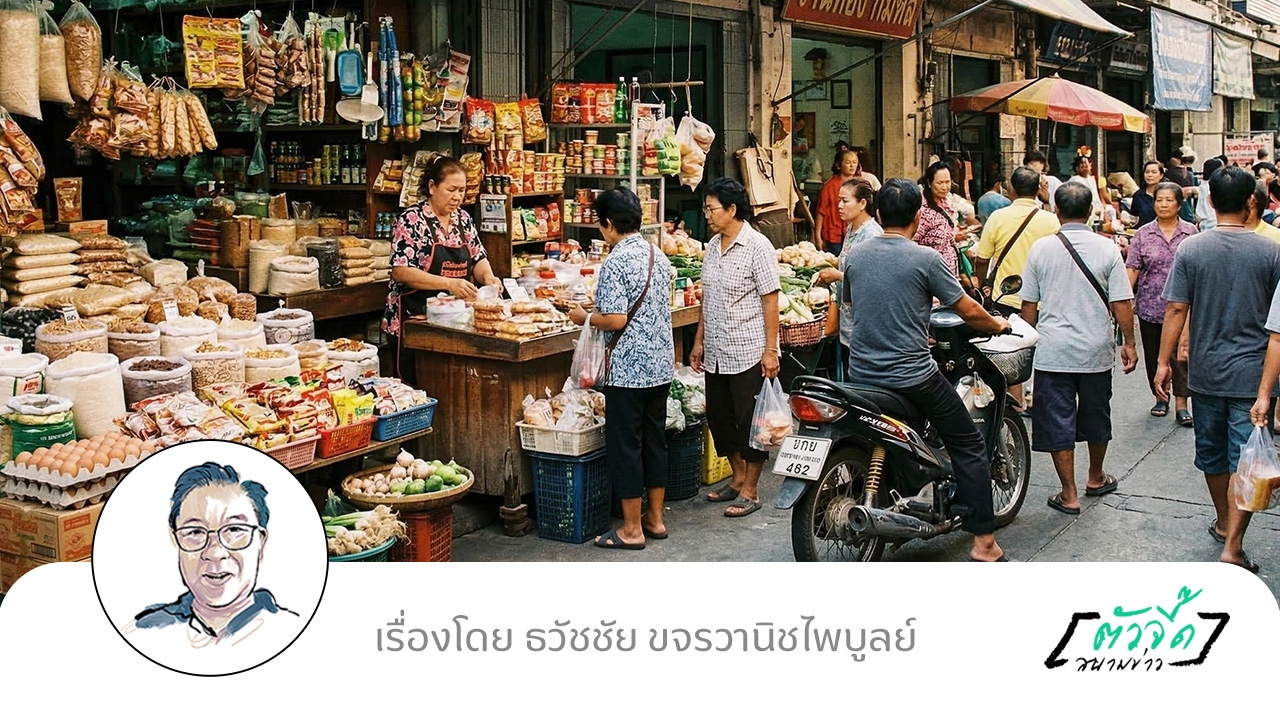
In recent years, large modern trade retailers have rapidly expanded branches nationwide, causing many local entrepreneurs to withdraw from the market. However, Sing Buri province has become a different case study, where local malls have maintained their market role despite competing with large retail capital.
Tops Plaza Sing Buri, a retail project by Central Retail Group with an investment of over 500 million baht on Asia Road, hosting more than 150 shops and services, was once planned as a new landmark for the province. However, after nearly ten years of operation, it closed on 15 March 2026 to renovate and shift its business model to "Thai Watsadu," a construction materials center under the same group.
This directional shift reflects key realities of retail markets in small towns, which face purchasing power limitations and a demographic structure with a higher proportion of elderly residents than big cities. Sing Buri also has relatively low average income per capita among central provinces, leading consumers to spend mainly on necessities, while fresh markets and nearby shops remain primary daily shopping channels.
Nonetheless, the exit of modern trade opened opportunities for local businesses to expand their market roles, especially "Chai Saeng Department Store," a longstanding local mall that began as a small fabric shop in a fresh market in 1965 before growing into a major retail center where Sing Buri residents are familiar with value-for-money shopping.
After Tops Plaza's closure, many retail brands started opening stores in Chai Saeng, with some relocating from the former project and others launching new branches in the area, such as Oppo, Vivo, Banana IT, Auntie Anne’s, as well as lifestyle brands like Moshi Moshi and Beautrium. Negotiations are also underway with major restaurant chains like MK and Shabushi to open future outlets.
The arrival of these brands has enabled Chai Saeng to develop magnet stores that attract more foot traffic to the mall.
“Ekphoom Treechairasamee,” an executive at Chai Saeng, revealed that the mall significantly revamped its business model by renovating the first floor from a traditional department store layout to leased spaces for various brands, aligning with consumer demand for specialty shops and a wider range of services.
This model has increased the mall's income from rent and sales shares while reducing risks associated with managing inventory. Additionally, having numerous restaurants, IT shops, and lifestyle stores helps create a balanced tenant mix, encouraging customers to spend more time in the mall.
Currently, Chai Saeng has evolved from a local department store into a comprehensive retail center, comprising Chai Saeng Department Store, Chai Saeng Superstore serving both retail and wholesale, and CS Park, a food and entertainment hub covering over 50 rai. The latest CS Park branch features well-known brands like KFC and Pantai Restaurant, serving as a community shopping center for customers from surrounding areas.
There is also the "Khun Jing by Chai Saeng" project, collaborating with local grocery stores in the province and nearby areas to build a local retail network. The group's overall business now exceeds one billion baht in annual sales.
Another major step is the superstore expansion into In Buri district, with an investment of over 100 million baht, scheduled to open in April on approximately 2,000 square meters. This store is designed to serve both retail and wholesale customers, catering to general consumers, restaurants, and small local entrepreneurs.
Having a wholesale center at the district level allows community shops to access goods at reasonable prices, reducing travel costs to the city for purchases, while also providing opportunities for agricultural and local products to enter modern retail distribution channels.
Although Sing Buri’s economy faces challenges from an aging population and the migration of young workers to larger cities, the Chai Saeng case shows that local retail still holds advantages large modern trade chains cannot replace: an understanding of community lifestyles and close customer relationships.
The Sing Buri case clearly demonstrates that retail markets in small towns are not decided solely by investment size but depend on understanding local consumer behavior.
The "Sing Buri Model" has thus become an example of local retail leveraging community closeness as a strength to stand firm amid competition from large retail capital.