

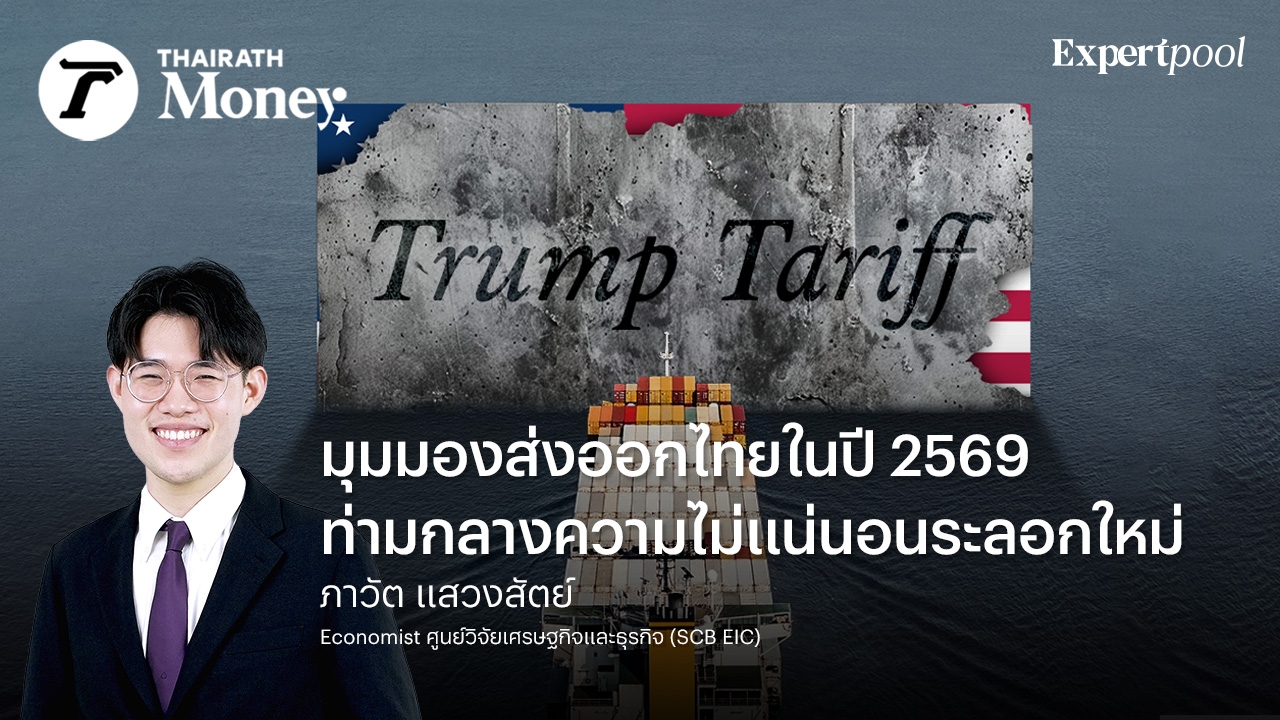
Since early 2026, Thailand's export sector has continued strong growth from last year. In the first two months of 2026, Thai export value surged 17% year-on-year, driven by electronics exports following high investment trends in AI and data centers, especially in the U.S., resulting in a 42% year-on-year growth in Thai exports to the U.S. during that period.
However, looking ahead, uncertainty will sharply increase due to two key turning points occurring in late February. The first is the U.S. Supreme Court ruling that the Trump administration lacked authority to impose import tariffs under the International Emergency Economic Powers Act (IEEPA), forcing the U.S. government to suspend some tariffs. The second is the U.S.-Israel attack on Iran, which led Iran to close the Strait of Hormuz, disrupting about 20% of global crude oil transportation and rapidly driving up energy prices worldwide.
After the U.S. Supreme Court ordered the Trump administration to suspend some import tariffs, including reciprocal tariffs that differ by country (Thailand was taxed at 19%), the Trump administration used Section 122 of The Trade Act of 1974 to impose a 10% tariff on imports from all countries for 150 days (24 Feb - 24 July 2026).
This change lowered the average tariff the U.S. imposed on Thai goods from about 22% to approximately 17% (based on WTO data), improving Thai products' price competitiveness in the U.S. market to some extent. U.S. importers may accelerate purchases of Thai goods in the short term to benefit from the temporarily reduced tariff rates.
However, the Thai export sector still faces high uncertainty because the U.S. government will use other laws to impose additional import tariffs, particularly Section 301 of The Trade Act of 1974, which allows re-imposition of reciprocal tariffs long-term through investigations of trading partners engaging in unfair trade practices. This process has already begun in two areas:
The Section 301 investigations underway may lead to higher U.S. import tariffs on Thai exports in the future. The investigation's outcome is highly uncertain, and the process is lengthy. The severity of the impact on Thai exports from Section 301 tariffs will depend on three key factors:
The Iran-U.S.-Israel war spreading to the Gulf countries has severely pressured demand in the Middle East region. However, overall, Thai exports are expected to have limited direct impact from reduced demand there, as exports to the Middle East account for only 3.7% of total export value.
Some export product groups may be more affected due to significant dependence on the Middle East market, such as wood and wood products, fresh/chilled/frozen fish, rice, and automobiles and parts. These groups rely on the Middle East for over 10% of their export value.
The Middle East conflict also indirectly affects Thailand's export sector through the global economy slowdown, driven by higher energy prices, shipping costs, and production costs. This results in increased inflation in many countries worldwide, pressuring purchasing power and demand for Thai goods.
In 2025, nearly 60% of Thai exports went to countries reliant on energy imports (net energy trade deficits), whose demand could be severely affected by accelerating global energy prices. Therefore, a prolonged war leading to sustained high energy prices could further pressure Thai exports through weakened partner demand.
Additionally, some industries may face supply chain disruptions, such as the chip supply chain possibly experiencing helium gas shortages, as the world's main helium producer is Qatar. This would affect electronics and electrical appliances that use chips, as well as petrochemical-based export products like plastic packaging and chemicals, which may face raw material shortages.
Both the uncertainty over U.S. import tariff policies and the Middle East war situation will pressure Thailand's export sector in 2026. SCB EIC projects Thai export value to grow only 1.2% this year, a sharp slowdown from 12.9% growth last year.
Thailand's export sector will continue facing downside risks that could shrink total export value this year, including risks of a prolonged Middle East war and the risk of higher or additional U.S. import tariffs on Thai goods compared to 2025, including electronics which previously had tariff exemptions.
In this high-uncertainty environment, government and private sector preparedness must be comprehensive beyond just monitoring the situation. Concrete measures should begin promptly, such as accelerating trade negotiations with the U.S., providing information during Section 301 investigations, and diversifying raw material sources to reduce risks from the Middle East.
Follow economic and government policy updates with ThairathMoney athttps://www.thairath.co.th/money/economics/thai_economics
Follow the Thairath Money Facebook page at this link https://www.facebook.com/ThairathMoney