

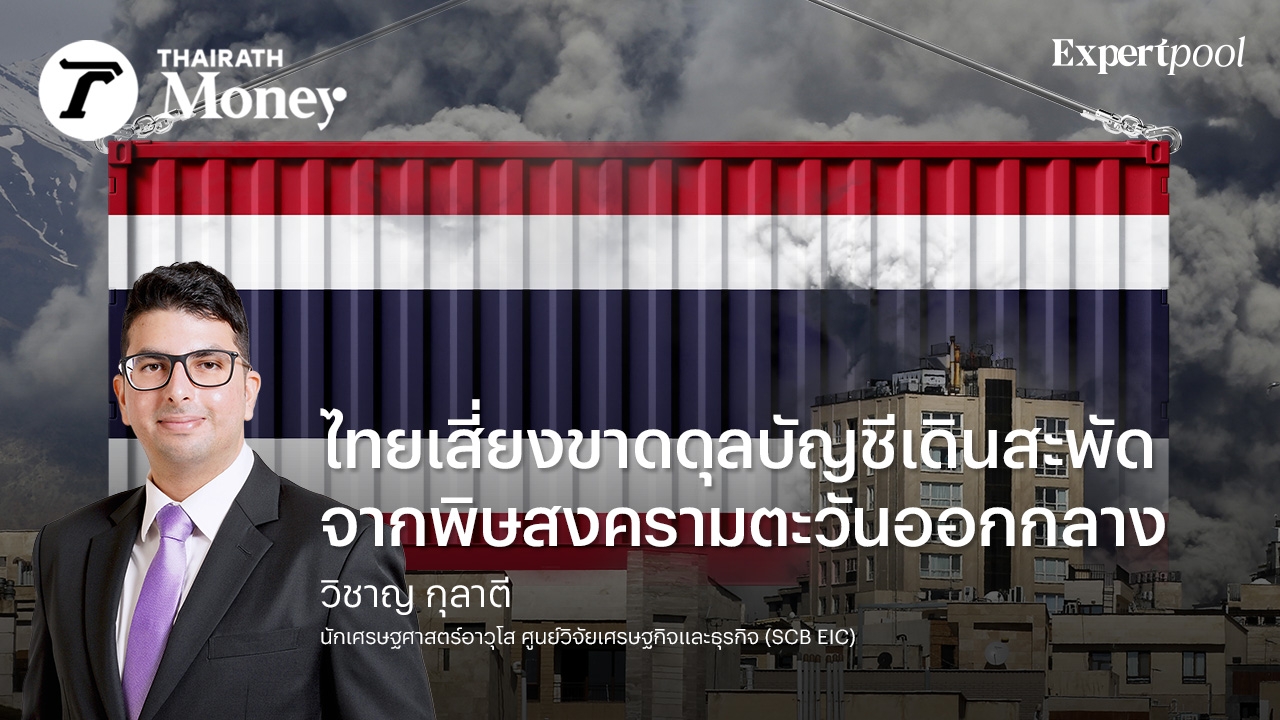
The current account (CA) is a key indicator for assessing the health of an economy's foreign sector. CA mainly consists of the trade balance and service balance, along with other components such as income balance and transfer balance, which reflect factors like income and expenses from international investments and labor compensation. A country with a CA surplus earns more foreign currency than it spends abroad, while a CA deficit means it spends more foreign currency than it earns.
This indicator is particularly important for Thailand because it is a highly open economy relying heavily on international trade. This is reflected in its trade openness ratio—the combined value of exports and imports of goods and services—which reached 137% of GDP in 2024, much higher than the global average of 57%, ranking Thailand 30th out of 196 countries worldwide.
Historically, Thailand has consistently recorded a CA surplus, especially before the COVID-19 crisis. For example, in 2019, Thailand's CA surplus was as high as 38.3 billion USD. However, the CA has worsened significantly after the COVID-19 crisis, dropping to 17.7 billion USD in 2025. This decline is likely to be exacerbated by the impact of the Middle East war and new US tariff barriers under the Trump administration, which affect exports. Consequently, Thailand risks returning to a CA deficit this year—a situation that has occurred only five times since the 1997 Asian financial crisis—through three main channels: a reduced trade surplus, higher freight costs, and a deteriorating tourism balance.
. . . The trade surplus is expected to decline because (1) Thai imports have been rising steadily. Despite strong export growth of 12.7% in 2025 and 16.9% in the first two months of 2026, driven by accelerated production before fully feeling the trade war’s effects, a surge in electronics exports linked to global investments in AI and data centers, and increased gold exports amid global economic and geopolitical volatility,
imports have grown even faster over the past five of six months, leading to a trade deficit in three of those months. This is especially true for imports from China and imports of raw and intermediate goods for electronics production, both for export and domestic use, which have significantly worsened the trade balance. While importing for production and export or for machinery and equipment is typically positive, current conditions suggest Thailand may not be benefiting sufficiently, as reflected by persistently weak manufacturing activity. Thailand’s capacity utilization was only 56.8% in February 2026, compared to 65.6% in 2021.
(2) The impact of the Middle East war is severe, with exports to Middle Eastern countries (ME 15) contracting by as much as 57.1% in March 2026 (preliminary customs data). This effect is expected to spread to exports to other countries due to global economic slowdown and supply disruptions in upstream products, which may increase costs or cause shortages of raw materials needed for export production.
Additionally, Thailand is a net energy importer accounting for about 8% of GDP. The value of energy imports will accelerate due to higher prices, with fuel product import prices rising 34.7% month-on-month in March compared to the previous month.
(3) US tariff barriers under Section 301 of The Trade Act of 1974 are currently under review. The US is considering imposing tariffs on Thai goods and key trading partners. If Thailand faces higher tariffs than competitors, it will lose competitiveness in the US market—the largest export market for Thailand, accounting for 21.3% of Thai exports in 2025. Conversely, Thailand may have to open its market further to US imports by lowering tariffs or easing non-tariff trade barriers to negotiate tariff reductions from the US.
Two International freight costs have risen sharply. The Freightos Global Container Index, reflecting global sea freight prices, reached 2,424.7 in 2025, up 76.2% from 1,375.8 in 2019, due to higher service costs. This raises Thailand’s import and export costs substantially. Although the index eased somewhat in early 2026, the Middle East war poses risks of freight costs rising again with energy prices, which are a major component of shipping costs.
Three The tourism balance has worsened due to the war. Before the 2019 crisis, foreign tourist arrivals in Thailand peaked at 39.8 million. However, post-COVID recovery has stalled, with arrivals reaching only 33 million in 2025. Factors include slower global economic growth, competition from other Asian countries' tourism policies ('tourism war'), and Chinese tourists’ safety concerns about traveling to Thailand.
For 2026, SCB EIC estimates that foreign tourist numbers may stagnate due to the Middle East war’s impacts, including global flight reductions, sharply higher travel costs from rising oil prices, and tourists’ economic concerns. Early signs already show declining tourist arrivals from the Middle East and Europe, groups with high spending power.
While the temporary 1-2 year deterioration in the current account from the Middle East war affects countries worldwide, it is concerning that Thailand’s CA was already weakening. Multiple worsening CA components will affect Thailand’s economic growth rate. In a worst-case scenario, a chronic CA deficit could weaken the baht. Although a weaker baht may help exports and tourism, it would also raise import costs, especially for energy. Furthermore, CA is a key variable considered by credit rating agencies.
How should Thailand adapt to handle a potential CA deficit? It should start with
(1) Increasing the share of domestic raw materials in manufacturing to reduce the import-to-export ratio. This not only benefits economic growth but also helps reduce the risk of US tariff barriers on transshipment goods.
(2) Upgrading the tourism sector toward high-value tourism, reducing reliance on tourist numbers, and focusing on health and cultural tourism while enhancing safety to attract wealthier tourists who stay longer.
(3) Accelerating the energy transition to reduce dependence on imported energy by promoting clean energy policies and supporting solar rooftop installations in households and industries.
The risk of a current account deficit worsened by the Middle East war and US tariffs clearly shows that Thailand can no longer rely on its traditional economic structure. Cooperation between government and private sectors to upgrade manufacturing, tourism, and energy is not just a short-term fix but a new direction for the Thai economy to reduce vulnerabilities and enhance long-term growth potential.
For economic and government policy updates, follow ThairathMoney at
Follow the Facebook page Thairath Money at this link: https://www.facebook.com/ThairathMoney