

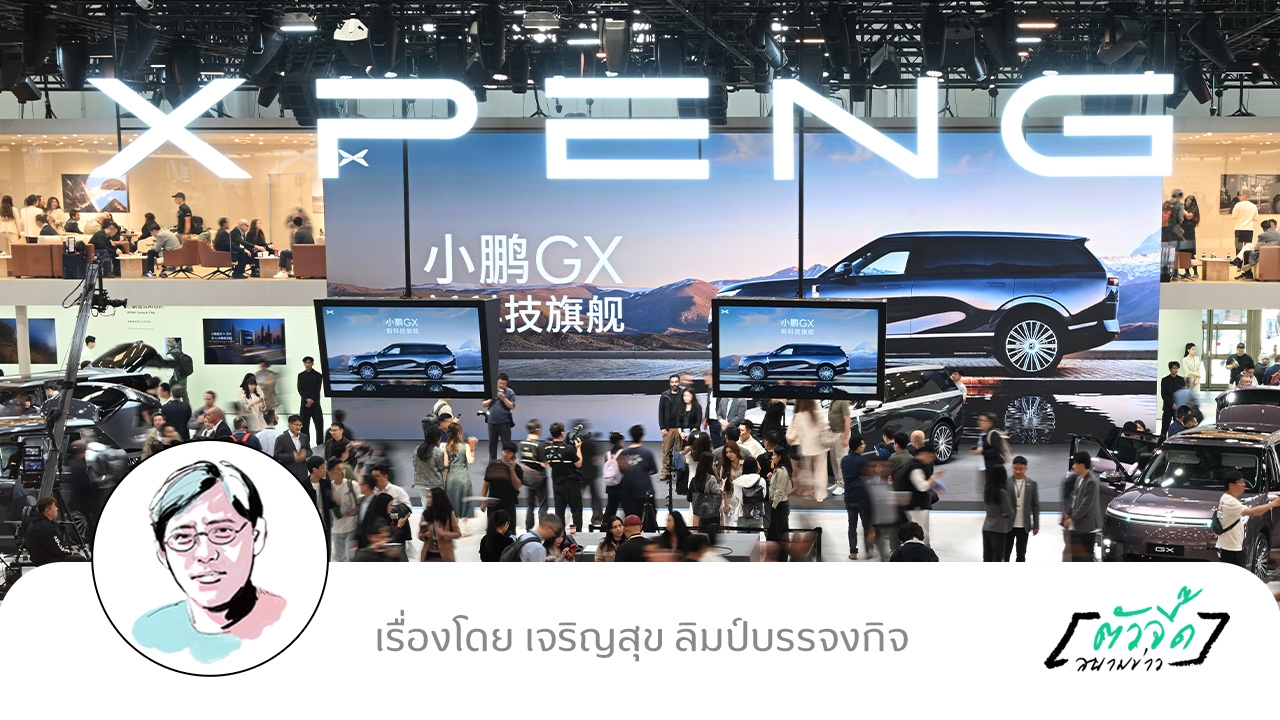
The Auto China 2026 automotive exhibition held in Beijing, China from late April to early May this year was not merely an innovation showcase but became a pivotal scene marking a quiet yet decisive power shift in the global automotive industry.
Spanning over 380,000 square meters, more than 1,400 vehicles were lined up like a declaration of the new era. Journalists worldwide and influencers streamed live coverage while senior executives explained technologies on giant screens. The massive crowds resembled those at major global tech events. This entire scene clearly reflected one truth—the center of the automotive world is shifting.
Once, European and Japanese car brands set the direction of the industry. German cars symbolized luxury, and Japanese vehicles stood for quality and durability. But today, new players from China are rewriting the rules of the game at a pace that many find hard to keep up with.
Chinese manufacturers do not compete based on image or long-standing heritage but instead employ more powerful weapons: technology and rapid development speed. Chinese electric vehicles can reach the market within just 18–24 months, nearly twice as fast as traditional producers, and at clearly more accessible prices.

Brands like BYD, Xiaomi, and Xpeng are redefining 'cars' from mechanical machines to mobile digital platforms. New models are not sold solely on range or acceleration but also feature artificial intelligence systems that communicate with drivers, understand voice commands, analyze behavior, and respond to human emotions.
When Xiaomi's CEO test-drove an electric car from Beijing to Shanghai, covering over 1,300 kilometers with only one charging stop, it was more than a performance test—it signaled the rapid erasure of previous limitations of electric vehicles.
This transition did not occur overnight. China spent more than 25 years building an electric vehicle ecosystem from upstream to downstream—from batteries, software, and processing chips to charging infrastructure. When Beijing announced its 'AI Plus' strategy to embed artificial intelligence across all economic sectors, automobiles became one of the most critical testing grounds of the new era.
The latest electric cars are no longer just internet-connected devices but are becoming machines capable of thinking, analyzing, and making decisions independently. Drivers can command the car to find parking near a mall entrance; the car can navigate using cameras without maps or even adjust lighting, music, and cabin atmosphere according to the driver's stress level.
The line between technology companies and automakers is almost erased. Cars are no longer defined by their engines but by the software, chips, and AI systems they contain.

Technology firms like Huawei are investing heavily in AI chips and intelligent driving systems, while many Chinese automakers accelerate development of their own chips to reduce dependence on foreign technology. This competition transcends business rivalry—it is an industrial and technological security contest at the national level.
This transformation sends shockwaves globally, especially among traditional automakers that once dominated the Chinese market. Many companies now accept the reality that competing in the world's largest car market can no longer rely on old formulas.
Many European and Japanese automakers have adopted a new strategy: 'Made in China for the World.' They no longer see China merely as a sales market but as a technology development hub and low-cost manufacturing base. Collaboration between Western and Chinese companies is increasing continuously—from adopting Chinese tech firms' driver-assistance systems to co-developing new electric vehicle platforms.
An interesting paradox is that while China once learned from the West, today foreign automakers must come to study China's speed of development, innovation, and production efficiency.
This pressure is clear among Japanese manufacturers. Honda, once a symbol of world-class engineering, has returned focus to research and development to revive its innovation spirit. Senior executives openly admit that after visiting fully automated Chinese supplier factories, they recognize the rivals' strengths—faster, cheaper, yet maintaining good quality.
Toshihiro Mibe, Honda Motor's president, stated, 'We hardly have a chance to compete with Chinese automakers.' This is not a surrender but an acknowledgment of the new era's reality.
Meanwhile, U.S. automakers face the challenge of balancing cooperation with Chinese carmakers in global markets and protecting the domestic automotive industry amid internal political and security pressures.

Jim Farley, Ford's chairman and CEO, revealed that Ford needs global partnerships, including intellectual property sharing with Chinese automakers, to boost competitiveness abroad. Reports indicated Ford once discussed cooperation with Geely, China's second-largest automaker, regarding Europe, possibly extending to technology use in the U.S., though talks are currently stalled.
Ford emphasizes it remains a global company seeking partners outside the U.S. for growth, but Farley expresses concern about opening the American market to Chinese vehicles, viewing it as a national security issue. He stresses the need to protect the domestic automotive base and maintain fair competition, similar to China, Japan, and South Korea's focus on their local industries.
Mary Barra, CEO of General Motors (GM), noted Chinese cars play a significant role outside the U.S. GM uses both American-developed and Chinese vehicles through joint ventures with Chinese state enterprises to serve emerging markets sensitive to price.
Both Ford and GM use China as a production base for exports. Farley described China as a 'key variable' global automakers must manage and said Ford will appropriately leverage opportunities in the Chinese market despite political obstacles to transferring cooperation back to the U.S.

At the same time, domestic competition in China is fierce, with price wars, trade-in promotions, and numerous new brand launches keeping the market highly dynamic. Manufacturers must compete not only on price but also on 'value' through superior technology, performance, and user experience.
Large SUVs have become market stars. Chinese consumers prioritize space, comfort, and smart technology over traditional brand prestige. This cultural shift enables local brands to quickly ascend into the premium segment.
What was considered impossible a few years ago—Chinese consumers choosing domestic luxury brands over European ones—has now become normal. The key question is whether this trend will expand globally.
Global oil price volatility due to geopolitical conflicts accelerates consumer adoption of electric vehicles. Europe, the Middle East, and Southeast Asia have become new targets for serious Chinese exports. Despite tariffs and trade barriers, cost advantages and technology remain strong driving forces.

The automotive world is entering an era where competition no longer centers on engine power or top speed, but on software capabilities, artificial intelligence, and digital ecosystems connecting users to daily life.
Cars are evolving from mere transportation devices into 'intelligent assistants on wheels' capable of managing daily life, booking restaurants, sensing moods, and even learning their owners' behaviors.
As cars begin to think independently, the critical question is not just who makes the best cars but who can create the smartest 'brains' for them.
Auto China 2026 in Beijing is thus not just a car show but a reflection of a changing world. The long-standing leadership in the automotive industry is being challenged, with former followers now shaping the future direction.
At this turning point, no one knows for certain who the ultimate winner will be, but one thing is clear—the game has completely changed, and the roar of engines is being replaced by the quiet hum of electric motors and the processing power of artificial intelligence behind the scenes.
The world is entering the era of fully intelligent vehicles, and the center of this transformation is inevitably revolving around China.
Follow the Facebook page: Thairath Money at this link https://www.facebook.com/ThairathMoney