

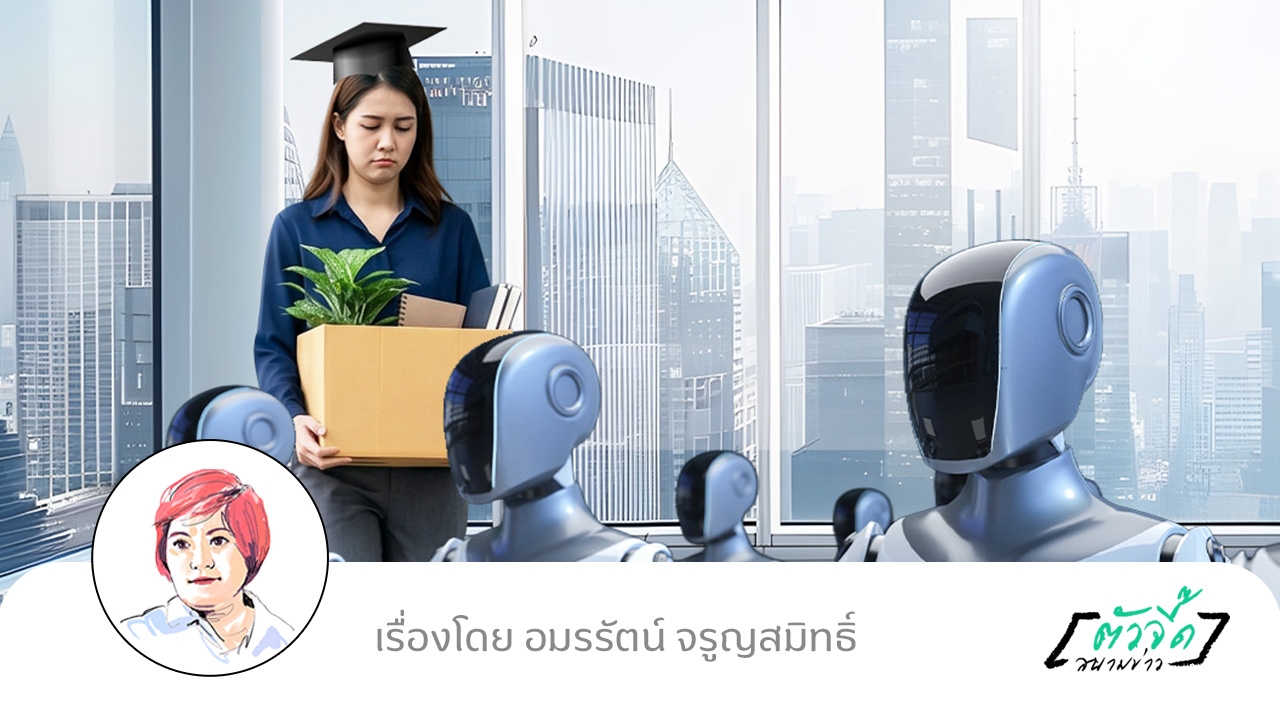
You might have a high degree, but AI is pushing you down? Here’s a list of high-skilled jobs in Thailand vulnerable to replacement by “Agentic AI”! Do you think having a bachelor's degree, earning nearly 30,000 baht a month, and working comfortably in an air-conditioned office in Bangkok means you’re safe from technology? The latest report from the Office of the National Economic and Social Development Council (NESDC) delivers a hard truth for all office workers: profiles like yours are the primary target for job displacement.
/ Danucha Pichayanan, Secretary-General of the NESDC, shared clear figures showing that 8.7 million Thai workers—21.8% of the workforce nationwide—are currently on the radar of artificial intelligence. What’s alarming is that AI today is smarter than just Generative AI (Gen AI), which only answers questions. We are now in the era of Agentic AI, artificial intelligence that can think independently, plan, and complete entire tasks on behalf of humans. Simply put, it’s ready to take your seat at work anytime.
Among those affected, the most concerning group is the 2.2 million workers at direct risk of replacement (Task Replacement). Check how many of these profiles match you or someone you know. The assessment shows 55.8% hold at least a bachelor's degree, earn an average of 27,820 baht per month, and have an average age of 36.5 years—prime working age. More than half of them work clustered in Bangkok and its metropolitan area.
Which jobs fall into this category?
The answer is popular positions for young workers involving repetitive, patterned, or strictly logical tasks. At the top are clerks, secretaries, and office support roles with a high risk rate of 52.5%, followed by advertising and marketing at 31.1%, customer service and public relations at 28.4%, financial analysts at 24.7%, and accountants at 13.7%. Even programmers face a 74.5% chance of being replaced or assisted by AI. This data dispels the old belief that specialized professional degrees guarantee safety. As long as the job involves data entry or coding based on set instructions, Agentic AI can easily take over—and it never gets tired.
A key issue for young workers to understand is the phenomenon of downshifting—high skills flowing downward. When computer-based workers lose their jobs to technology, they may accept lower-skilled jobs to survive. This leads to an oversupply of labor in lower-tier jobs, making it harder for new graduates to find work in their fields, and eventually results in reduced working hours and income. The future arrival of Physical AI (robotic systems) will further limit jobs requiring physical labor or fixed-step tasks.
However, there is still hope for those who adapt quickly: about 6.5 million workers currently use AI to augment their tasks (Task Augmentation). Most in this group have less than a bachelor’s degree and earn an average of 21,506 baht per month. They are not 100% displaced because their main tasks still rely heavily on distinctly human skills that robots cannot easily replicate—such as communication, negotiation, and on-the-spot problem-solving. Examples include managers, salespeople, or shop owners who use AI as a personal assistant to summarize documents and gather information, allowing them to work faster and more efficiently. In these cases, AI cannot fully replace their roles.
This situation reflects that the key to survival in today’s workforce isn’t your degree major but rather how easily AI can replace your job tasks. The only way forward for young people is to quickly transition from task doers to AI managers—taking control, verifying accuracy, and fixing technical gaps that AI cannot yet handle.
At the same time, the NESDC suggests that the government and education sectors must overhaul systems, accelerate AI adoption alongside developing data infrastructure, and upgrade digital governance laws to keep pace with technology. This includes clearly defining liability if AI causes harm.
The AI job displacement crisis is not a future problem; it is already present in our offices today. Higher education no longer guarantees job security. Reflect on whether you are a high-skilled worker awaiting replacement or someone developing into an AI controller. In the era of Agentic AI, those who stand still are unknowingly preparing to be downshifted.
Follow economic and government policy updates with ThairathMoney at
Follow the Facebook page: Thairath Money at this link https://www.facebook.com/ThairathMoney