

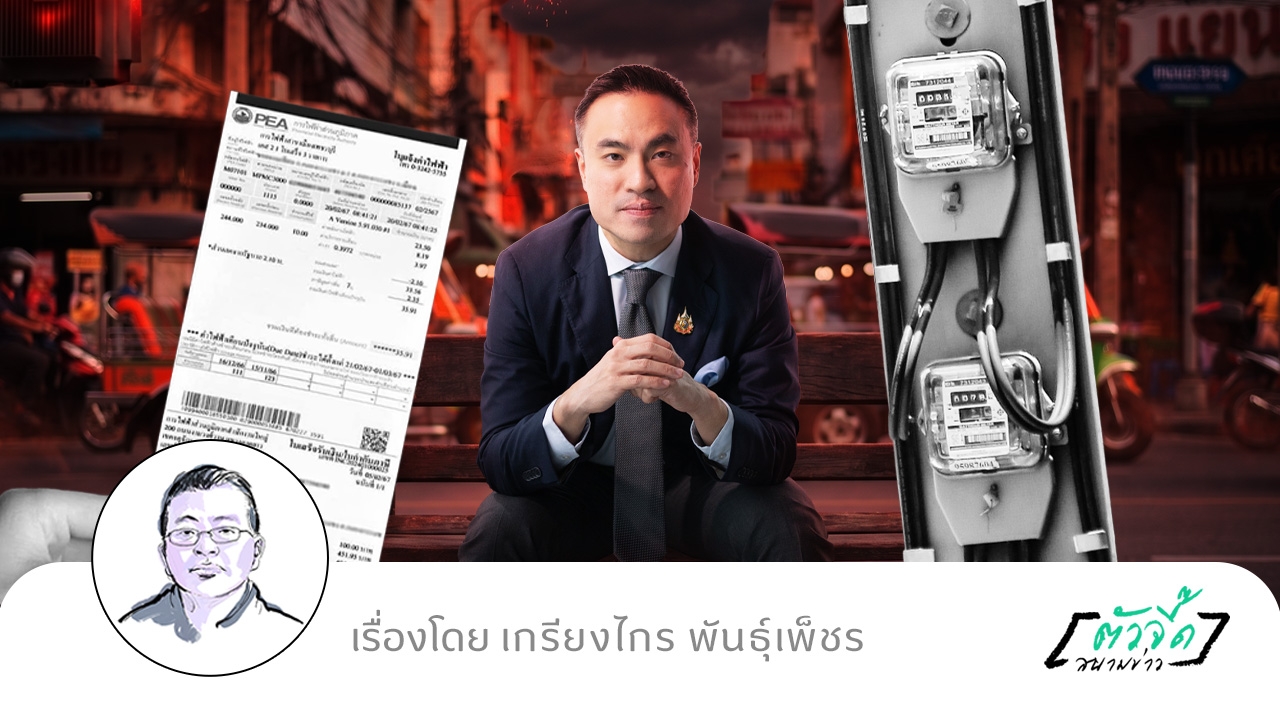
Thailand is facing an energy price crisis due to the U.S.-Iran conflict and geopolitical instability in many regions worldwide, causing volatile and unstable oil and natural gas prices.
It is therefore the government's responsibility Prime Minister and Minister of Interior "Anutin Charnvirakul" to devise measures to address high oil prices, which are the root of problems for the private sector and the public, especially demands to reduce electricity costs so as not to impact living expenses or production costs; if these costs are unsustainable, product prices will rise accordingly.
Importantly, in the recent election, all political parties heavily promoted policies to lower electricity prices to gain votes, making this issue now the responsibility of "Aeknath Promphan, Minister of Energy, and the Energy Regulatory Commission (ERC)."
However, recently the electricity rate for May-August 2026 remains at 3.95 baht per unit, with no measures found to reduce it from the campaign promise of no more than 3 baht per unit.
Previously, the National Energy Policy Council (NEPC) assigned the Ministry of Energy to urgently restructure the overall energy system, especially electricity pricing, aiming to reduce citizens' expenses and solve long-standing structural issues.
A key aspect of the plan is to reorganize electricity rates more fairly, reflecting usage levels that best indicate users' circumstances, by averaging costs from heavy users to subsidize light users. The Metropolitan Electricity Authority (MEA) and the Provincial Electricity Authority (PEA) categorized users into three groups.
The first group includes those using up to 200 units per month, totaling 15.4 million households. This largest group would pay no more than 3 baht per unit, directly easing living costs and being the primary beneficiaries of the price restructuring.
The second group consists of medium users consuming over 200 but no more than 400 units monthly. This group pays 3 baht per unit for the first 200 units, then the normal rate of 3.95 baht for units between 201 and 400. This group numbers 4.6 million households and experiences mixed benefits and drawbacks.
The third group uses more than 400 units per month. They face increased rates, rising from 4.50 baht to over 5 baht per unit, encompassing 3.2 million users.
After this third group protested strongly against the government, arguing the new pricing structure was unfair, Aeknath ultimately withdrew the plan, causing the ERC to delay announcing new rates for May-August, forcing all users to pay 3.95 baht per unit for another period.
With the plan to price the first 200 units at no more than 3 baht by sharing the burden with users consuming over 400 units collapsed, Aeknath returned to reconsider new approaches, affirming the goal to reduce rates for the first 200 units remains.
Going forward, the focus will shift to addressing structural costs in the electricity system through three key measures:
Simultaneously, a new electricity user category specifically for Data Centers will be proposed to the NEPC, reflecting their high consumption and growing investment in Thailand, establishing a pricing structure that reflects true costs without burdening general consumers.
Aeknath summarized that successful implementation of these three measures—reducing Adder costs, lowering availability payments, and reorganizing system costs, plus having Data Centers bear appropriate costs—would allow citizens to pay 3 baht per unit for the first 200 units without raising rates for users over 400 units.
He also noted that highway electricity costs are another urgent issue, as these have been unfairly bundled into citizens' bills and counted as system losses, an incorrect practice.
"Electricity for highways and rural roads must have clear separate accounting to determine actual usage. This issue has persisted for over 10 years, forcing citizens to bear costs exceeding 10 billion baht annually."
Thus, it remains to be seen how this matter will be resolved, whether it will truly ease public burden, and who will ultimately pay for highway electricity.
"Another assistance measure for users consuming up to 200 units is a subsidy. I confirm the plan to propose to the Cabinet to approve using EGAT’s profits—not affecting investment plans—to reserve funds for this subsidy, separate from fuel cost burdens EGAT has already borne."
Reviewing EGAT’s net profits shows 49.6 billion baht in 2024 and 42.3 billion baht in 2025. Of these, EGAT remitted 21.3 billion baht in 2024 and 20 billion baht in 2025 as state revenue.
Remaining profits, after remittance, are allocated to investing in power production and transmission for energy security, reducing government expenses, and EGAT’s operations. Meanwhile, EGAT’s balance sheet records 35.9 billion baht in outstanding automatic fuel cost adjustments (FT) owed by the government due to prior fuel price subsidies.
Therefore, it is uncertain whether the EGAT labor union will agree to use EGAT’s profits to help reduce electricity costs and, if so, how much profit will be allocated to lower rates for users under 200 units per month.
Another debated issue is why Aeknath has not sought to use profits from MEA and PEA to similarly reduce electricity costs across all three utilities.
Energy experts view that while some pricing adjustments occur, this is not an overall energy cost reduction or substantive restructuring; reorganizing electricity bills falls short of meaningful reform.
Shifting cost burdens to EGAT cannot be sustained indefinitely. Meanwhile, the Adder policy for renewable energy purchases at 4–5 baht per unit, intended initially to promote clean energy, has become a costly burden reflected in consumers' bills.
Another ministry plan to ease high electricity costs is promoting solar rooftop installations, allowing citizens to generate their own power and sell surplus at 2.20 baht per unit. This shifts users into producers. However, this option is limited as it requires significant investment, suitable space, and credit access, excluding financially vulnerable groups from participation.
Therefore, solving electricity cost issues requires addressing root causes. Short-term relief policies do not offer sustainable solutions. The government must reform the entire electricity structure, including billing, fuel contract management, and promoting household clean energy.
Although these measures may not address every issue fully, partial implementation could still reduce average electricity costs in the future.
Follow economic and government policy updates with ThairathMoney at
Follow the Thairath Money Facebook page atwww.facebook.com/ThairathMoney