

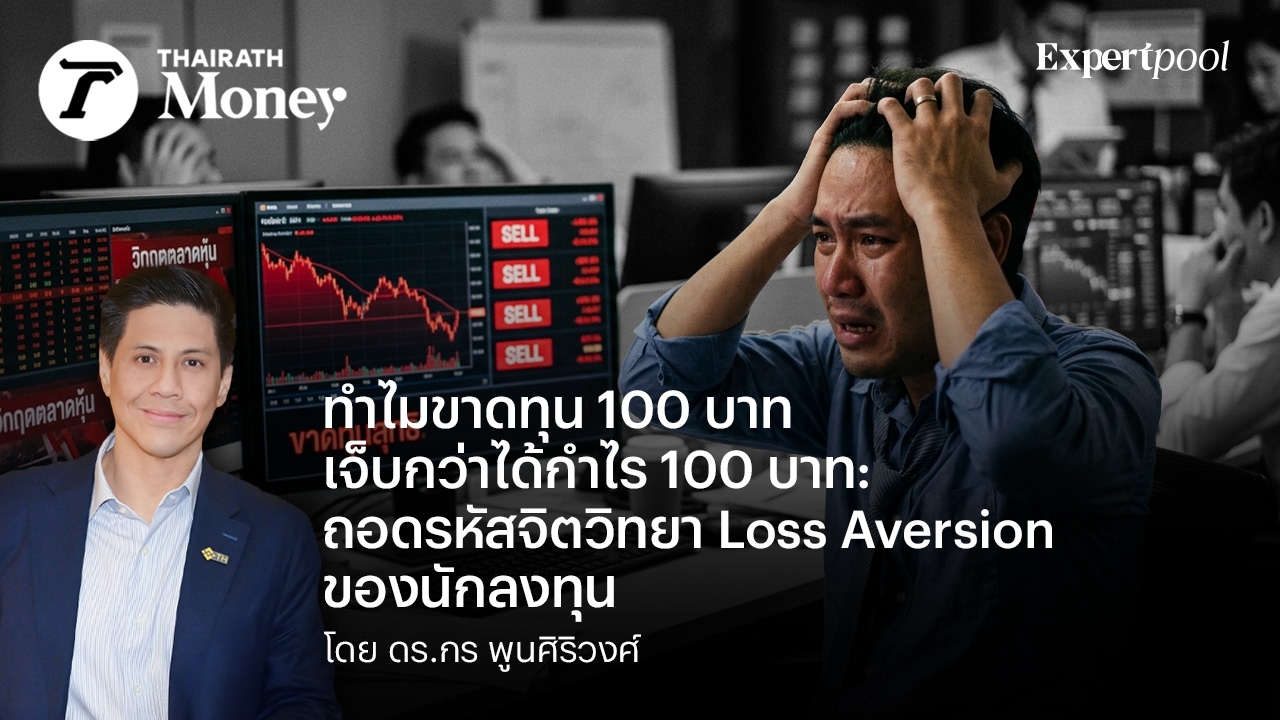
Imagine your investment portfolio gains 1,000 baht today. You might feel happy, satisfied, or smile slightly at this return. But if the next day your portfolio loses 1,000 baht, even though the amount is the same, the feeling is much more intense. The pain of losing money clearly outweighs the joy of gaining the same amount. This is not just a personal trait but a psychological phenomenon behavioral economists call "Loss Aversion" or "fear of loss."
This concept was systematically explained by Daniel Kahneman and Amos Tversky through Prospect Theory in 1979, becoming a cornerstone of behavioral economics. It helps explain why many people do not always make fully rational financial decisions in investing. Loss Aversion is one of the strongest biases because it causes many investors to do the opposite of good investment principles: holding onto losing assets too long and selling winning assets too early.
Behavioral economics research explains that humans feel the pain of losses many times stronger than the pleasure of equivalent gains. Simply put, losing 1,000 baht feels more painful than gaining 1,000 baht feels joyful. Evolutionarily, this makes sense. The human brain is designed to prioritize avoiding danger over seeking rewards because in the past, missing a meal was not fatal, but misjudging threats could mean death.
This mechanism persists today, though the battlefield has shifted from forests to investment screens. When stock prices or asset values in a portfolio turn negative, many brains do not see just financial numbers but interpret it as a "threat" to security, confidence, and the correctness of one's decisions. This explains why many investors feel deep pain at seeing a portfolio in loss, even when rationally knowing market fluctuations are normal. The problem isn’t fear itself, which is natural, but when fear overtakes rational decision-making.
A clear result of Loss Aversion is the “Disposition Effect,” where investors hold losing assets too long because they do not want to admit mistakes. Many comfort themselves by thinking, “If I haven’t sold yet, I haven’t really lost.” But in reality, portfolio value has already declined the moment market prices drop. Not selling only delays recording the loss. What makes this behavior dangerous is the attachment to the “purchase price.” Many investors plan to sell only when prices return to their original cost, although the market doesn't care about our cost basis. Purchase price means something emotionally but nothing to the market.
Mathematically, recovering from deep losses is difficult. If a portfolio drops 50%, an investor must gain 100% to break even—not just 50%, as many think. The deeper the loss, the harder the path back to breakeven. But because humans hate facing the feeling “I was wrong,” they hold onto assets that should be reassessed too long—sometimes months, years, or until better investment opportunities are lost unknowingly. This is where Loss Aversion shifts from a feeling to a real financial cost.
Conversely, when assets start to show profits, many investors sell too soon even if the business fundamentals or growth prospects remain strong. The main reason is the brain’s fear that visible profits might disappear. Unrealized gains are just numbers on a screen, so investors often feel compelled to convert them into real cash before losing that opportunity. This behavior clearly reflects the proverb “a bird in the hand is worth two in the bush.”
Another related bias is “Regret Aversion” or “fear of future regret.” Investors want to avoid situations where they later think, “I should have sold long ago,” so they prefer small certain profits today over potentially larger but uncertain future gains. The result is many do the opposite of the fundamental investment principle: “cut losses quickly and let profits run.” In practice, many sell gains too early and let losses continue to grow. While this may seem minor each time, repeated often it quietly erodes long-term portfolio returns.
Instead, what should be done and practiced is creating decision-making systems in advance: defining reasons to buy, points to reassess, conditions to cut losses, and profit-taking rules before investing. With a clear plan, investors reduce the chance that emotions during volatile markets dominate decisions.
Ultimately, Loss Aversion is not abnormal but a universal human trait. The difference between disciplined investors and others is not the absence of fear but awareness that fear is at work and not letting it override data, reason, and pre-set investment plans. In investing, sometimes the hardest challenge isn’t finding good assets but overcoming oneself when the numbers on screen cause more fear than warranted.
Follow the Facebook page: Thairath Money at this link -https://www.facebook.com/ThairathMoney