

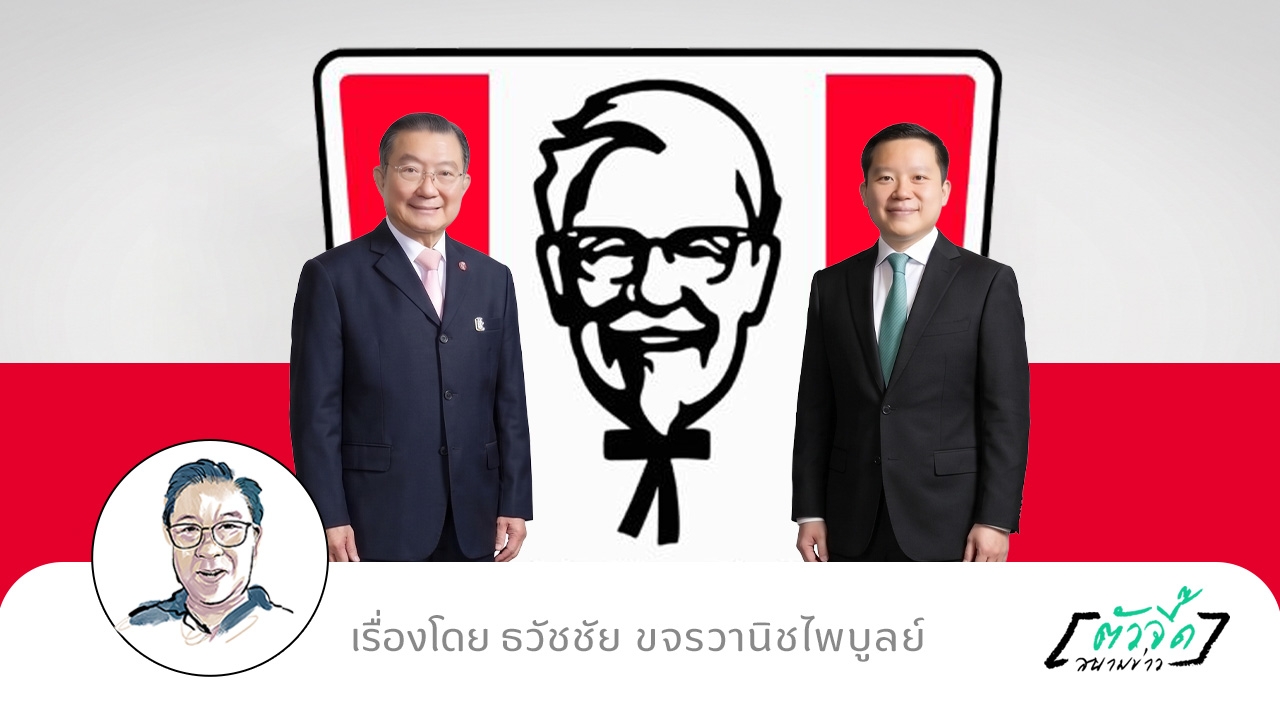
Over the past 30 years, the Thai capital market has been familiar with "Charoen Sirivadhanabhakdi" and ThaiBev consistently in one role: that of the “buyer.” One of the earliest deals many recall was their entry into the hotel business in 1994 by acquiring the New Imperial hotel group.
They then continuously acquired key real estate and major assets, including Sermsuk, Oishi, F&N, Big C, and Sabeco, Vietnam’s beer giant. Every deal followed the same direction: expanding the empire and diversifying risk beyond the original beer and liquor business.
However, when management was passed to “Thapana Sirivadhanabhakdi,” ThaiBev’s strategy shifted from growth through acquisitions to enhancing portfolio efficiency under the PASSION 2030 strategy, aiming for sustainable growth via capital allocation, unlocking asset value, and focusing on businesses that generate the highest long-term returns.
But in mid-July, international news agencies reported a significant shift: the company appointed Bank of America as financial advisor to explore investor interest in acquiring The QSR of Asia Company Limited (QSA), the largest KFC franchise operator in Thailand with over 558 outlets.
This was not mere rumor; in three decades, it has been nearly unprecedented for Charoen Sirivadhanabhakdi and his group to assume the role of “seller” of a large, still-profitable asset like this.
Generally, large companies do not divest profitable assets unless the business is facing problems. But QSA’s numbers contradict that assumption entirely.
Back in 2017, ThaiBev invested around 11.4 billion baht to acquire the management rights for 252 KFC outlets from Yum! Brands, subsequently expanding to 558 outlets, nearly half of all 1,226 KFC locations nationwide.
Reviewing historical performance trends, QSA’s revenue and profits have steadily increased.
Although there was a brief disruption during the COVID-19 pandemic in 2021 with a loss of about 47 million baht, the company quickly recovered and maintained a stable net profit margin around 3.7–3.9% consistently.
The question is, if it is still profitable, why sell? The answer lies in the capital allocation structure.
While ThaiBev’s food business generates healthy cash flow, it accounts for only 6.6% of the group’s total revenue. More importantly, the profit margin of the core beverage segment is 17 times higher than that of the food business.
The same capital, if allocated to the beverage business or used to pay down debt and reduce interest expenses, would yield better returns than holding a quick service restaurant (QSR) business that requires heavy investment to expand outlets and compete fiercely on price. This is the logic behind capital recycling, not selling due to business failure.
The latest QSR market size this year is estimated at 51.5 billion baht, growing 8% compared to 47.7 billion baht last year, which grew 6% over the previous year.
In theory, holding both the beverage portfolio and KFC should create huge synergies since the 558 outlets serve as excellent distribution channels for beverages. But the reality is quite the opposite.
ThaiBev owns the soft drink brand Est Cola (via Sermsuk), but all KFC outlets nationwide serve only PepsiCo beverages.
This is because Yum! Brands has a global contract with PepsiCo that applies to all franchisees. Thus, although ThaiBev has owned KFC for almost nine years, it has never been able to sell Est Cola at its own outlets, except in flagship stores where beer and Oishi green tea are available.
Attempts to leverage the business elsewhere, such as installing draft beer taps or selling coffee and Oishi green tea in flagship outlets, have yielded limited results. Strategically, KFC is a non-core business for ThaiBev: although it remains profitable, it cannot fully synergize with the group’s core beverage business.
If ThaiBev proceeds with the sale, who would be the buyer? Examining major F&B portfolios in Thailand reveals constraints due to competing fried chicken brands, as Yum! carefully limits ownership of competing brands and market concentration.
At the end of 2023, another KFC franchisee, RD, sold 274 outlets to Devyani Group (India) for about 128.9 million USD (approximately 4.5 billion baht), significantly below the original target price of 200 million USD.
The main reason RD accepted a loss at a discounted price was its accumulated losses over five consecutive years (2018–2022) totaling nearly 800 million baht, despite overall growth in Thailand’s fried chicken market. RD’s problem was not market-related.
It was due to cost structure: RD lacked complementary strengths between businesses, unlike ThaiBev, which has real estate assets, or CRG, supported by Central department stores. Rapid expansion from 127 to 274 outlets without owning assets resulted in rent and operating costs eroding profits.
Additionally, RD’s major shareholder was a private equity fund (AIGF Advisors) with a clear exit timeline, making a loss-cutting sale the logical choice, unlike ThaiBev which is selling QSA while operations remain strong.
However, warning signs have emerged as competition in Thailand’s fried chicken and QSR sector intensifies fiercely, with players battling for consumer spending through value offers and heavy price promotions, visibly slowing revenue growth (down to about 3% in 2024 before rebounding to 4.58% in 2025), still below the 8% QSR market growth this year.
Meanwhile, marketing expenses and expansion costs continue unabated. Selling now could unlock asset value while earnings remain robust (expected to exceed 10 billion baht) before profit margins erode further.
From analysts’ perspective, the most likely buyers are regional private equity funds or QSR operators from the Middle East and South Asia seeking to expand in Southeast Asia, similar to Devyani International’s investment approach.
The process is currently exploratory and must undergo strict approval from Yum! Brands.
The clearest signal from this deal is ThaiBev’s major strategic shift towards "divesting non-core assets to regain cash and focus on the beverage business."
If the KFC deal succeeds, it may not only be one of the largest food business sales in Thailand,
but also a key milestone reflecting ThaiBev’s transition from the acquisition-driven empire-building era under Charoen Sirivadhanabhakdi to the capital allocation, asset unlocking, and higher-return investment approach under Thapana Sirivadhanabhakdi’s PASSION 2030 vision.
Follow the Facebook page: Thairath Money at the following link -https://www.facebook.com/ThairathMoney