

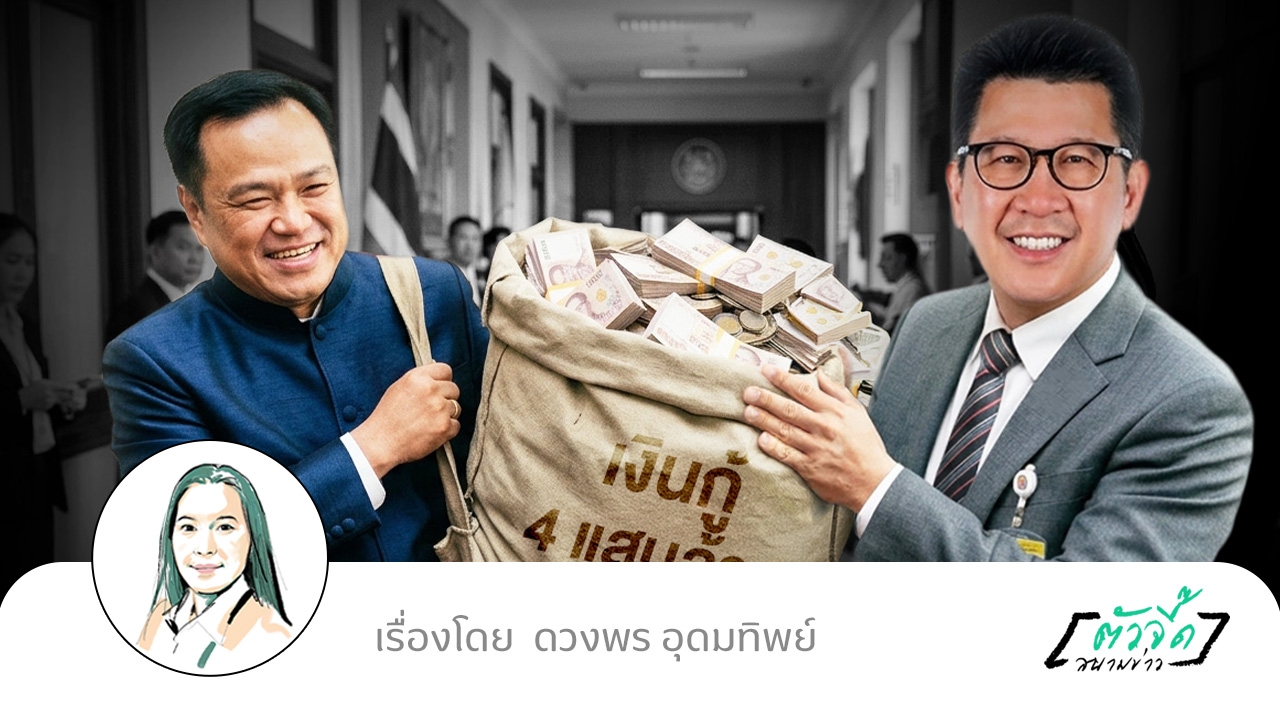
The Royal Decree empowering the Ministry of Finance to borrow 400 billion baht to address the impacts of the energy crisis and support the country's energy transition in 2026, known as the "Loan Decree," has passed the House of Representatives with an overwhelming vote of 285 in favor and 141 against.
This allows the government Prime Minister and Minister of Interior Anutin Charnvirakul and Deputy Prime Minister and Minister of Finance Dr. Aeknithi Nitithanprapas as key economic leaders to confidently state that the 400 billion baht loan process has fully complied with all legal procedures.
Every time the government borrows, it increases the country's public debt. As of 30 June 2026, public debt stood at 66.87% of Thailand's GDP, equivalent to 12.92 trillion baht, while GDP was 19.33 trillion baht.
As the country’s debt rises, citizens are invited to jointly scrutinize and review the details of projects funded by the government’s 400 billion baht loan to determine whether every baht spent is truly worthwhile.
Starting with the first loan tranche of 200 billion baht, the Ministry of Finance, through the Public Debt Management Office, has already borrowed over 140 billion baht to alleviate public hardship via the Thai Chai Thai Plus 60/40 program and topping up state welfare cards with 1,000 baht per person for four months, ending in September 2026.
It is expected that the remaining 30 to 40 billion baht of this tranche may be used to support tourism operators or provide another 1,000 baht per person under Thai Chai Thai Plus 60/40 Phase 2 and continued welfare card top-ups for 2–3 months to stimulate economic circulation from October to December 2026, the final quarter of the year, as the Thai economy has not fully recovered.
The second loan tranche of 200 billion baht will focus on the energy transition. It aims to upgrade the country’s energy infrastructure towards clean energy by subsidizing households to convert their rooftops into solar power plants, reducing electricity bills and household expenses. It also supports government agencies and state enterprises to install solar panels on office rooftops, turning Thailand’s rooftops into large clean energy sources.
With solar power production, the Electricity Generating Authority of Thailand (EGAT), Metropolitan Electricity Authority (MEA), and Provincial Electricity Authority (PEA) must invest in smart grid infrastructure to accommodate excess solar electricity fed back into the system, replacing the current one-way distribution system that only supplies power from plants to homes.
Additionally, the transition of public transport energy from fossil fuel vehicles to electric vehicles (EVs) aims to reduce costs, potentially lowering public transport fares and decreasing vehicle emissions. The Ministry of Transport is urgently preparing to submit this loan usage plan to the Ministry of Finance.
Regarding the overall restructuring of vehicle taxes, the approach is not merely to subsidize EV use as before but to adjust the entire system to restore fairness to longstanding car manufacturers who have invested in Thailand for decades, creating jobs, income, and economic circulation.
Therefore, Dr. Aeknithi has tasked the Excise Department with studying the restructuring of EV taxes, incorporating Free Trade Agreement (FTA) considerations. Although FTAs attract foreign investment to Thailand, they may reduce government revenue and be unfair to existing manufacturers.
Thus, excise tax mechanisms must protect and ensure fairness for domestic car manufacturers. For example, domestically produced vehicles would have lower taxes, while imports would face higher taxes. The exact rates remain undecided, though rumors suggest a maximum ceiling of 30% based on engine power and battery capacity.
Dr. Aeknithi emphasized that concrete results on the loan usage plan for the energy transition will be visible by September, as each agency submits their proposals to the Ministry of Finance. The loan project screening subcommittee, chaired by Permanent Secretary of Finance Lawan Sangsnit, will expedite thorough review.
However, the specific allocation within the energy transition loan—such as subsidies for solar panel installation, public transport transition, and EV tax incentives—remains unclear as agencies are still preparing proposals for the Ministry of Finance. Intense meetings are expected by September to finalize projects.
For more economic and policy news with ThairathMoney to help you achieve “Good Finance, Good Life,” visit
Follow the Facebook page Thairath Money atwww.facebook.com/ThairathMoney