

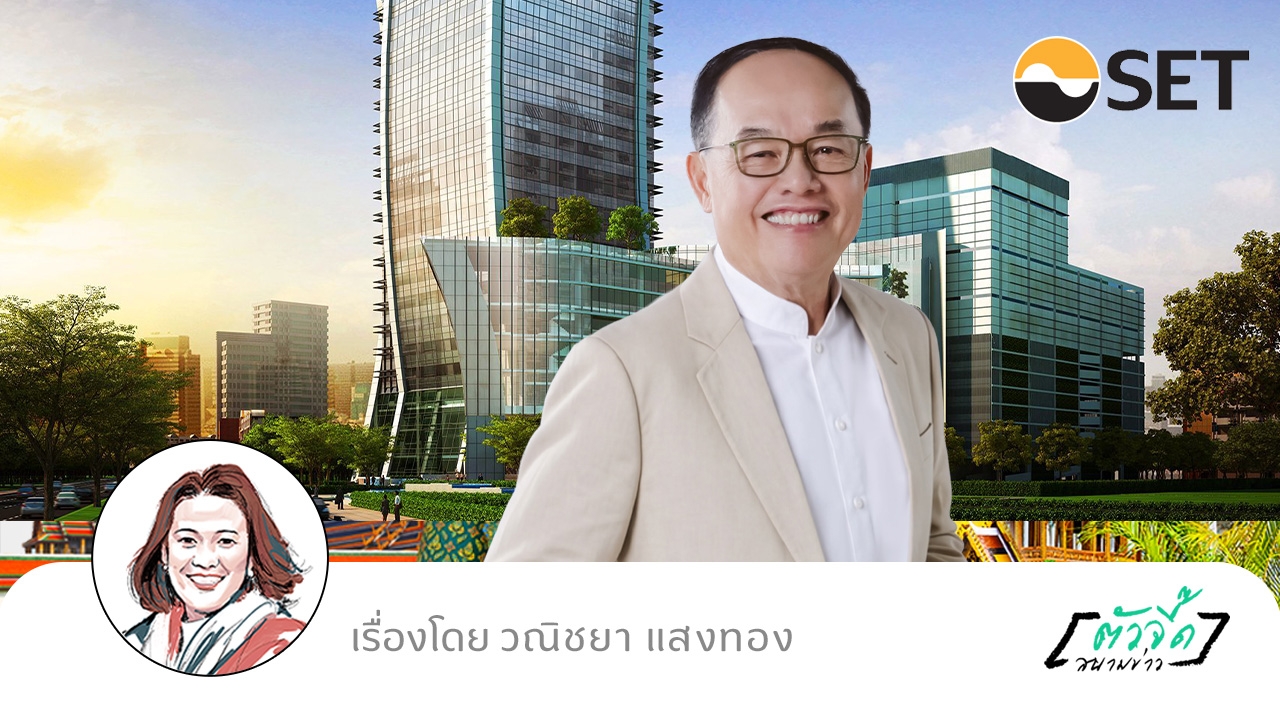
It marks one year since Professor Kitipong Uraveephatthanapong began his second term as Chairman of the Stock Exchange of Thailand. Professor Kitipong Uraveephatthanapong. Since August 2025, the direction for advancing Thailand’s capital market has been structured around three main missions: building trust, creating business opportunities, and ensuring sustainability.
This is encapsulated in the concept of Trusted Gateway – Opportunities – Sustainability, aiming to position Thailand’s capital market as a "gateway of trust and opportunity."
Over the past year, the Stock Exchange has proceeded with revising trading rules, upgrading supervisory systems with technology, opening access for new and small-to-medium-sized businesses to the capital market, while simultaneously establishing ESG and long-term savings frameworks.
The first mission, serving as a fundamental base, is Trusted Gateway — building trust in Thailand’s capital market by updating rules and supervisory systems to better align with market conditions.
Recently, the Stock Exchange has revised various trading-related regulations, including Tick Size, Short Selling, High-Frequency Trading (HFT), and Treasury Stocks, to ensure fairer and more equitable trading.
Additionally, artificial intelligence (AI) technology has been introduced to proactively supervise and monitor trading behaviors, enhancing the efficiency of detecting and closing loopholes for misconduct.
At the same time, collaboration has been strengthened between the Stock Exchange, the Securities and Exchange Commission (SEC), and the Anti-Money Laundering Office (AMLO).
Efforts continue to push for omnibus law amendments through the Ministry of Finance to raise standards of capital market supervision for greater transparency and effectiveness.
Professor Kitipong stated that the Stock Exchange is committed to building a sustainable foundation for Thailand’s capital market through key regulatory reforms and technological upgrades, transforming and strengthening the market for the long term.
The second milestone is Opportunities — expanding access for businesses to the capital market and allowing new business models to become part of Thailand’s capital market ecosystem.
A key approach involves easing restrictions on SMEs and startups through Dual-class share structures and reducing limits on business Spin-offs to broaden fundraising and growth options.
For traditional businesses, the Stock Exchange has advanced the JUMP+ project to enhance company capabilities, while also expanding capital market connectivity to family businesses to enable long-term growth opportunities.
Another significant step is cooperating with the Board of Investment (BOI) to attract New Economy sectors and industries to list on Thailand’s capital market.
At the same time, the establishment of the PE Trust project acts as a mechanism to support business funding.
On the investor and public side, the Stock Exchange promotes long-term saving discipline through the TISA project, positioned as a tool to build long-term financial security.
Professor Kitipong noted that the Stock Exchange continues to expand opportunities for new businesses, attract New Economy and family businesses to grow via the capital market, and promote long-term savings through TISA.
The third mission is Sustainability — integrating sustainability into the capital market’s structural framework.
A major initiative is developing the ESG Data Platform to build ESG data infrastructure and enhancing the rigor of SET ESG Ratings.
Meanwhile, the Stock Exchange established SET SE Co., Ltd. to serve as a mechanism for developing social enterprises through various programs such as CBCE.
Beyond the capital market and business sectors, efforts extend to social assistance in multiple areas, including the Dharma Dhamma project, medical equipment donations, financial literacy and computer skills training for Thai children, and flood relief.
These activities leverage cooperation between the Stock Exchange and listed companies to generate ongoing social benefits.
“The Stock Exchange is committed to integrating ESG sustainability principles as a core business focus, alongside empowering social enterprises to create long-term social impact,” the Chairman said.
Reviewing the achievements over the past year, the Chairman’s mission has spanned market structure levels, including trading rules, supervisory systems, AI technology, regulatory agency collaboration, and opening capital-raising channels for new businesses.
Simultaneously, efforts have extended to attracting the New Economy, SMEs, startups, and family businesses to leverage the capital market.
On another front, sustainability frameworks have been established through the ESG Data Platform, SET ESG Ratings, and SET SE, along with promoting long-term savings via TISA.
Looking ahead, Professor Kitipong continues to aim for regulatory reforms to strengthen Thailand’s capital market and enhance proactive AI use for monitoring and management.
Another key goal is to attract more New Economy businesses to the market and embed ESG principles into listed companies’ operations.
The overarching objective is to create a stronger capital market that encourages long-term saving discipline and links the market’s role to improving Thai people’s quality of life.
From “trust” to “opportunity” and on to “sustainability” are the three core milestones of the Chairman’s mission during his second term, which continues to advance.
Read stock and investment news with Thairath Money to help you achieve "Good Finance, Good Life" athttps://www.thairath.co.th/money/investment
Follow the Facebook page: Thairath Money at this linkhttps://www.facebook.com/ThairathMoney