

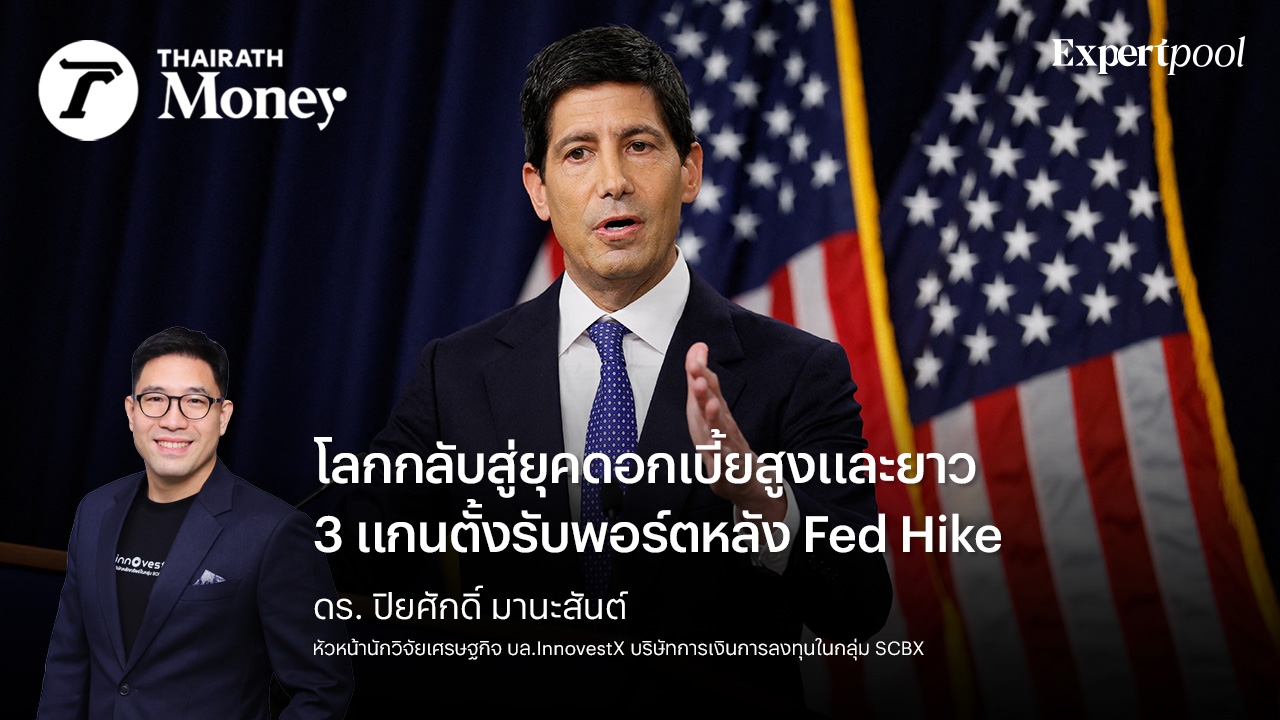
The latest meeting of the U.S. Federal Open Market Committee (FOMC) marked a crucial turning point for global financial markets as the Federal Reserve (Fed) raised interest rates for the first time in over three years, amid persistent inflation and rising oil prices driven by tensions in the Middle East.
This signal indicates that the world may be entering another "Higher for Longer" interest rate era. The key question for investors is no longer whether the Fed will raise rates, but how to structure portfolios moving forward.
The FOMC unanimously voted 12-0 to raise the policy rate by 25 basis points to a range of 3.75–4.00%, marking the first hike since July 2023, citing sustained high inflation alongside a robust economy and labor market.
In the press conference, new Fed Chair Kevin Warsh emphasized that this rate increase is merely a "removal of accommodation," not an economic brake, reaffirming the Fed's commitment to price stability despite political pressures. This stance supports the Fed's credibility and independence.
What surprised markets was the broadly revised economic projections (SEP), with the Fed raising GDP forecasts for 2026–2027 to 2.3% and 2.4%, respectively, increasing the 2026 Core PCE inflation forecast to 3.4%, lowering the unemployment rate to 4.1%, and adjusting the longer-run dot to 3.25% from 3.06%. This reflects the Fed's view of a higher neutral interest rate, resulting in a more hawkish outlook than both the market and InnovestX had anticipated.
The median Dot Plot suggests the Fed is likely to raise rates once more this year to 4.00–4.25%, maintaining that level throughout 2027 before beginning cuts in 2028. Twelve of eighteen governors foresee two hikes this year, while four expect up to three, underscoring a tighter and longer policy path than previously expected.
InnovestX projects three rate hikes total, culminating at 4.38%, including two this year (September and December) and one in early 2027, assuming oil prices at $90 and $80 per barrel this year and next. This is slightly more stringent than the 2027 Dot Plot but less aggressive than the market's expectation of approximately two additional hikes.
A critical directional variable remains the situation in the Middle East and oil prices, which will determine inflation and monetary policy in the near future.
Effects on bond and currency markets are becoming clear, with the 2-year bond yield surging to 4.73%. We have therefore revised year-end forecasts to 4.75% (2-year) and 5.10% (10-year). The yield curve has flattened but remains uninverted. Meanwhile, the dollar has strengthened to around 101.5, pressuring the Thai baht to weaken to 33.8 baht per dollar by year-end, reflecting a Fed-Bank of Thailand interest rate differential of approximately 340 basis points, before modestly recovering to 33.5 in 2027.
History shows that the first rate hike in a cycle often causes short-term pressure. In the past five cycles, the S&P 500 declined by an average of 3.5% in the first month and typically remained negative for three months before rebounding with a median 6% gain at 12 months. Similarly, studies of six cycles since 1988 show average returns of about -2% in the first three months. However, we expect this correction to be somewhat more pronounced than historical averages.
Nonetheless, we do not view this as a fundamental bear market as long as earnings revisions remain broadly positive, since top companies maintain strong fundamentals, especially technology firms benefiting from approximately $800 billion in AI investment estimated for 2026, growing to $1.2 trillion in 2027. The appropriate strategy is to “buy on dips” rather than chase prices, shifting focus from increasing risk to managing risk and diversifying portfolios.
For U.S. equity strategies post-Fed hike, we recommend a portfolio built on three pillars: the energy sector as an inflation hedge due to oil price-driven rate hikes (e.g., XOM, CVX, COP); high-quality technology companies benefiting from AI growth but with strong balance sheets (NVDA, AVGO, MSFT, GOOGL); and quality non-tech sectors to diversify risk, including financials (JPM, GS, MS, BAC, V, MA) and consumer staples (WMT, COST, PG, KO).
Conversely, reduce exposure to growth stocks sensitive to long-term interest rates, including highly leveraged companies and real estate investment trusts (REITs), which are vulnerable to rising bond yields and borrowing costs.
Regarding Thai equities, which face risks of foreign capital outflows and selling pressure in the first 1–3 months, we recommend increasing cash holdings and gradually accumulating positions in three main themes: beneficiaries of rising interest rates and a weaker baht (major banks: BBL, KBANK, KTB; life insurers: TLI, BLA; exporters: TU, ITC); domestically oriented sectors (retail: CPALL, CPN, CRC; healthcare: BDMS, BCH, PR9, CHG); and defensive growth through GRID.
For portfolio allocation, we advise reducing average fixed income duration to 3–5 years to capture yield spreads and maintaining gold allocations as a strategic risk hedge without chasing prices. These recommendations align with our Q4 2026 outlook targeting the Thai stock index at 1,700 points, viewing 1,550 points as a buying opportunity. Featured stocks for the quarter include AMATA, CENTEL, CRC, KTB, and PR9.
In summary, the world is returning to an era of rising interest rates driven by supply-side inflation. In the short term, risky assets will be volatile and the SET index is at risk of correction, but medium-term direction still hinges on earnings growth. Key factors to watch include oil prices (especially if they exceed $100 per barrel), the U.S. 10-year bond yield, earnings revision trends, and the risk of Fed policy error through excessive rate hikes. The recommended strategy remains “buy on dips without chasing prices,” with a defensive and diversified portfolio approach.
We wish investors good luck.
For stock and investment news, visit Thairath Money to help you achieve “Good Finance, Good Life.”https://www.thairath.co.th/money/investment
Follow the Facebook page: Thairath Money at this linkhttps://www.facebook.com/ThairathMoney