

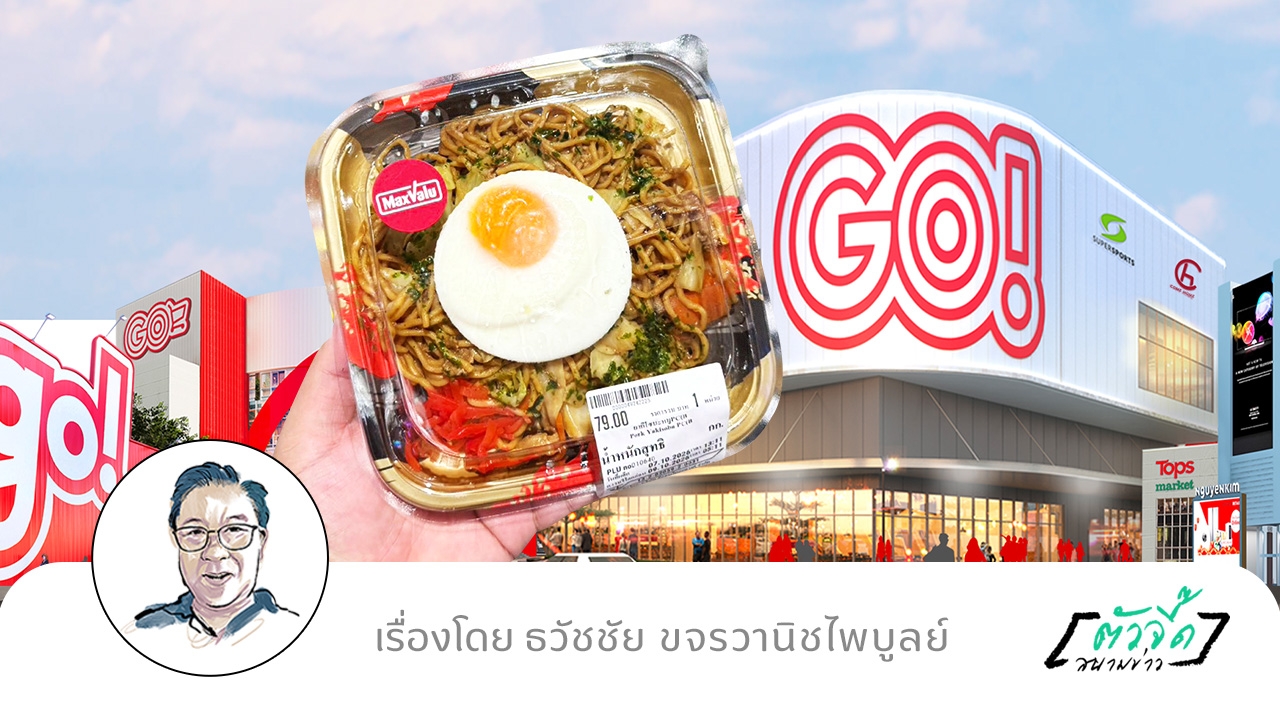
On 30 Sep, AEON's retail withdrawal from Thailand became evident as MaxValu signs at some branches were replaced by Tops. This marks the end of the Japanese retail giant’s supermarket business in Thailand after over 40 years, following the sale of remaining operations to Central Retail (CRC). The move reflects AEON's strategic exit from a market it has long operated in.
The key issue is not just the change of ownership of MaxValu but AEON’s strategic pivot, reducing its role in Thailand while focusing on Vietnam as a crucial growth market for the future.
Historically, AEON entered Thailand through Siam Jusco, starting with a branch on Ratchadapisek Road in 1984, then expanding to locations like Phatthanakan, Sukhaphiban 1, Rattanathibet, Bang Bon, and Laksi.
At that time, Jusco emphasized large supermarkets and community-focused shopping centers, pioneering the Neighborhood Shopping Center model in Thailand as a foreign player.
However, with intensifying competition, the 1997 economic crisis, and changing consumer behavior, Jusco gradually downsized and sold unprofitable branches, rebranding to AEON (Thailand) in 2007 and shifting its supermarket business to the MaxValu brand.
One clear transition was the Jusco Rattanathibet branch, which Central later acquired and developed into Central Rattanathibet before rebranding as Central NorthVille today.
AEON’s latest move followed Central Food Retail, part of Central Retail, purchasing all shares of AEON (Thailand), the operator of MaxValu in Thailand. The deal covers 30 MaxValu and MaxValu Tanjai branches, with CRC planning to convert all to the Tops brand.
MaxValu ceased operations under its original name in Thailand after 30 Sep 2026. From 1 Oct onward, branches will gradually transition to Tops. AEON’s remaining business in Thailand will be limited to financial services and lending.
AEON entered the Vietnamese market in 2014 but expanded slowly in the first decade, with just eight shopping centers and malls. Starting in 2024, investments accelerated markedly, with plans to open five new centers in 2026, the highest since entering Vietnam, expanding into new areas like Haiphong, Thanh Hoa, and Quang Ninh.
Besides large malls, AEON is rapidly growing its supermarket business, aiming to increase MaxValu outlets from about 60 to 300 to better reach daily consumers. By 2030, AEON targets tripling revenue and quadrupling profits in Vietnam.
These goals align with the group’s mid-term business plan, positioning Vietnam as a key strategic market, aiming for operating revenue exceeding 300 billion yen (approx. $1.9 billion) by March 2031—a 2.5-fold increase from FY2026 estimates—with about 60% of Southeast Asia investments allocated to Vietnam.
As of Feb 2026, AEON operates 302 outlets in Vietnam, including shopping centers, supermarkets, and Ministop convenience stores.
AEON’s plan extends beyond branch growth to building integrated business systems from products to customer base. The company aims to increase private label products from about 6% to 20%, and boost purchases from Vietnamese suppliers for domestic and export markets, including Japan.
Regarding the Waon membership base, Vietnam has about 4 million members, targeting 20 million by FY2030, with plans to expand financial services by 2027.
Focusing on Vietnam does not mean AEON lacks strong markets elsewhere in ASEAN. The company’s experience across markets shows that retail opportunities and success models vary by country.
In Malaysia, AEON has a strong retail base, reporting revenues of approximately 3.77 billion ringgit in 2025. Market share data indicates AEON increased supermarket share from 23% in 2024 to 28% in 2025.
In Cambodia, AEON built its business through three shopping centers in Phnom Penh and steadily expanded MaxValu stores, demonstrating its ability to develop retail in diverse ASEAN markets.
While AEON accelerates in Vietnam, Thailand’s Central Retail (CRC) is also continuously expanding its business in the same market.
CRC has invested in Vietnam since 2012 and now has over 300 retail outlets across 26 provinces, with accumulated investments exceeding 49 billion baht.
The company announced plans to invest an additional $1.5 billion over 3–5 years, targeting expansion into secondary cities and growth areas. CRC’s management reported scouting about 200 potential locations nationwide but will carefully select sites matching business models and project viability.
Currently, GO! Hypermarket is a key CRC brand with over 40 branches in 26 provinces. CRC is also developing other store formats like mini go!, alongside non-food and lifestyle products. CRC executives noted that modern trade in Vietnam accounts for only 13%, with traditional retail or small shops making up the rest, compared to 50% modern trade in Thailand.
Interestingly, CRC shares AEON’s growth approach by building consumer bases and local business networks simultaneously. The company reports over 7.4 million The 1 Vietnam members within less than a year, with more than 90% of products sourced locally and connections to over 2,000 local suppliers.
Meanwhile, the Central Group also pursues other opportunities in Vietnam. Central Pattana (CPN) plans to invest $2 billion over 10–15 years to expand real estate business and develop various projects, while Centara already has hotel operations in the market.
This shows Thai investment in Vietnam extends beyond retail to shopping centers, real estate, hotels, and other services.
AEON and Central are both expanding in Vietnam but with different strengths and investment models. AEON focuses on Japanese retail networks and integrated business systems, while Central Group is leveraging its retail base toward real estate and services.
Comparing business sizes by revenue, AEON Group Japan's operating revenue is about 2.35–2.46 trillion baht, while Thailand’s Central Group reports over 520 billion baht in total sales—a difference of approximately 4.5 to 4.7 times.
Although revenue scopes differ, this highlights the scale of Japanese retail capital expanding in Vietnam, where Central Group is also heavily investing.
Besides Central Group, BJC under ThaiCC Group is expanding in Vietnam by acquiring MM Mega Market Vietnam from German investors to develop wholesale and distribution business.
BJC plans to grow the network to 54 branches and bring back the Big C brand to Vietnam next year, reflecting Thai capital's increasing focus on the Vietnamese retail market.
However, the competition isn’t only Japanese and Thai capital. South Korea’s Lotte Mart is also increasing investments, while local operators like WinCommerce, running WinMart and WinMart+, have extensive networks and target secondary cities and communities.
Competition depends not just on investment size or branch numbers but on the ability to select locations, reach local consumers, source products fitting purchasing power, and build strong supplier networks.
Although foreign players have capital, technology, and experience, local operators hold advantages in consumer understanding and local networks. This makes Vietnam a high-growth market and a competitive arena requiring adaptability from all players.
Vietnam has over 100 million people, continuous economic growth, and a modern retail market with room to expand, recently showing double-digit growth rates. These factors attract foreign retail capital.
However, business opportunities do not guarantee automatic success. Investments face challenges including complex regulations, land access, and high land costs.
CRC data indicates that although the government tries to simplify procedures, some regulations remain ambiguous, requiring investors to carefully understand requirements to proceed.
Another key challenge is accessing land and high prices, especially for large projects needing significant capital. Land costs not aligned with area potential may affect returns and project viability.
This is critical for retail, where location choice affects costs, customer reach, and sales opportunities. Expanding many branches demands careful site selection and cost management.
Both AEON and Central face these challenges despite their capital and experience from other markets.
What remains to be seen is how companies will convert market opportunities into actual growth in earnings.
AEON’s supermarket exit from Thailand comes as the Thai economy faces growth concerns, while Vietnam emerges as a target market for foreign retail capital due to expanding purchasing power and ample modern retail growth potential.
The term “Sick Man of Asia” used by some foreign media for Thailand’s economy raises questions about whether Thailand still attracts enough investment and can sustain long-term growth. AEON’s decision reflects multinational capital’s readiness to redirect investments when growth prospects lie elsewhere.
Meanwhile, CRC pursues a dual approach in Thailand and Vietnam. Taking over MaxValu supports its domestic retail base, while Vietnam has been a market since 2012, with over 300 shopping centers and stores developed.
CRC is not a newcomer but a Thai capital expanding a steadily built business amid competition from Japanese, Korean, and local operators.
CRC exemplifies a 'Local Hero'—a major retail player growing from its home market to compete with multinationals in Thailand. Yet, abroad, home-market advantages do not guarantee success.
CRC’s challenge is not just maintaining its Thai base or increasing Vietnam outlets but leveraging market insight, network strength, and adaptability to achieve sustainable regional growth.
From local hero to regional player, this is Central Group’s next step. AEON’s case raises a vital question for Thailand: as capital gains more options, what new opportunities and incentives will keep businesses investing here?
It’s not just about preserving existing businesses but ensuring Thailand remains a market where investors see future growth.
Read economic and policy news with Thairath Money for your “Better Finance, Better Life” athttps://www.thairath.co.th/money/economics/thai_economics
Follow the Thairath Money Facebook page at the link https://www.facebook.com/ThairathMoney