

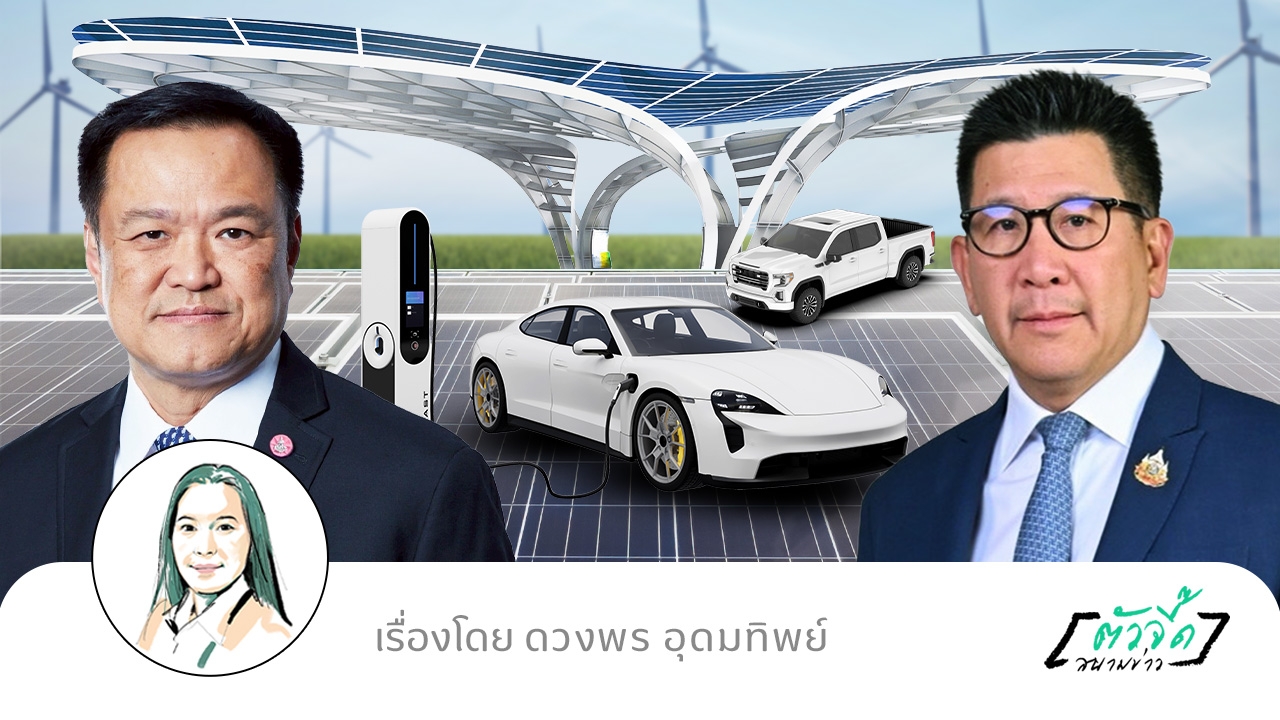
Currently, the government led by Anutin Charnvirakul, Prime Minister and Minister of Interior, and Akanit Nitithanprapas, Deputy Prime Minister and Minister of Finance, the economic strategist duo, is "laying the groundwork" for the country's energy transition policy toward clean energy, aiming to achieve multiple benefits with a single initiative.
These include energy savings, reducing government expenses by lessening energy imports, lowering electricity and fuel costs for citizens, combating global warming, and reducing carbon dioxide emissions. The Ministry of Finance has already calculated that this is "cost-effective" in the long run.
This energy transition must be executed following the objectives of the Emergency Decree empowering the Ministry of Finance to borrow funds to address the impacts of the energy crisis and to drive the country's energy transition, B.E. 2569 (2026), with a budget of 200 billion baht, which must be urgently used by December 2027, borrowing only as needed without accumulating unused funds.
The initiatives begin with the People's Solar Project, an old-for-new vehicle exchange program for electric pickup trucks and motorcycles, reduction of excise tax on diesel B20 and gasoline E20 fuels, and restructuring excise tax on EV-REEV vehicles to 35%.
The plan is to transform the rooftops of 1 million households into solar power plants, using 50 billion baht from the loan, or 50,000 baht per household. Citizens can install panels on their roofs, vacant land, or water bodies like ponds or reservoirs but must first register with the Metropolitan Electricity Authority (MEA) and the Provincial Electricity Authority (PEA) to receive priority rights.
Then, the selection of contractors will proceed only from those approved by MEA and PEA. Once selected, contractors will survey the site to confirm readiness for installation, especially checking if the roof is strong enough to support the solar panels' weight.
If all 1 million households install 5 kilowatts each, Thailand will have 5,000 megawatts of solar power plants, reducing natural gas imports and saving citizens 25 billion baht annually.
For those installing solar panels, it is emphasized that a monthly electricity bill of at least 3,000 baht is necessary for it to be worthwhile, with household members using electricity during the day.
If electricity use is below 3,000 baht per month, it is not recommended even if excess power is sold back to the state, because although the government grants 50,000 baht, the remaining 140,000 baht is citizens' own money. If they do not have the money, they must take a loan, which means incurring "debt."
The advice is that citizens considering installation should thoroughly study the information before making a decision.
The Excise Department proposes a program exchanging old vehicles for new diesel pickup trucks running on B20 or E20 fuels, and old motorcycles for electric motorcycles (EVs), using a loan budget of about 10 to 20 billion baht. The subsidy is 40,000 baht per new vehicle, with the EV motorcycle subsidy varying by vehicle size.
This measure aims to stimulate the sluggish pickup truck market, which has suffered due to financial institutions withholding loans. Switching to new vehicles using B20 and E20 fuels helps reduce environmental pollution, crude oil imports, and citizens' expenses, as these fuels are 9 to 10 baht cheaper per liter than regular fuels.
Additionally, it will raise prices of agricultural products such as sugarcane, palm oil, and cassava, benefiting Thai farmers.
However, conditions for exchanging old vehicles are not yet fully finalized. Besides the old vehicle being manufactured before 2012, it must not be scrap, still functional, have paid taxes fully, and not have any liens. After exchange, the old vehicle will be immediately scrapped.
This measure is awaiting approval by the loan expenditure screening committee and then the Cabinet, expected to be proposed before the end of this year to invigorate the automotive market.
The government will reduce fuel taxes to ease citizens' expenses. Diesel B20 and gasoline E20 prices will immediately drop by 5 to 6 baht, making the pump price difference nearly 10 baht per liter, as prices previously differed by 3 to 5 baht per liter.
Since the government wants to encourage more drivers to use B20 and E20, this not only saves money but also reduces crude oil imports, raising prices of agricultural products such as sugarcane, cassava, and palm oil. This is considered hitting multiple targets with one action.
Although the government will lose 15 billion baht in revenue over three months (28 Oct 2026 - 27 Jan 2027), it claims the move is "worth it." Whether the benefits multiply remains to be seen.
The excise tax on electric vehicles and range-extended electric vehicles (EV-REEV) will be adjusted from 10% to 35%. The government explains this is not favoring any particular automaker but aims to create fairness in the automotive industry, attract new manufacturers to invest, and encourage existing ones to expand in Thailand, sustaining the country's status as the regional automotive production hub, known as the 'Detroit of Asia.'
"The excise tax restructuring has been carried out step-by-step to promote and support Thailand's shift to electric vehicles and the establishment of vehicle manufacturing plants in Thailand through EV3.0 and EV3.5 measures, which have been successful," said Lawan Saengsanit, Permanent Secretary of the Ministry of Finance, repeatedly emphasizing this point.
"Currently, electric vehicle usage in Thailand is steadily increasing, and eight vehicle factories have been established. Raising the tax on imported vehicles is expected to encourage the ninth and tenth plants to be set up in Thailand soon."
Next, the Excise Department will define the proportion of locally produced parts to support Thai manufacturers, possibly establishing four tiered tax rates: starting at 2% for vehicles with battery plants in Thailand,
15% for vehicles with a certain number of parts produced locally, 25% for those with more local parts, and 35% for fully imported vehicles. Automakers will be given approximately three years to prepare, plan investments, and get ready.
Who will benefit or lose? The process will be transparent, cost-effective, and free of conflicts of interest. Close monitoring and scrutiny are necessary.
For economic news and government policies, visit ThairathMoney to help you "manage your finances for a better life."
Follow the Facebook page Thairath Money at the linkwww.facebook.com/ThairathMoney