

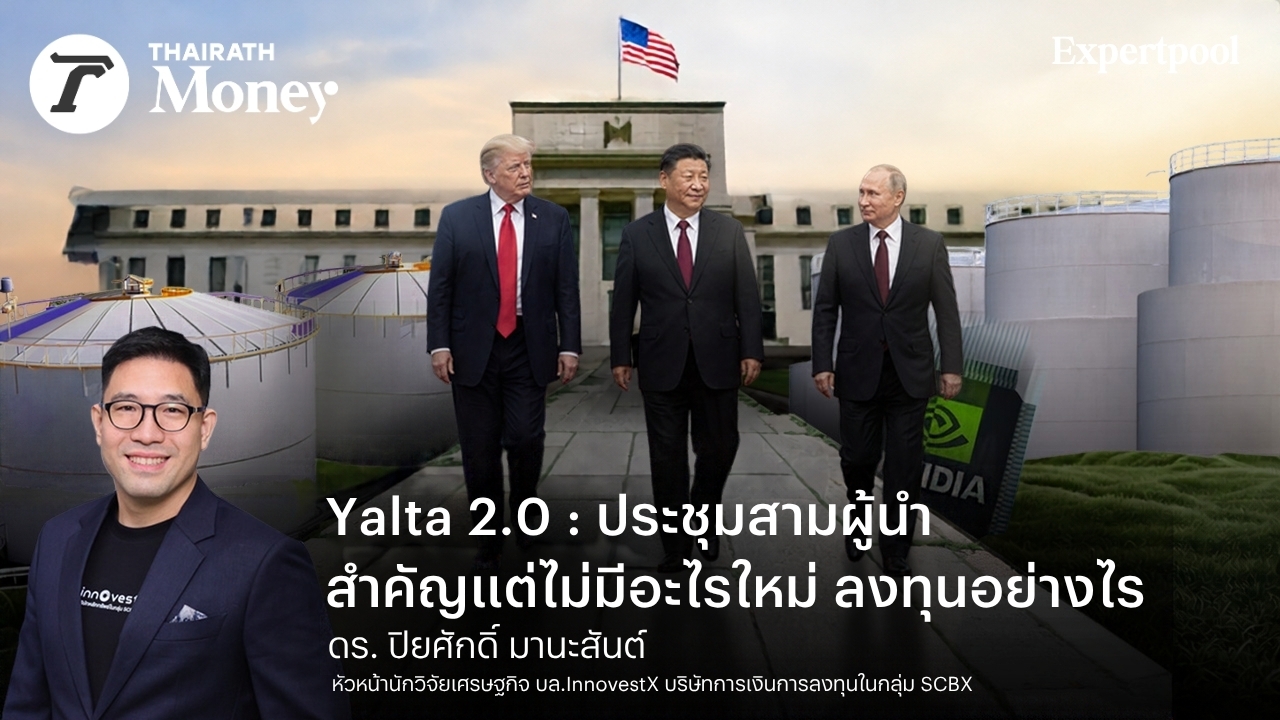
In a previous article, the author assessed that the APEC meeting on 18–19 Nov could be a turning point if the trilateral meeting between Trump, Putin, and Xi Jinping progressed toward a ceasefire. The author refers to this event as "Yalta 2.0." However, the outcome was no ceasefire agreements in Ukraine or Iran, and no easing of chip export restrictions.
Meanwhile, the global financial market has clearly entered a risk-averse (Risk-off) phase as we anticipated. Nonetheless, the author sees this as one of the best times to gradually accumulate assets, summarized in four key points.
In February 1945, Roosevelt, Churchill, and Stalin met in Yalta on the Crimean Peninsula to shape the post-World War II order. In 2026, the three great powers met again, but none were ready to reorganize the world. The only tangible results were an agreement to increase refined oil supply without specifying amount or timeframe and a pact to discuss reducing nuclear weapon risks after the New START treaty expired in February 2026. Xi Jinping proposed establishing a crisis communication mechanism. Notably, Yalta is located in Crimea, the current center of the Ukraine conflict unresolved by the three leaders.
Although concrete outcomes were limited, the value of Yalta 2.0 lies in serving as a "guardrail." As long as the great powers continue talks, the chance of miscalculating each other's intentions decreases. Without meetings this year, amid unresolved Taiwan, Strait of Hormuz, and tech war issues, geopolitical risk premiums would rise.
Nvidia reported Q3 revenue of $116 billion, a 103% increase, yet its share price continued to fall, pushing the Nasdaq 100 more than 13% below its October peak. Anthropic raised $81 billion in the largest IPO in history, closing the first day 17% above the offering price, but this failed to support the overall market.
Pressure came from AI stock sell-offs, U.S. chip control measures, and the Fed’s hawkish stance, which priced in about a 95% chance of a rate hike in December. The 10-year U.S. Treasury yield stayed above 5%, the VIX index surged to 28, and no safe-haven asset performed well. Gold slipped below $3,700 per ounce, its lowest in 14 months, while Bitcoin dropped to around $62,000.
Thailand’s stock market declined less than regional peers due to a smaller tech sector weight, but the economy shows K-shaped growth. GDP in 3Q26 grew 2.9%, below expectations. Private investment expanded 16.2%, the highest in 55 quarters, but foreign tourists declined for the sixth straight quarter. A new risk arises from U.S. rules requiring export licenses for advanced chips to Thailand and four other countries, directly impacting Data Center investments. InnovestX forecasts Thai GDP slowing to 1.5% in 1Q27 before gradually recovering. The concluded key points of the U.S.-Thailand Agreement on Reciprocal Trade (ART) reduce some tax uncertainty.
The first condition is the peak of interest rate hikes. InnovestX expects the Fed to raise rates by 25bps in December and another 25bps in 1Q27 before stopping, with the 10-year Treasury yield at 4.6% by end-2027.
The second condition is the war calming down. The negotiation channel opened at Yalta 2.0 could lead to a ceasefire.
The third condition is a decline in oil prices. Brent crude has fallen to about $92 per barrel, and the IEA estimates the oil market will enter an oversupply from 4Q26 through 2027.
If all three conditions occur together, which we see as possible from Q2 2027, capital will return to a Risk-on mode again, and the assets gradually accumulated will start to generate returns.
InnovestX recommends gradually accumulating assets rather than investing a lump sum, as the market may remain volatile until the Fed stops raising rates. Historical data shows a median correction of 11.2% for a 10–15% S&P 500 pullback, indicating a possible further 5% downside risk for the U.S. market.
In the short term, defensive holdings should include stocks with domestic revenue streams such as healthcare (BDMS, BCH), retail (CPALL, CPAXT), communications (TRUE), and tourism entering peak season (AOT, ERW, MINT, CENTEL), as well as stocks benefiting from year-end tax incentive funds (BBL, KTB, KKP, HMPRO, PTT).
For bonds, yields above 5% present an opportunity to lock in income in short- to medium-term bonds and gradually extend duration as the Fed nears the end of its rate hikes.
For accumulation in anticipation of a Risk-on cycle, gradually buy quality stocks sold below fair value, including electronics (DELTA, HANA, KCE), industrial estates (WHA, AMATA), and renewable energy (GULF, GPSC, GUNKUL).
Internationally, accumulate U.S. and Japanese stocks on market dips, favor Indian stocks as a relative safe haven in emerging markets, and Chinese stocks dependent on domestic technology such as SMIC. Avoid AI stocks reliant on debt, high-yield Thai bonds, and finance sector stocks (MTC, SAWAD, TIDLOR).
Yalta in 1945 shaped the world for decades, but Yalta 2.0 offers no clear answers yet. It signals that the world is not ready to improve immediately but also not ready to deteriorate further. The market tends to reward disciplined buyers who invest when others fear, emphasizing steady accumulation rather than emotional buying.
Wishing investors good luck.
Read economic and policy news with ThairathMoney to help you achieve "Better Finance, Better Life."
Follow the Facebook page: Thairath Money at this link https://www.facebook.com/ThairathMoney