

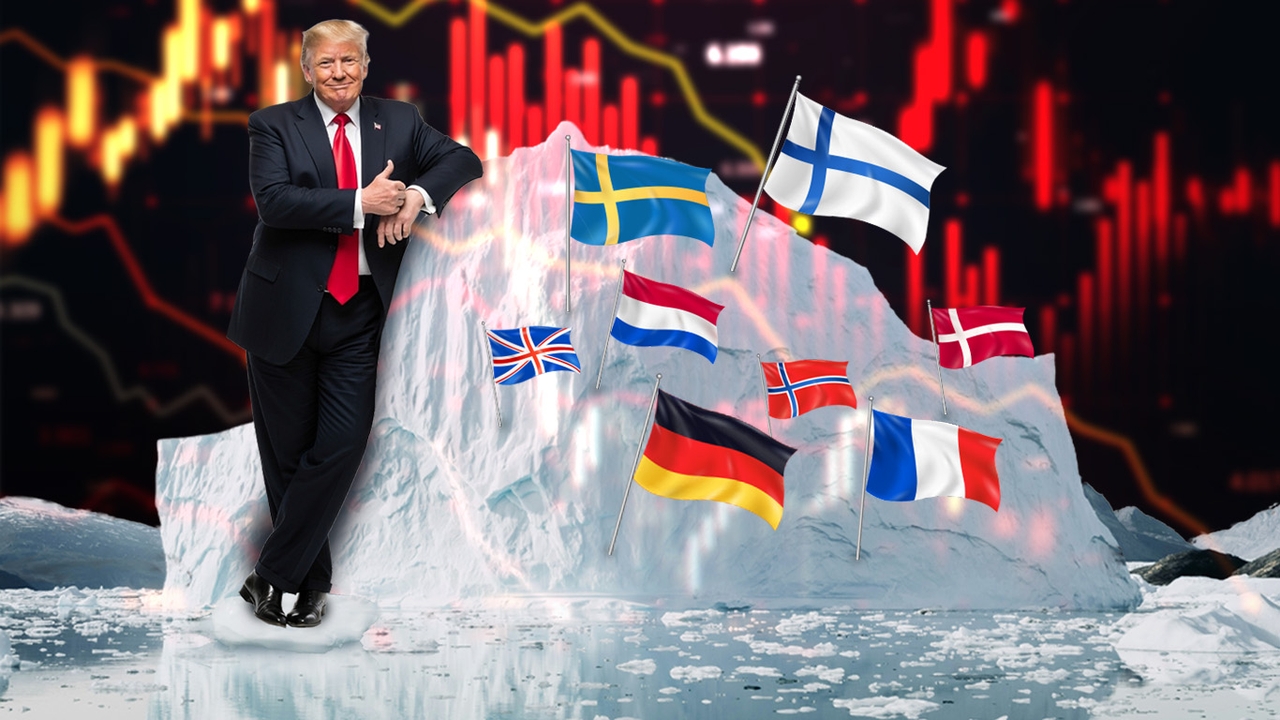
Who would have believed that Donald Trump's desire to own Greenland would become the single spark igniting a new trade war between the U.S. and Europe, turning into a full blaze?
This has caused global investment sentiment to tense up once again this morning, with stock markets in both the West and Asia all dropping sharply, reflecting concerns over the conflict after Trump threatened to impose tariffs on European imports in exchange for Greenland.
However, several analysts are signaling that Asian markets, including Thailand, may be shifting roles to become a new "safe haven," as investment funds are likely to move out of conflict zones toward lower-risk markets. This could be a key moment where the "world crisis" turns into a "golden investment opportunity."
The main cause of today's global market sell-off stems from escalating tensions between the U.S. and Europe, sparked by President Donald Trump's demand to buy Greenland. If the demand is not met, he threatens to use tariffs as leverage.
The U.S. threatens to impose a 10% import tariff starting 1 Feb 2026 on goods from eight European countries—Denmark, Norway, Sweden, France, Germany, the United Kingdom, the Netherlands, and Finland—and to raise it to 25% in June if the Greenland deal stalls.
Meanwhile, the European Union is preparing retaliatory measures, including tariffs on U.S. goods worth over 93 billion euros, and may use other tools to counter economic coercion.
Analysts believe this situation could make it harder to reduce U.S. inflation since imports from the EU account for 20.2%, and it puts pressure on the U.S. 10-year bond yield, which has surged to a four-month high.
As of 09:34 this morning, major Asian and European stock markets have noticeably dropped, reflecting investor concerns, such as:
Despite these frightening external factors, analysts see Thai stocks as likely to outperform or be less affected than developed markets.
Asia Plus Securities research team. They state that Thailand stands to benefit from this trade crisis if U.S. and Europe escalate their conflict, with opportunities arising from "trade diversion" in two main areas.
1. Exports: Thailand can replace goods that the U.S. and EU stop trading with each other, especially industrial products like electronic components, automotive parts, and processed foods.
2. Investment: Thailand has the chance to attract foreign direct investment (FDI) as a neutral production base with lower costs.
Trade data shows that the U.S. and EU combined account for 20.5% of Thailand's trade (over 130 billion dollars), which is even more than China, Thailand’s top trading partner.
Therefore, they recommend standout stocks to capture global trends and Q4/2025 earnings amid volatile external factors, as funds may flow into Asian markets, including Thailand, which carry less uncertainty.
For investment strategy, the research team recommends stocks in the following beneficiary groups.
They forecast that listed companies’ Q4/2025 profits will grow up to 99% from a low base last year, supporting continued foreign investor inflows.
Meanwhile, Dao Securities analysts assess that this conflict is negative for global markets this morning and that investors are closely watching how the U.S. will resolve the Greenland issue. If it ends without military action or amicably, market concerns could ease, similar to the improved situation with Iran.
Despite worries over Greenland, the Thai stock index still has a chance to retest a key level at 1,281 points, as buying is not concentrated only in DELTA or banking stocks but spread across other groups, increasing the likelihood of a stronger rise than before.
This week, attention remains on both laggard plays and stocks driven by strong earnings prospects, including:
Read stock news and investment updates at Thairath Money.
Follow the Facebook page: Thairath Money at this link.