

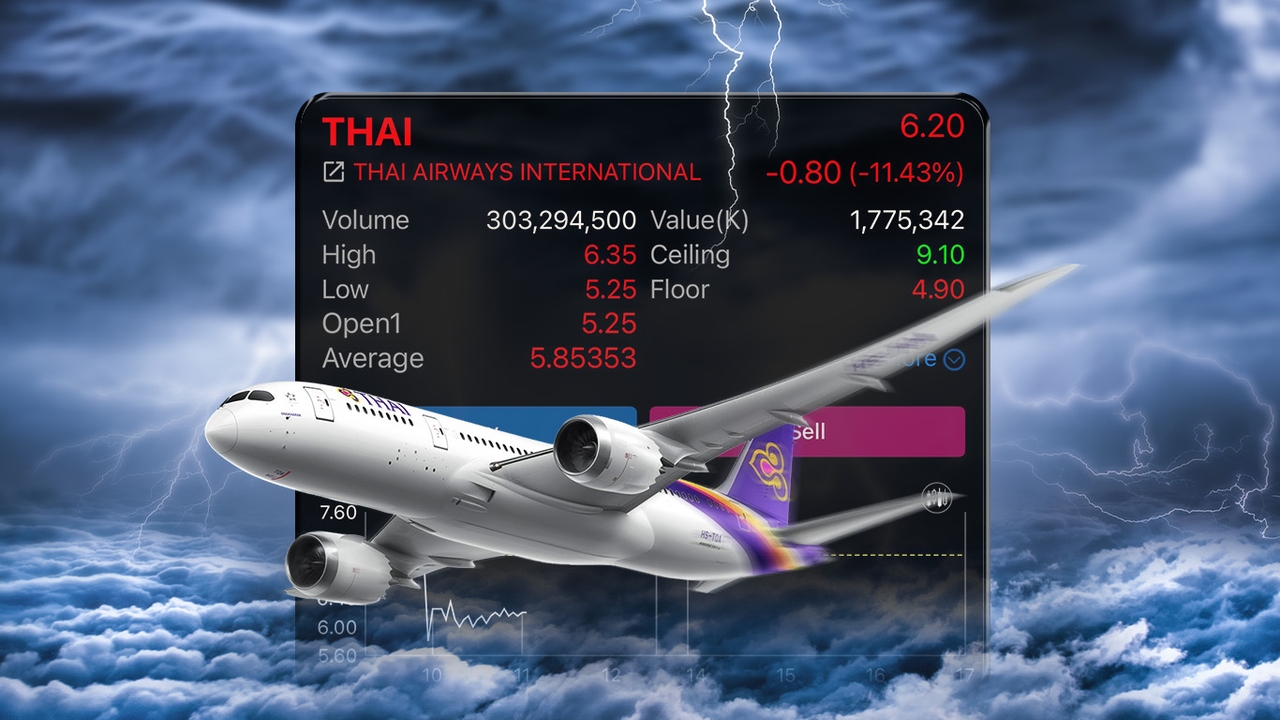
Investment atmosphere surrounding shares Thai Airways International Public Company Limited, or THAI Today became a hot topic closely watched by investors after the first day marking the end of the Silent Period restriction on selling shares for the "creditors."
This means a massive amount of shares—over 6.6 billion shares, representing 25% of shares from debt-to-equity conversion and capital increase from existing shareholders—can now be sold on the market.
At market open, heavy selling pressure caused THAI shares to plunge temporarily to 5.25 baht per share before buying interest began supporting the price. As of 11:05 a.m., the price recovered to 6.20 baht, still down 0.80 baht (-11.43%) from the previous close, with heavy trading volume exceeding 1.77 billion baht.
However, this may not be the end of selling pressure because besides this initial lot in February, the market must prepare for a second wave as over 19 billion more THAI shares are set to unlock from Silent Period and become sellable in August 2026—an important factor investors must plan for.
To understand the full picture, one must look back at the business rehabilitation exit process, whose key element was "debt-to-equity conversion" to restore shareholders' equity to positive levels, as required by the Stock Exchange.
In this process, major financial institutional creditors—including Bangkok Bank, Krungthai Bank, Government Savings Bank, Export-Import Bank of Thailand, and various savings cooperatives—converted their status from "creditors" to "major shareholders" of Thai Airways.
Currently, the top 10 major shareholders are:
To stabilize share prices during the initial trading period, the Stock Exchange imposed a Silent Period rule preventing creditors and existing shareholders who received low-priced allocated shares from selling all their shares simultaneously, stipulating that:
Therefore, today's event is a phenomenon where some creditors sell to realize profits or adjust their portfolios after holding shares for one year as per the rule, causing a large volume of shares to flow into the market.
A securities analyst from Yuanta Securities (Thailand) told Thairath Money that the sharp morning price drop was driven by selling from some creditors and existing shareholders, but the rebound from 5.25 baht back above 6 baht indicates that the valuation level at that price began to attract investors.
An interesting positive point is "dividends." If Thai Airways can declare dividends as the market expects, the lower share price will significantly increase dividend yield, attracting investment inflows to accumulate shares.
However, the analyst warned to be cautious about further impacts because this round unlocks only 25%, with another 75% set to enter in August.
Meanwhile, if Thai Airways can achieve strong financial results and progress on projects per its operational plan—such as expanding aircraft maintenance centers or clarifying wide-body aircraft procurement to meet tourism demand—these will be positive factors boosting confidence, slowing selling pressure, and limiting downside risks to share price.
Furthermore, the situation is viewed as merely "short-term volatility." Therefore, for risk-tolerant investors, gradual accumulation during price dips is recommended to seek dividend returns. For those with low risk tolerance, it is advised to wait for selling pressure to ease or for price stabilization signals before considering investment.
Read more stock and investment news with Thairath Money at
Follow the Facebook page: Thairath Money at this link