

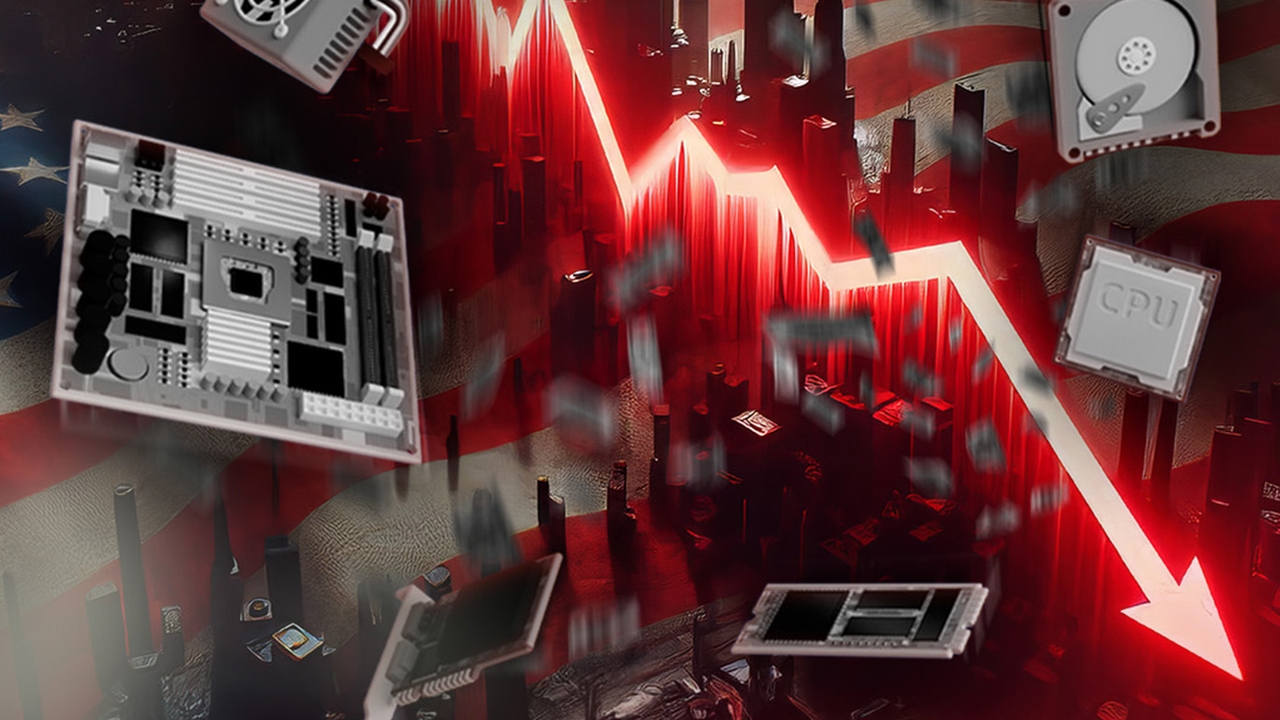
Recently, the US stock market has faced a major test as technology stocks clearly show signs of "losing steam," even though many companies' overall earnings remain robust.
It appears investors are shifting from "chasing prices" to adopting a more "cautious" stance, leading to a significant reset that has shaken confidence in the global AI industry.
Currently, major US stock indexes are moving in clearly opposite directions, especially the NASDAQ, which is heavily weighted with tech stocks and has declined, reflecting targeted profit-taking in the technology sector. This shows that even slight concerns prompt investors to sell immediately, causing the NASDAQ index to
Zooming in on the NASDAQ 100, which comprises the 100 largest companies, selling pressure is concentrated on technology and semiconductor stocks. The biggest decliners yesterday included:
Interestingly, the Dow Jones index rose, gaining 0.53% in one day, 0.88% over one week, and 1.07% over one month, indicating that funds are not leaving the stock market entirely but are instead rotating into value stocks.
Thai brokers generally agree that growing earnings in tech stocks may no longer guarantee stock prices at this time.
Analysts at Asia Plus Securities have noted clear signs of capital moving out of US technology stocks, especially in chip and software sectors, due to concerns about an "AI bubble" and valuations rising beyond fundamentals.
Although recent quarterly earnings of many companies look good, investors prefer to shift funds into non-tech stocks, smaller companies, and value stocks benefiting from growth in other economic sectors.
. Research department at Krungsri Securities stated in their analysis that global capital is rotating out of technology into energy, construction materials, and real estate sectors, as markets grow concerned about the return on investment (ROI) or cost-effectiveness of AI infrastructure investments.
After several tech companies issued less optimistic future guidance than market expectations—such as AMD, whose stock had risen significantly—this sentiment has actually benefited Asian markets, especially Thailand, where value stocks have a higher proportion.
. Pai Securities analysis points out that most investors focus on individual earnings announcements, and even when results exceed analyst expectations, it may not be enough.
Instead, investors watch for signals about future growth. For example, AMD signaled modest growth ahead, pressuring its stock to a 17% correction and weighing on the entire tech sector. Amazon's upcoming earnings release tonight is also closely watched; if the outlook improves, it may ease investment concerns.
Another major negative factor worsening US software stocks' plunge is panic over the launch of a new feature by Anthropic, an AI startup developing its own model called Claude. Anthropic is a key competitor to OpenAI, with investments from Google and Amazon.
Anthropic unveiled a legal-focused feature that assists in tasks such as reviewing and analyzing contracts, preparing legal documents, and conducting legal research and summarization.
This tool is not just a basic search program; it could actually replace human work processes, potentially accelerating the loss of competitive advantage for other software businesses.
Reuters news agency reported that European and US stock markets have seen severe sell-offs in software stocks due to investor fears that AI advancements will replace traditional businesses rather than enhance value. The key trigger was Anthropic's launch.
Many stocks plummeted, including major legal data firms like Thomson Reuters, RELX, and Wolters Kluwer, some falling more than 10% and reaching multi-year lows.
Jonathan McMullan, securities analyst at Schroders Asset Management, stated that investors are aggressively repricing stocks. The additional return investors are willing to pay, or the visibility premium, is shrinking because rapid AI development complicates long-term valuation. Especially as AI tools enable businesses to do more with fewer staff, threatening traditional per-user software pricing models.
For stock and investment news, visit Thairath Money at
Follow the Facebook page Thairath Money at this link