

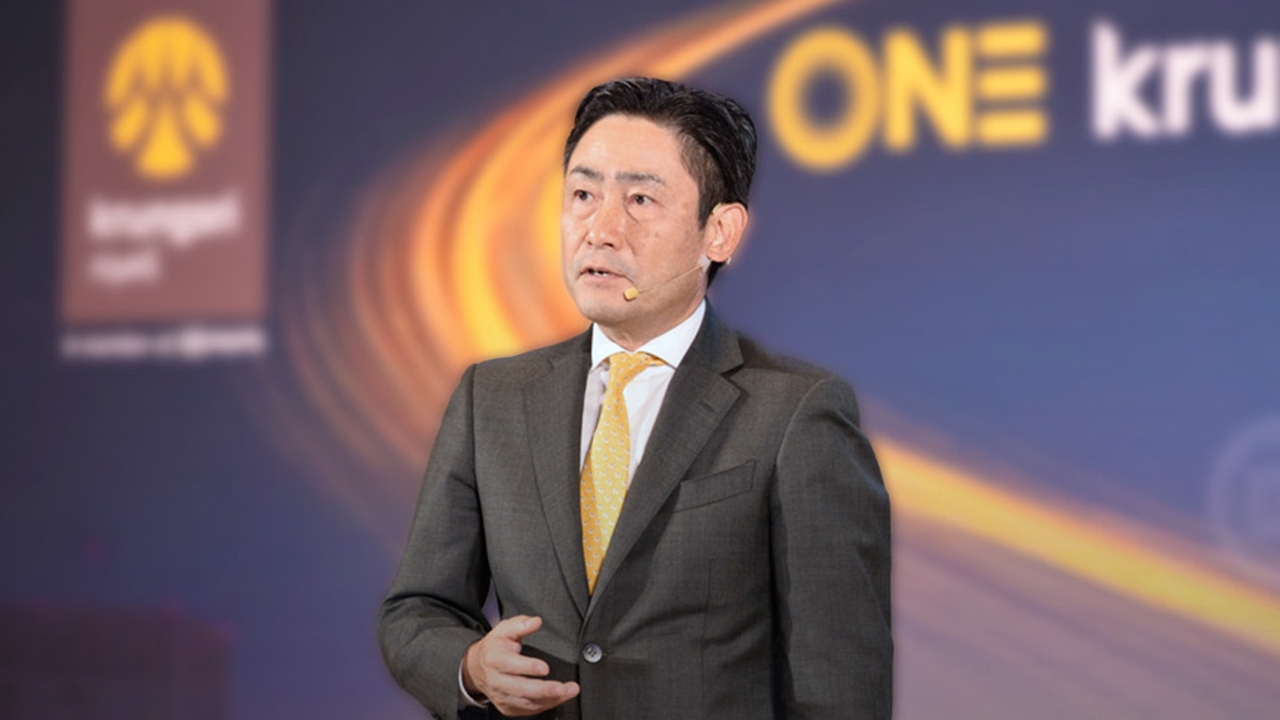
Amid intense scrutiny of Thailand's economy and its characterization as the "sick man of Asia," Krungsri Bank points out that although the economy is weaker than its peers, foreign investors still regard Thailand as a viable market. Notably, Japanese investment continues to flow steadily into the country.
The bank stresses that this is not an incurable "serious illness." If the new government can accelerate structural reforms earnestly alongside clear investment promotion policies, it will help restore confidence and pave the way for long-term growth.
Moreover, the bank emphasizes its role as more than just a lender, committing to be a partner that strengthens the economy. It has outlined growth plans for 2026, aiming for loan growth of 2-4% this year.
Kenichi Yamato, President and Chief Executive Officer of Krungsri Bank Public Company Limited (BAY), . points out that foreign direct investment (FDI) in Thailand continues to show positive signs, especially in target industries such as semiconductors and data centers.
Japanese companies remain the top investors in Thailand, confident in the country's potential as a key strategic hub, with many firms deciding to establish their headquarters in Thailand.
These investors show no signs of hesitation or slowing down, consistent with the Board of Investment's outlook for increased investment inflows, particularly from major automotive firms expanding their electric vehicle (EV) production lines and attracting related supply chain investments.
Regarding emerging industries with high potential such as telecommunications and data centers, although ASEAN countries fiercely compete for foreign investment,
Thailand's outstanding infrastructure and strong supply chains remain key factors attracting leading global investors and companies to continue investing in the country.
Since the recent election, Kenichi has expressed expectations that the new government recognizes the importance of attracting foreign investment by implementing concrete support measures and policies for investors.
If these elements align and clear promotion policies are in place, it will build confidence and present a clearer, more stable long-term investment outlook for the business sector.
Kenichi also remarked that while recent comparisons have labeled Thailand as the "sick man of Asia," it must be acknowledged that although Thailand's economic fundamentals appear weaker than neighboring countries,
this condition is not a severe, incurable disease. The root causes are well understood, but a full recovery requires long-term structural reforms. He hopes the new government will earnestly address these structural issues and implement measures to support collaboration between the public and private sectors, enabling Thailand to sustainably overcome this weakness trap.
Kenichi Yamato emphasizes that the bank recognizes its role as a systemically important financial institution and has set five urgent structural agendas to support sustainable economic growth: systematically addressing household debt issues, strengthening Thai SMEs, enhancing regional competitiveness, accelerating the transition to a low-carbon economy, and building confidence in financial system stability.
These five urgent agendas form the basis for the bank's 2026 strategy, driven by three core pillars:
The bank targets overall loan growth of 2-4%, expecting growth primarily from foreign customer loans, especially in high-potential countries like the Philippines, Vietnam, and Indonesia amid a relatively subdued domestic lending environment.
Currently, foreign loans account for 5% of the bank's total loans and approximately 20% of total revenue. The bank remains open to expanding its business to support future growth through both organic means and inorganic growth such as acquisitions.
Additionally, the bank aims for a net interest margin (NIM) of 4.0-4.3%, with the ASEAN portfolio targeting an NIM of 20.00-22.00%, while domestic NIM is projected at 3.25-3.50%.
Non-interest income is expected to grow at a mid-single-digit rate, with a focus on operational efficiency targeting an expense-to-income ratio in the mid-40% range.
Regarding credit portfolio strength, the bank aims for a non-performing loan (NPL) ratio of 3.25-3.50%, maintaining loan loss reserves at 200-230 basis points of total loans and a loan loss reserve to NPL ratio (LLR) of 120-135%.
One key goal is to achieve Net Zero. Krungsri has raised its target for social and sustainable finance portfolio support to 350 billion baht by 2030.
For more stock and investment news, visit Thairath Money at
Follow the Facebook page Thairath Money at this link: