

At this moment, no news impacts the wallets of Thai people more than the "oil price crisis" after the government decided to end the diesel and gasoline price cap measures, allowing prices to fully reflect market forces.
On the morning of 26 March 2026, fuel prices at service stations surged by 6 baht per liter in one jump, affecting not only drivers but potentially triggering a large domino effect impacting production costs and the overall economic outlook.
Amid ongoing conflicts in the Middle East, investors see this as unlocking profit potential for oil station stocks, becoming a prominent theme in the Thai stock market at this time, with PTG analysts naming as the leading beneficiary.
Yesterday, the Fuel Oil Fund Management Committee (FFMC) resolved to raise retail fuel prices—including diesel and gasoline—by 6 baht per liter, effective from 05:00 on 26 March 2026, causing diesel prices to jump to 38.94 baht per liter from the previous cap of 33 baht.
The main cause was the Fuel Oil Fund’s deficit exceeding 35 billion baht, bearing a compensation burden of over 80 billion baht per month, amid soaring global oil prices due to Middle East conflicts.
This sharp fuel price hike is viewed by securities analysts as a negative psychological impact on the Thai stock market due to inflation and rising costs concerns, though some sectors, especially oil station stocks, stand to benefit.
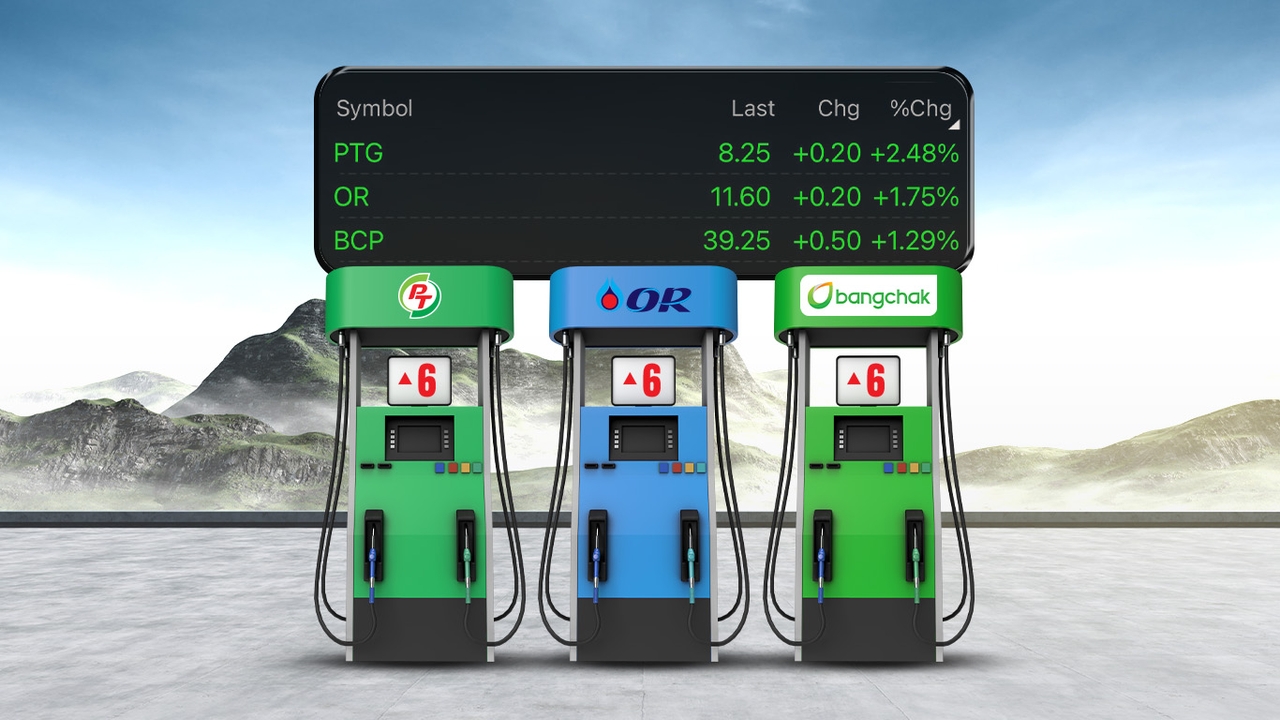
At 10:05 this morning, the Thai stock index fell to 1,439.98 points, down 17.93 points or about -1.23%. However, oil station stocks bucked the trend, led by PTG rising to 8.25 baht (+2.48%), followed by OR at 11.60 baht (+1.75%) and BCP at 39.25 baht (+1.29%).
Analysts at Krungsri Securities said the FFMC’s 6 baht per liter price hike, aligned with the free-market policy, negatively affects the SET Index psychology, impacting sectors reliant on domestic consumption, such as retail and hire-purchase.
Conversely, it has a positive psychological effect on oil stations, mass transit, and EV hire-purchase sectors, with OR, PTG, BEM, and KKP selected as standout stocks.
Analysis from Pie Securities noted that a 6 baht per liter increase is quite high, likely pushing Thai inflation upward, with cost pass-through to product prices expected, pressuring companies unable to pass on costs and reducing profits.
They also believe Thai interest rates have passed their lows, benefiting banks but pressuring non-bank sectors, while retail faces headwinds from slowing consumption.
Asia Plus Securities research assesses that ending price caps and moving to free market mechanisms will allow oil station operators to fully manage their "marketing margin," after previously being heavily pressured by government policy. Comparing data shows clear advantages as follows.
PTG shares, or PTG Energy Public Company Limited,
are the most sensitive to marketing margin changes in the group, as their revenue structure relies almost entirely on retail oil business.
They have a diesel sales ratio of 71% of total volume, directly benefiting from the price cap removal. Their average gross margin per liter is 1.65 baht, noticeably higher than peers.
OR shares, or PTT Oil and Retail Business Public Company Limited,
although the largest market share holder at 39.5%, are seen by Asia Plus as secondary beneficiaries due to diesel sales making up about 40% of volume and commercial sales accounting for 59%, limiting retail marketing margin adjustments' effect on overall profits compared to PTG.
However, OR’s strength in non-oil businesses and a broad station network remain long-term advantages.
BCP shares, or Bangchak Corporation Public Company Limited,
are assessed as the "least positive" beneficiary in the oil station group. Despite a diesel sales ratio of 51%, their profit structure relies mainly on refining and upstream businesses.
The oil station business contributes only about 17% of EBITDA, so changes in marketing margins at stations have less impact on overall company profits than for others.
Hence, trading recommendations favor PTG with a short-term price target of 9.80 baht due to positive marketing margin developments, with OR targeted at 16.50 baht and BCP at 43.00 baht.
For stock and investment news, visit Thairath Money at
Follow the Facebook page: Thairath Money at this link