

Tensions in the Middle East remain worrisome with no sign of resolution. The crisis has recently spread to major Thai industrial firms such as Siam Cement Group (SCC).
SCC has announced a temporary shutdown of its LSP factory in Vietnam. Meanwhile, brokers have collectively downgraded their recommendations despite the stock reaching this year's new highs, due to the high level of ongoing uncertainty.
The conflict in the Middle East and the continued closure of the Hormuz Strait look set to persist. Recent foreign media reports indicate that ceasefire talks to reopen shipping lanes in Islamabad have stalled.
Amid ongoing ship seizures and blockades, the crisis has severely impacted global supply chains.
Since the Hormuz Strait is a critical maritime route for transporting crude oil, natural gas, and petrochemical raw materials, shipping companies have had to reroute vessels. This has led to increased transportation and insurance costs, delivery delays, and continuous rises in energy and raw material prices worldwide.
The severe supply chain disruption has inevitably affected Siam Cement Group (SCC). On 22 April 2026, SCC notified the Stock Exchange of Thailand of the necessity to temporarily halt operations at Long Son Petrochemicals Co., Ltd. (LSP) in Vietnam, starting around mid-May 2026.
SCC cited the prolonged and highly uncertain Middle East situation as beyond their control, resulting in constraints on raw material supply via the Hormuz Strait in terms of price and continuity. The company has attempted to mitigate impacts by sourcing raw materials from outside the Strait but challenges remain.
This LSP shutdown will impact costs by approximately 250 million baht per month. SCC will use this period to accelerate maintenance and prepare for the ethane feedstock expansion project (LSPE) to ensure machinery readiness and support long-term competitiveness enhancement plans.
Previously, Rayong Olefins Co., Ltd. (ROC), a major primary petrochemical producer in the SCGC group, had already temporarily halted its olefins plant since 10 March 2026.
Operations of other chemical business units and SCG's other businesses continue as usual, with operational adjustments made to align with the situation.
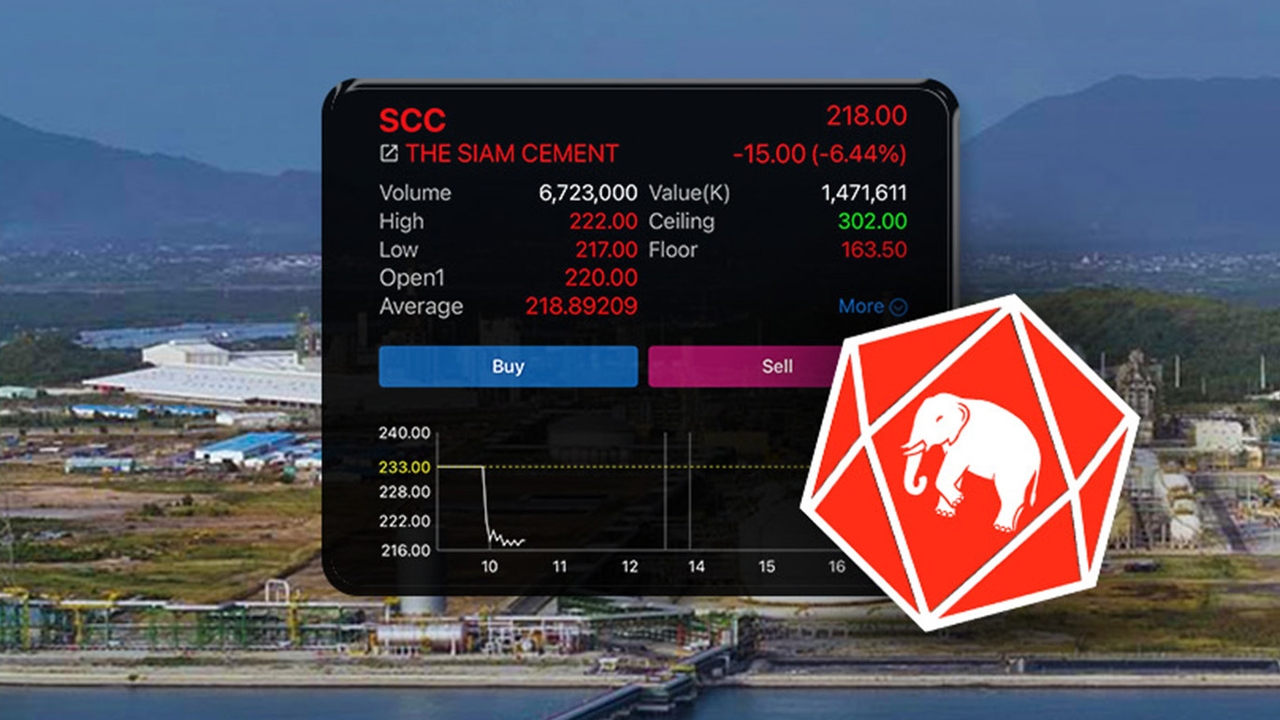
SCC's stock has performed strongly since early this year, closing at 233.00 baht on 22 April 2026, up 26.98% year-to-date.
However, this morning's trading saw SCC shares fall sharply. At 10:26 a.m., the stock traded at 218.00 baht, down 15.00 baht or 6.44% from the previous day.
Analysts have adopted a cautious stance and downgraded investment recommendations. Asia Plus Securities revised their rating from 'Trading' to 'Sell,' with a target price of 220.00 baht.
They view the decision to pre-announce the LSP shutdown about four weeks in advance—allowing customers to manage production plans—as reasonable given limited and costly raw material supplies. Redirecting feedstock to the MOC plant in Thailand is expected to create better value by producing higher-margin HVA products.
The 250 million baht monthly cash cost is part of fixed expenses (mainly depreciation) for LSP's existing monthly cost of about 1 billion baht, so it does not significantly increase SCC's expenses compared to previous periods.
Despite the stock rising roughly 40% from its low after the conflict began—on expectations that the petrochemical downturn cycle would end sooner than anticipated—uncertainty remains high, and current prices have exceeded the assessed fair value.
Dao Securities (Thailand) revised their recommendation to 'Hold' with a target price of 250.00 baht, expecting significant petrochemical product sales volume declines in the first half of 2026 due to the LSP and ROC plant shutdowns, which account for a large share of main product capacity.
They also see risks to the 2026 net profit forecast from possibly lower sales volumes. Sensitivity analysis estimates that each month of shutdown at LSP and ROC would reduce production (PE, PP) by about 120,000 tons combined.
Although initial net profit estimates and target prices remain unchanged, since there is still a chance the plants may resume operations if the war ends, the stock price has already reflected most of the upside, leaving limited potential gains. Therefore, the recommendation is to hold and monitor the situation.
Read stock and investment news with Thairath Money at
Follow the Facebook page: Thairath Money at this link