

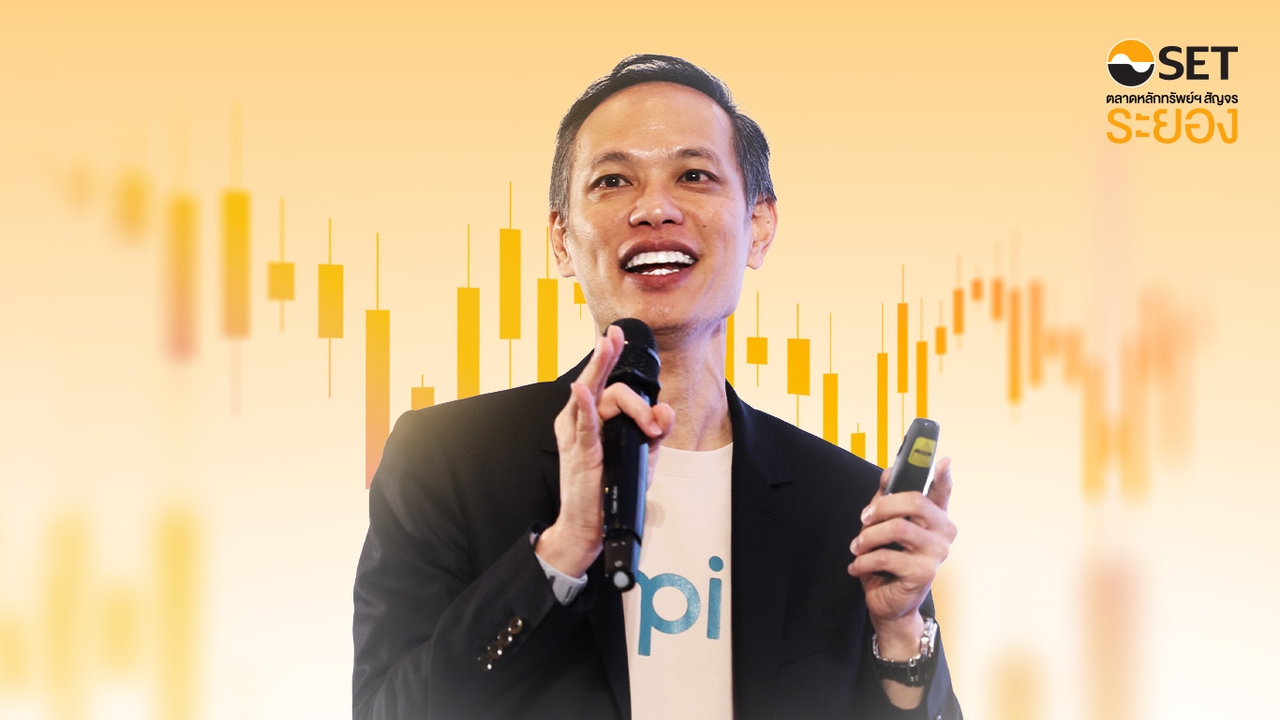
The Stock Exchange of Thailand (SET) Brought knowledge directly to investors in the Eastern region at the "Stock Exchange on Tour in Rayong" event, where a major highlight attracting strong interest was
a seminar titled "Step-by-Step Stock Selection for Beginners" led by renowned investment expert Kavi Chookitkasem, Chief Investment Portfolio Management Officer of Pi Securities Public Company Limited, who gave an in-depth talk to unlock mindsets and arm new investors with essential knowledge.
Kavi emphasized, “First, we must understand what we are best at and what kind of investments suit us. Only when we are ready should we enter investing.” Stocks are not always the best-performing asset if one lacks proper knowledge.
Therefore, the first step for beginners is to assess their own strengths because every investor has a different style. Some prosper by investing in bonds, real estate, or even amulets, without necessarily investing in stocks.
But if someone recognizes that the “stock market” is their arena, here are three crucial steps summarized by Thairath Money.
Kavi Chookitkasem stated that historical data proves the stock market tends to rise in the long term, but many investors fail because they "choose the wrong stocks."
Many chase stocks aiming for explosive growth like Nvidia, but in reality, no one can guarantee which stocks will skyrocket.
Allocating a small portion, say 1-2%, into small stocks isn’t wrong, but for value investing (VI), the goal isn't always multi-bagger returns but to hold stocks "for the long haul."
The key is to invest as a business owner by selecting quality companies using two main tools:
1. Check financial health through financial statements.
Choosing good stocks means reviewing financial metrics such as steady gross profit margins, low expenses, minimal debt, and profitability—especially return on equity (ROE) above 15%. These historical figures indicate the stock’s strength over time.
2. Analyze using the Five Forces Model.
Another method is to assess a company’s competitive advantage through the Five Forces Model, which evaluates:
Companies that manage these pressures well can maintain margins, generate steady profits, and become quality long-term stocks.
After identifying fundamentally strong stocks, investors must "wait for the right timing," which often comes during crises causing steep market declines. These moments are ideal for buying quality stocks at lower prices rather than chasing expensive stocks amid heavy buying.
Crises happen frequently worldwide, from economic downturns and wars to natural disasters and pandemics. In Thailand’s stock market, crises are common due to political factors, floods, or tourism impacts, making volatility a normal part of investing here.
“Every crisis is an opportunity. Notice how stocks don’t stay down long... that’s exactly when I choose to shop,” said Kavi Chookitkasem. .
Many wonder if the Thai stock market remains attractive. Although a clear new S-curve is not yet visible, Thailand has global geographical advantages such as
being a regional data center hub, a mineral center, one of the world’s largest hard disk drive (HDD) producers, and having abundant electricity and water resources critical for data centers in the AI era.
It is also a tourism and medical hub strategically located so that over two-thirds of the world’s population can reach Thailand within 3-5 hours by flight. Regardless of economic conditions, travel persists, and positioning as a Medical Hub reinforces the strength of Thailand’s service and healthcare industries.
Therefore, the stock market is not as intimidating as it seems and still offers many investment opportunities if one starts with knowledge of business fundamentals, patiently waits for the right timing, and recognizes hidden opportunities in the economic structure.
If you have read this far and want to learn more detailed investment tips, rest assured that the grand event "Stock Exchange on Tour" by the Stock Exchange of Thailand continues to empower Thai investors.
The next stop is Chiang Mai Province in the north, guaranteed to feature top-level speakers sharing comprehensive strategies as before.
Investors who don’t want to miss this portfolio growth upskilling event can check the schedule and follow updates on the Stock Exchange of Thailand’s website.www.set.or.th