

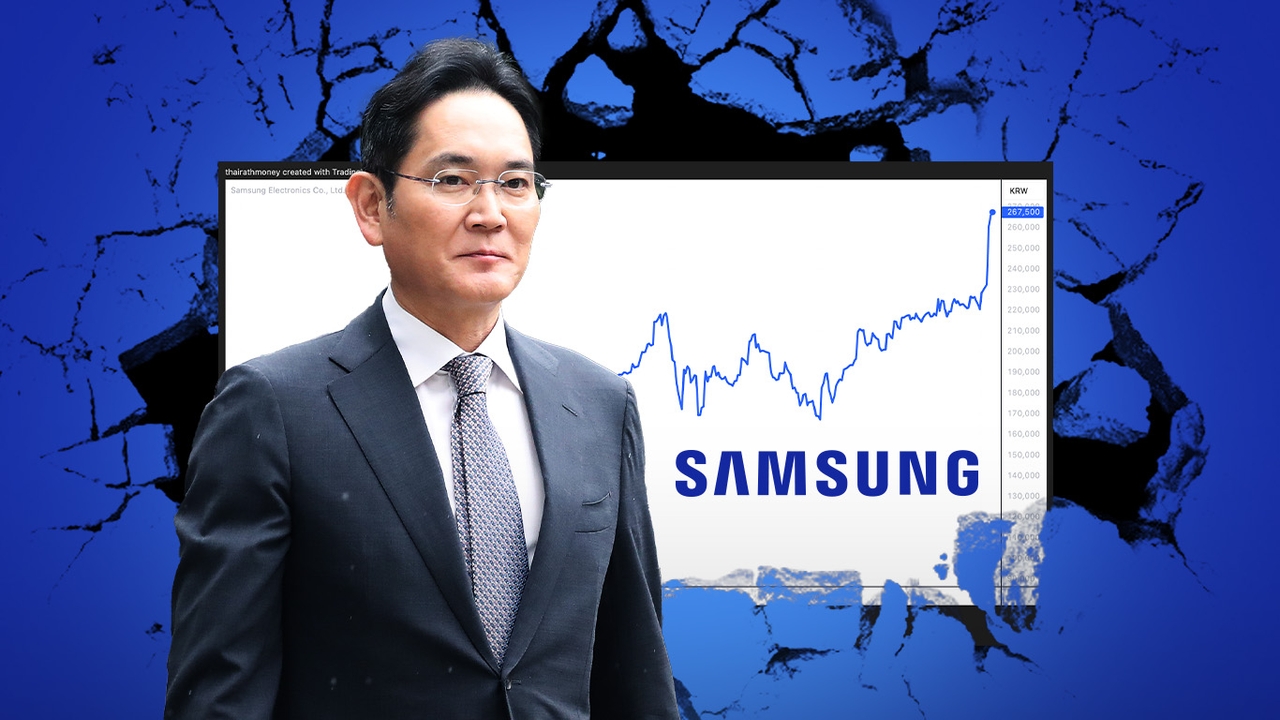
Samsung Electronics shares jumped more than 15% this morning (6 May), pushing the South Korean chip giant's market capitalization beyond one trillion US dollars amid global investor enthusiasm for AI-related stocks.
This surge made Samsung the second Asian company to surpass a one trillion US dollar market value, following Taiwan Semiconductor Manufacturing Company (TSMC). FactSet data showed Samsung had previously crossed this threshold once on 26 February.
Samsung's share price hit a new all-time high and is on track to set a record for the largest single-day gain ever recorded.
The key driver is the exceptionally strong Q1 earnings reported last week, with operating profit soaring over eightfold or 750% year-on-year to 57.2 trillion won (about 39.3 billion US dollars or over 1.2 trillion baht), while total revenue reached a record high of 133.9 trillion won (approximately 92 billion US dollars or over 2.9 trillion baht*).
Notably, the company’s Q1 operating profit alone exceeded the entire 2025 annual profit of 43.6 trillion won, reflecting a robust recovery in the semiconductor business and rising demand for memory chips.
Investor confidence was further boosted by a Bloomberg report that Apple has begun preliminary talks with Samsung and Intel to explore manufacturing Apple chips domestically in the US, signaling a move to diversify supply away from reliance on TSMC as the sole major supplier.
The gains were not limited to Samsung; fellow South Korean memory chip giant SK Hynix shares also rose more than 10%, lifting the South Korean KOSPI stock index over 5% to surpass 7,000 points for the first time ever.
Growth in high-bandwidth memory (HBM) chip sales is a major factor supporting Samsung’s profitability, although the company faces stiff competition after losing some market advantage in HBM to SK Hynix.
Samsung has been working to close the gap with SK Hynix in the rapidly expanding AI memory market. In February, it announced becoming the world’s first mass producer of HBM4 chips and has started deliveries to select customers, though names remain undisclosed.
HBM4 is the sixth-generation high-bandwidth memory technology and currently the latest, expected to play a key role in Nvidia’s new AI architecture, Vera Rubin, designed for advanced AI workloads in data centers.
Analysts view Samsung’s sharp stock rise as mainly driven by rapidly growing AI-related memory chip demand, tight supply, and improved competitiveness in the HBM market.
According to CNBC, Morningstar technology equity analyst Yu Jing Jie said, “The market is currently experiencing a severe shortage of DRAM and NAND chips due to surging AI demand, as AI requires massive bandwidth and storage capacity.”
DRAM is high-speed volatile memory used temporarily during processor operations, while NAND is non-volatile memory that retains data even when powered off.
Although global chip makers are ramping up production capacity, building new semiconductor facilities takes about two to three years before full-scale production begins, meaning supply will remain tight in the short term and supporting expectations for strong profit and margin growth for chip manufacturers over the next one to two years.
Rolf Bulk, head of semiconductors and infrastructure at The Futurum Group, noted that despite new chip plants opening over the coming years, the currently high memory prices and strong earnings from Samsung and others are likely to continue supporting the market for some time.
He added that customer feedback on Samsung’s latest HBM4 products has been positive, helping the company narrow the technology gap with SK Hynix.
Although SK Hynix still leads the HBM market with about 55% share compared to Samsung’s roughly 25%, investors are less concerned about this gap as traditional DRAM profitability has recently surpassed HBM profits, providing Samsung with a strong memory business base supporting long-term growth.
*Exchange rate as of 6 May 2026
Follow the Facebook page: Thairath Money at this link -https://www.facebook.com/ThairathMoney