

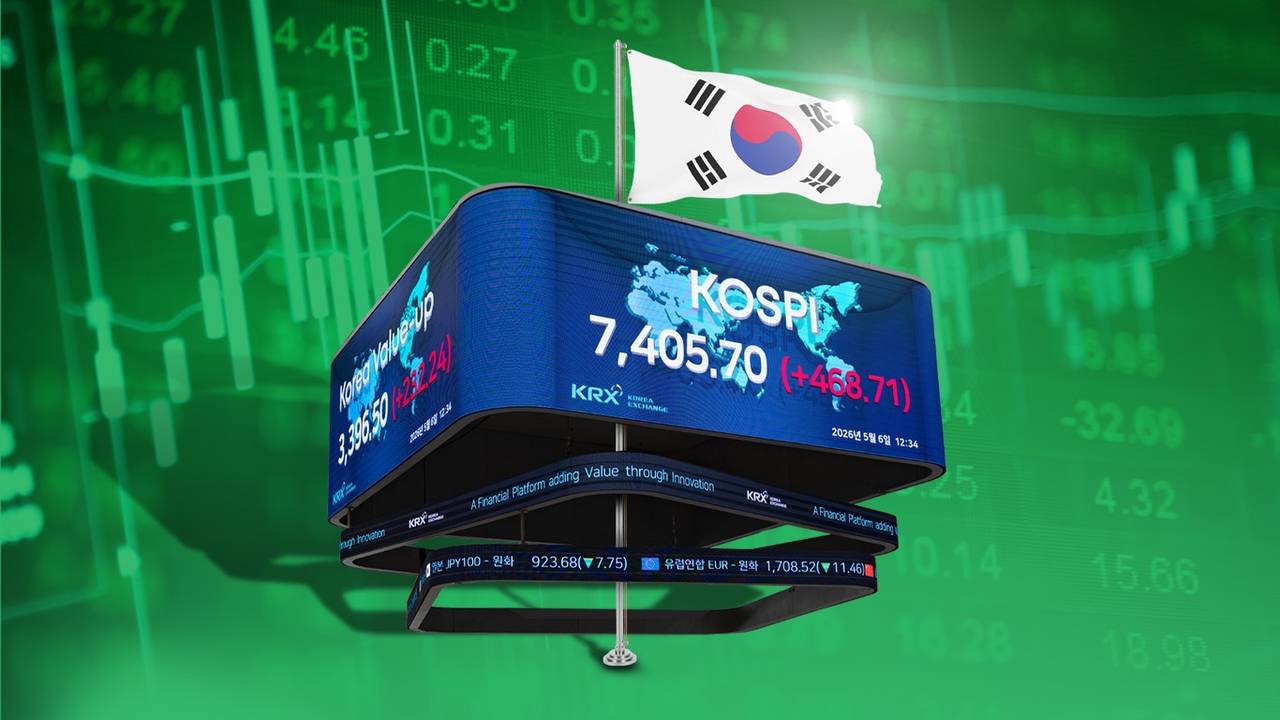
South Korea’s stock market has once again become a global financial star this year as the Kospi (Korea Composite Stock Price Index) has surged 75% since the start of the year, despite less than five months passing. It is approaching its previous record return of 76%, which made it the hottest stock market worldwide last year.
Most recently, the Kospi index rose another 6.5% on Wednesday, bringing the total number of days this year with gains exceeding 5% to eight, compared to only one such day in all of 2025. Meanwhile, foreign investors continue to buy Korean stocks steadily, with inflows exceeding 2 billion US dollars in a single day—close to historic highs.
This entire momentum is driven primarily by strong buying in technology sectors, particularly AI and semiconductors.
South Korean companies once overlooked by global investors have been re-rated as the market recognizes South Korea as one of the countries with the greatest advantages in the global AI supply chain, especially in the “Memory Chips” business, led by Samsung Electronics and SK Hynix. These key AI chip industry stocks have more than doubled this year, continuously setting new record highs.
Samsung Electronics recently became the first South Korean company to surpass a market capitalization of 1 trillion US dollars, while semiconductor business revenue tripled in one quarter due to skyrocketing global demand for AI data center chips.
Moreover, rising demand for AI chips has pushed up prices of other chip types as well, due to tight supply conditions, making memory chip manufacturers among the most sought-after businesses by investors worldwide currently.
Chan H. Lee, Managing Partner at Petra Capital Management in Seoul, noted that this is not just about South Korea but a global AI memory cycle, and that Samsung Electronics’ true value is finally being recognized.
Although some compare South Korea’s stock market heat to the dot-com bubble era, FactSet data shows this rally differs because the surge is driven by “real corporate profit growth” rather than mere speculation. Analysts highlight that the market’s price-to-earnings (P/E) ratio has actually declined this year despite the sharp index rise, indicating stock price increases are supported by actual earnings growth, especially in the semiconductor sector.
The AI boom has also propelled South Korea’s market capitalization past Canada’s, making it the seventh-largest stock market globally. Bloomberg data shows that the combined market value of South Korean listed companies rose 71% this year to 4.59 trillion US dollars, while Canada’s market grew only 7%.
A key factor is the markedly different market structure: chip stocks like Samsung and SK Hynix account for 45% of the Kospi index, allowing South Korea to fully benefit from the AI cycle. In contrast, Canada’s market relies mainly on energy and financial stocks, which grow more slowly in an era where AI is becoming the world’s “new economic engine.”
Ha SeokKeun, Chief Investment Officer at Eugene Asset Management, explained that rapid growth surpassing major European markets like the UK and France reflects “the market structure driven by technology and AI chip stocks as a core has become a crucial factor shaping each country’s economic and capital market direction.”
This phenomenon is not unique to South Korea. Taiwan’s Taiex index, led by Taiwan Semiconductor Manufacturing Company (TSMC), has risen over 42% this year, while the US semiconductor index, the PHLX Semiconductor Index (SOX), has surged 55%.
“All this reflects a shared picture that AI is becoming a new economic cycle driving global capital markets, especially in countries with the world’s strongest chip industries and technology infrastructures.”
Data shows this hot market growth is strongly supported by President Lee Jae-myung’s policy to promote the stock market as a key pillar of household wealth.
The South Korean government is pushing corporate governance reforms to increase shareholder returns and develop the capital market as a long-term wealth accumulation channel for citizens. Amid tensions in the Middle East and the Iran war—which increase oil price risks—investors have renewed interest in South Korea’s shipbuilding and defense industries, which have quietly strengthened over recent years.
However, some analysts warn signs of an overheated market exist. While the overall picture remains strong, concerns grow that the market may be overheating in some areas. The Kospi index recently closed at 7,384 points, well above the previous 5,000-point target once deemed “impossible,” and nearing Goldman Sachs’ year-end forecast of 8,000 points.
The rally remains concentrated: despite the index’s strong rise, over 600 of the 835 Kospi-listed companies fell on the same day, indicating the market is still driven mainly by a few AI and semiconductor stocks. Nevertheless, for global investors, South Korea now reflects a new era in which AI is fundamentally reshaping the economy, capital markets, and national wealth.
Follow the Facebook page: Thairath Money at this link -