

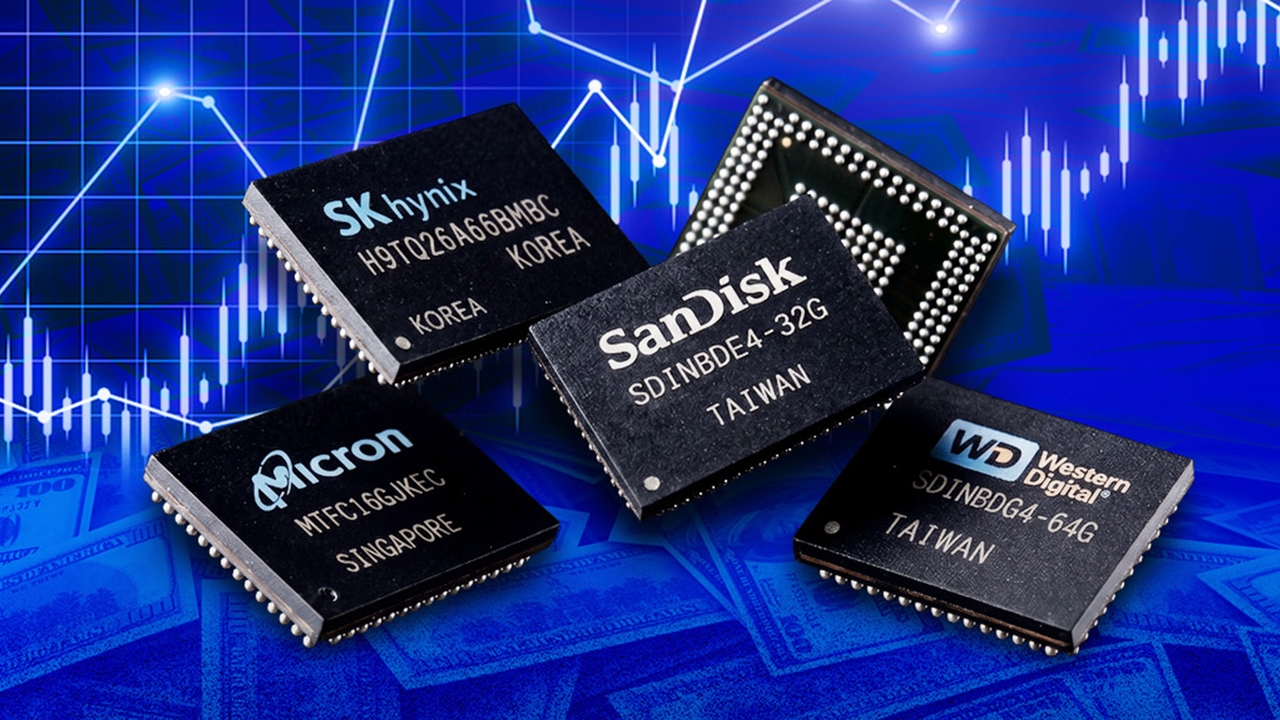
Memory chip stocks are becoming a new wave in AI that investors worldwide are watching closely. AI growth has rapidly boosted demand for memory chips, causing the share prices of memory chip manufacturers to soar and turning them into a key group pushing the S&P 500 and Nasdaq Composite indices to continuous new highs.
Notable stocks include SanDisk, which has been the best performer in the S&P 500 this year with a 558% rise. Seagate shares rose 172%, while Western Digital and Micron climbed over 100%, gaining 156% and 137% respectively. This surge is driven by the evolution of AI transitioning from the era of “Training or model training” to the era of “Inference or widespread practical AI application.”
This transition has massively increased memory demand because AI relies on large amounts of data stored on memory chips, especially during the Inference stage when systems access data in real time.
Ruben Dalfovo, investment strategist at Saxo, stated, “This shift makes memory chips a more strategic resource because AI Inference requires speed, bandwidth, and energy efficiency—not just raw processing power.”
Micron explained that memory chips and storage systems are becoming the “heart of AI.” The company said these components act as the backbone of AI cognition, accelerating performance, enabling new innovations, and transforming memory from a commodity into a “strategic asset.”
The AI trend has sharply increased memory chip demand beyond production capacity. During the AI boom, many chip makers focused production on High Bandwidth Memory (HBM)—high-performance memory for AI—instead of chips for general electronic devices, pushing memory chip prices higher across the industry.
IDC further explained, “AI servers and enterprise systems require many times more memory per machine than consumer devices, causing AI’s expansion to consume most of the global production capacity unevenly, leading to shortages as manufacturers prioritize orders from major tech firms and AI server builders.”
IDC also warned that this memory market cycle differs from past technology cycles because AI is directly restructuring the market. IDC said, “This is not just a cyclical supply-demand imbalance but a strategic reallocation of the world's silicon wafer production capacity, which may become permanent.”
Dave Mazza from Roundhill clearly stated, “Memory chips are the bottleneck of AI.” He explained that demand from large companies or hyperscalers like cloud giants is unavoidable while supply is physically limited, as new chip factories take 3-5 years to become operational.
Moreover, with demand exceeding production capacity, memory chip prices have surged rapidly. The rising memory costs have become a major issue cited by big tech companies during earnings announcements.
Meta CEO Mark Zuckerberg noted that one reason for the company’s rising expenses is higher memory chip costs, while Apple also acknowledged that increased memory costs are pressuring the company.
However, although high chip prices pressure users, this is very positive news for chip manufacturers.
One indicator of this theme’s strength is the ETF Roundhill Memory ETF, trading under the ticker “DRAM,” which has risen about 88% since launching on 2 April—just over a month ago.
Dave Mazza, CEO of Roundhill, told Business Insider that the firm created this ETF because the market lacked a dedicated investment tool focusing exclusively on memory chips.
He explained, “Memory chips are the most supply-constrained part of AI infrastructure, yet investors previously had no efficient way to access this theme.”
This ETF includes memory chip producers worldwide, such as U.S. companies SanDisk and Micron; South Korean firms SK hynix and Samsung; Japan’s Kioxia Holdings; and Taiwan’s Nanya Technology and Winbond Electronics.
Bank of America recently noted in its analysis of SanDisk that demand remains higher than supply and raised its price target. Bernstein analyst Mark Newman also issued a positive outlook, stating SanDisk’s average selling prices remain high.
Not only SanDisk but also Micron, Seagate, and Western Digital have seen price target increases driven by AI demand.
Dave Mazza views this memory chip stock surge as a market re-rating. He said, “The memory chip industry has long been seen as cyclical, and the market still values these companies using old frameworks.”
“But what the market undervalues is that 65% of this industry’s revenue now comes from hyperscalers under multi-year contracts. This means these companies are no longer cyclical but instead are infrastructure providers with stable contracts.”
Source:Business Insider
Follow the Facebook page: Thairath Money at this link -https://www.facebook.com/ThairathMoney