

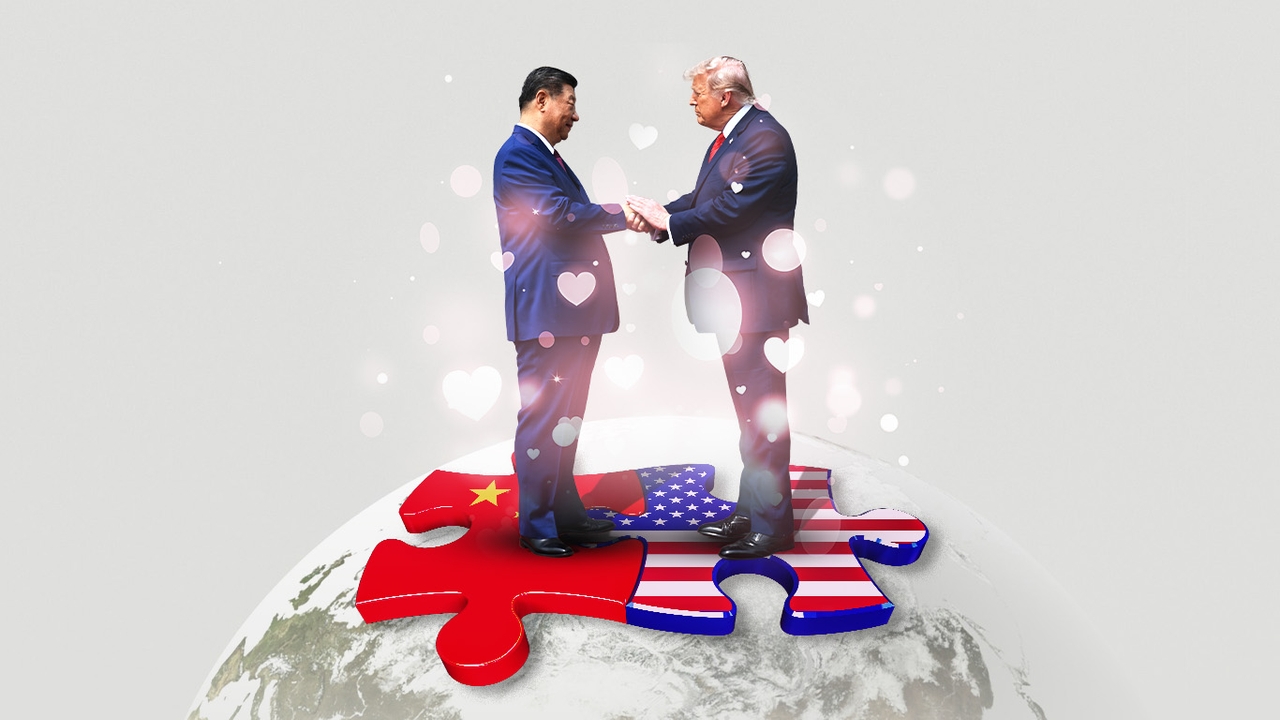
Stocks in the semiconductor, aerospace, and electric vehicle sectors are under close watch after President Donald Trump arrived in Beijing to initiate important talks with President Xi Jinping, amid expectations that this meeting could mark a turning point in the trade war and technology restrictions between the U.S. and China.
Yesterday (13 May), Donald Trump arrived in China accompanied by a group of CEOs and representatives from major U.S. technology and financial companies. This marks Trump's second visit to China as president, regarded worldwide as a highly anticipated summit.
Key issues on the negotiation table include import tariffs, rare earth minerals, artificial intelligence (AI), Taiwan, and the conflict situation in Iran. Global financial markets remain highly sensitive to trade relations between the two superpowers, after years of escalating technology controls and supply chain restrictions.
According to CNBC, analysts and investment strategists believe investors should watch stocks related to agricultural exports, the aviation industry, and semiconductor manufacturers if the two superpowers can reach even partial trade agreements.
One possibility is that China may increase imports from the U.S., including soybeans, corn, liquefied natural gas (LNG), crude oil, and Boeing aircraft, in exchange for easing tariffs related to fentanyl issues. Previously, Trump imposed tariffs on countries considered transit points for this drug, with China viewed as a major source of fentanyl precursors.
However, analysts also note that the U.S. aims to secure agreements for China to buy more aircraft, agricultural, and energy products, but such deals may depend on the U.S. stance on Taiwan, as well as discussions on tariff reductions and easing some technology restrictions.
Regarding the stock market on 13 May, Nvidia shares closed up 2.3%, after CEO Jensen Huang decided to join the trip to China at the last minute, while other chipmakers such as Micron rose 4.8% and Qualcomm increased by 1.4%. In the electric vehicle sector, Tesla shares closed up 2.7%, and in aerospace, Boeing shares rose 1.6%.
CNBC reports that Boeing is seen as one of the companies that would benefit most if U.S.-China relations begin to ease, as Boeing is both a key American exporter and a significant bargaining chip in trade talks with Beijing.
Kelly Ortberg, Boeing's CEO, was among the executives invited by Trump to join the China visit.
Analysts believe China may place additional orders for Boeing aircraft in exchange for tariff relief and trade stability, a development closely watched globally after years of tension severely affected aircraft deliveries to Chinese airlines.
Ronald Epstein, a Bank of America analyst, stated that Boeing could be the clearest "winner" of this summit, revealing the possibility that China might order about 500 Boeing 737 Max aircraft, marking the first major order from China in nearly a decade.
George Ferguson, a Bloomberg Intelligence analyst, views it as highly likely that Boeing orders will be placed during this meeting. Additionally, Boeing aircraft orders also mean orders for General Electric engines, boosting demand for aerospace equipment and benefiting Collins Aerospace under RTX.
Investors are watching a potential mega deal where China might decide to purchase more agricultural and energy products from the U.S. Wolfe Research predicts China may announce plans to buy additional agricultural and energy goods, positively impacting stocks linked to agricultural exports, LNG producers, and U.S. oil exporters.
Kristen Owen, an analyst at Oppenheimer, believes the biggest beneficiaries could be Deere & Company, a major tractor manufacturer, and Corteva, a provider of agricultural seeds.
However, Wolfe cautions investors not to be overly optimistic about this deal, noting China's history of not fully meeting past agreements, such as the 2020 Phase One trade deal, which initially eased trade tensions but ultimately saw China importing less than the agreed targets.
Semiconductor stocks continue to be heavily monitored during the Trump-Xi meeting, amid intense competition between the two powers, particularly as China works to strengthen its domestic chip industry.
Recently, Nvidia obtained licenses to sell certain chips to customers in China, seen as a small step toward re-entering the world's largest chip market. Jensen Huang's last-minute decision to join Trump's trip is also viewed as significant for these negotiations.
Bank of America analysts see this summit as a potential positive catalyst for ASML Holding if both sides can reach agreements on chip production equipment export controls and rare earth mineral supplies.
Didier Scemama, a Bank of America analyst, previously noted that both countries stand to lose if no middle ground is found. Any easing of export restrictions could lead to upward revisions of company earnings in the industry, as Nvidia currently values its business assuming zero sales in China.
Bank of America also cited an event last October when, following a phone call between Trump and Xi Jinping, rare earth exports increased and new chip export bans were delayed for one year for companies on the U.S. Entity List.
Analysts believe this helped the Chinese semiconductor market recover rapidly in the second half of 2025.
However, Chinese semiconductor equipment makers may face short-term selling pressure if export restrictions are relaxed, as investors might see less need for domestic technology substitutes.
Jefferies analysts state that although China still aims to develop its domestic chip industry due to long-term risks of reliance on U.S. technology, any selling pressure could present buying opportunities for long-term investors.
Jefferies also identifies Advanced Micro-Fabrication Equipment as a standout stock to watch in China's semiconductor equipment sector.
Stocks in the electric vehicle and battery sectors are another group investors are watching closely.
Morgan Stanley analysts view China's Contemporary Amperex Technology (CATL) as likely to perform well, noting that its technology licensing deal with U.S. Ford Motor Company could become a model for future industrial cooperation between the U.S. and China if relations stabilize after the Trump-Xi meeting.
Meanwhile, investors are also watching for potential increases in cross-border investments, with Barclays suggesting the U.S. might open more to clean energy technology investments from China.
Still, both countries are expected to maintain restrictions on strategically sensitive technologies such as AI, advanced chips, and technology infrastructure, meaning any easing will likely be short-term signals.
China has long used control of the rare earth minerals market as a strategic bargaining tool, prompting the U.S. to accelerate building its own supply chains.
JPMorgan Chase analyst Bill Peterson says that if the two countries agree on rare earth mineral exports, it could pose risks to MP Materials, a key U.S. player in this industry.
Last year, the U.S. Department of Defense acquired shares in MP Materials, causing its stock price to surge over 100%. The U.S. government also holds stakes in other important mining companies like USA Rare Earth, as well as key mineral firms such as Lithium Americas and Trilogy Metals.
Sources:CNBC,Bloomberg,The Guardian
Follow the Facebook page: Thairath Money at this link -https://www.facebook.com/ThairathMoney