

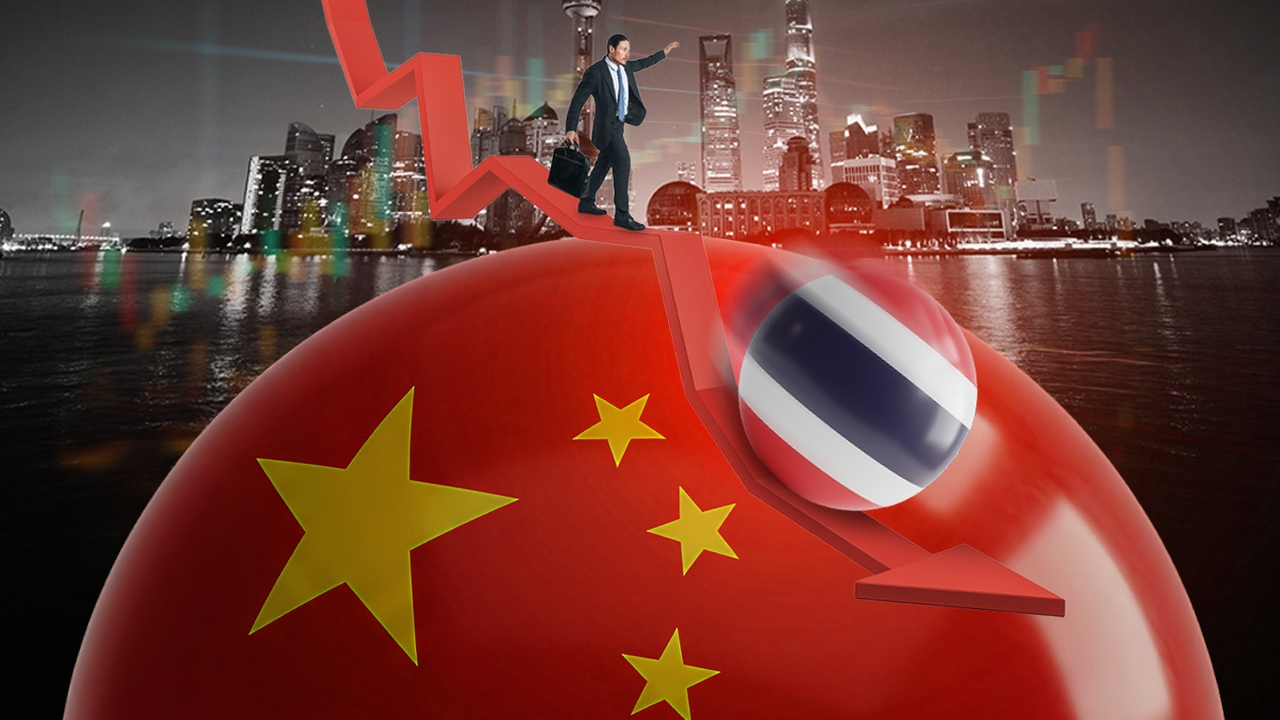
China's economy is sending increasingly worrying signals as consumption figures and the real estate sector fail to recover as expected. Analysts see these pressures undermining confidence among Chinese households and businesses, leaving economic growth prospects uncertain.
This issue does not affect China alone but may also impact key trading partners like Thailand in exports, tourism, and commodity demand—factors investors need to monitor closely.
Reuters Reports indicate that China's economy shows clearer signs of slowdown from consumption, with retail sales in May 2026 contracting by 0.6% year-on-year, reversing April’s 0.2% growth.
This marks the first contraction since China ended its Zero-Covid policy in late 2022, reflecting cautious consumer spending.
Meanwhile, fixed asset investment fell 4.1% in the first five months, indicating household and business confidence has yet to fully recover.
The real estate sector, once a key economic driver, remains weak. In May 2026, new home prices in 70 major Chinese cities dropped 0.2% month-on-month, accelerating from April’s 0.1% decline.
Prices have decreased for 35 consecutive months year-on-year, showing government stimulus measures have yet to restore confidence.
Additionally, real estate investment contracted 16.2% in the first five months, with sales and construction continuing to decline, turning this sector—once about a quarter of China’s economy—into a drag on growth and household wealth.
With consumption and real estate—the two main pillars of China’s economy—weakening, demand for imports, raw materials, and overseas travel by Chinese consumers is expected to slow as well.
This slowdown could affect several Thai industries dependent on China’s economy, including exports, tourism, petrochemicals, and rubber.
Asia Plus Securities Research Department stated in an analysis that China’s economic slowdown reflects consumer caution in spending, and this shock impacts Thailand’s economy.
As China’s domestic economy slows, demand for Thai goods and raw materials decreases. Total trade (exports and imports) between Thailand and China exceeds 100 billion US dollars annually, accounting for about 20-25% of Thailand’s GDP.
Thai exports to China represent around 12% of the country’s total export value.
Thus, reduced demand in China affects key Thai exports such as electronic components, plastic pellets, chemicals, fresh fruit, and rubber products, which will pressure Thailand’s GDP growth.
Moreover, Thailand heavily relies on revenue from Chinese tourists, who before Covid-19 accounted for over 25% of all foreign visitors. This may hinder the number of tourists and per capita spending from reaching targets set by the Tourism Authority of Thailand (TAT).
Therefore, the Thai stock market sectors requiring special caution include:
Tourism, hotels, and logistics groups
Electronic components group
Energy and petrochemical group
Rubber group
Residential development group
Source: Reuters/ /,Asia Plus Securities
For stock and investment news, visit Thairath Money at
Follow the Facebook page: Thairath Money at this link