

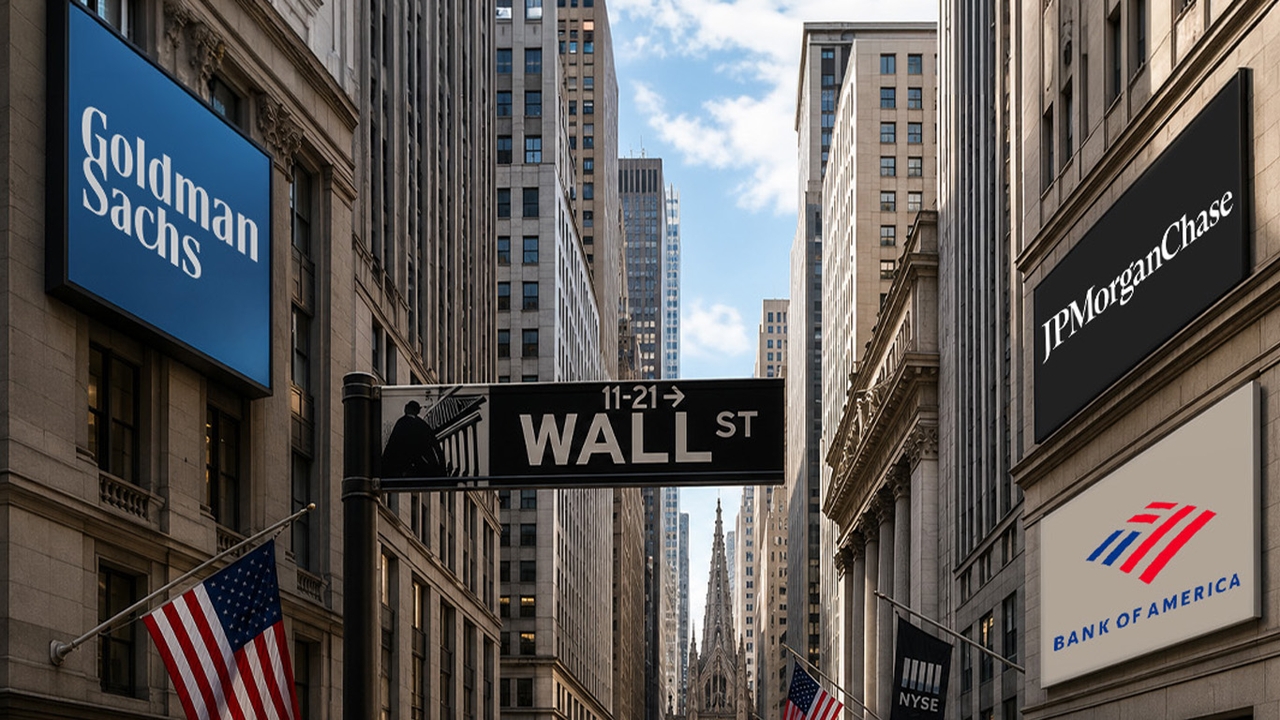
The AI investment wave is no longer benefiting only technology companies or chip manufacturers but is also driving momentum in the financial sector, especially investment banks. These providers of hundreds of billions of dollars in funding are currently benefiting from global AI investments.
A recent notable point from U.S. technology media indicates that major Wall Street investment banks, led by Goldman Sachs and JPMorgan Chase, are emerging as new winners in the AI arena despite not producing chips or revolutionary models.
Last week, both banks reported record-breaking quarterly earnings: Goldman Sachs saw revenue rise 39% year-over-year to $20.3 billion, while JPMorgan Chase's revenue increased 27% to $58 billion.
Jeremy Barnum, Chief Financial Officer (CFO) of JPMorgan, said that AI is now everywhere in the financial market, explaining that the market is currently full of financial activities including large IPOs, equity offerings, debt issuance, mergers and acquisitions (M&A), and investments in Asia—all consequences of the global AI wave.
Goldman Sachs also noted that this movement is not merely growth in AI stocks but represents the start of a major investment cycle, or the AI Capex Super Cycle. Investment is focused on creating long-term assets such as data centers, power plants, electrical transmission systems, chip manufacturing facilities, fiber optic networks, and digital infrastructure. Moreover, the capital demand for these objectives is supported by financial instruments of all types, in every region worldwide, and across nearly every industry.
David Solomon, Chief Executive Officer of Goldman Sachs, estimates this investment cycle could last 3-5 years and is currently just beginning. In other words, while the initial AI revolution generated revenue for GPU producers, the next phase will be a competition to build "infrastructure" to support AI globally, requiring enormous capital investment.
As companies worldwide deploy hundreds of billions of dollars to build data centers, power plants, electrical systems, and expand AI businesses, nearly every major transaction relies on banking services, including
In essence, the more companies invest in AI, the greater the demand for financial services becomes. Solomon calls this phenomenon theRipple Effect,which disperses AI-driven capital throughout the economy and creates new opportunities for banking businesses.
Before the second-quarter earnings announcements, most analysts predicted that major U.S. banks—including JPMorgan Chase, Bank of America, Citigroup, Wells Fargo, Goldman Sachs, and Morgan Stanley—would report strong revenues driven by investment banking and trading businesses.
Following earnings reports, these views were confirmed: JPMorgan's equities trading revenue rose 86% to $6 billion, Goldman Sachs increased 72% to $7.42 billion, and Bank of America grew 70%.
One significant deal last quarter was SpaceX's IPO and Alphabet's $90 billion fundraising, with Goldman Sachs serving as lead advisor for both. The bank also advised Dominion Energy on its sale to NextEra Energy, involving investments in energy infrastructure for the AI era.
Banks earn not only fees from deal-making but also revenue from lending, debt issuance, and wealth management for new shareholders after companies go public. Additionally, a large portion of investment banking revenue comes from so-called Soft Dollars—payments hedge funds make to receive allocations of oversubscribed IPO shares.
Various analysts also note that this cycle is generating momentum in global capital markets and positively impacting confidence in commercial lending.
Soofian Zuberi, Co-Head of Global Markets at Bank of America, said investors are expanding AI investments from U.S. stocks to key semiconductor manufacturing countries such as South Korea, Taiwan, and Japan, driving sustained capital inflows into Asian markets.
. Mike Mayo, an analyst at Wells Fargo, observes that beyond investment banking, the more interesting development is the return of commercial lending after years of stagnation. Business borrowing demand is returning as companies invest in factories, infrastructure, and AI-related projects despite economic uncertainties.
He further stated,"The business sector now views uncertainty as the new normal, so they are proceeding to build factories, invest in production lines, and expand operations."Moreover, banks are beginning to compete again with private credit lenders for business loan market share, indicating that banks are benefiting not only from Wall Street but also seeing growth in lending within the real economy.
Regional banks like Fifth Third Bancorp may benefit more from this trend than large banks, as their revenue depends more heavily on commercial lending.
At the same time, consumer banking remains robust due to low unemployment rates, enabling most customers to keep up with mortgage, auto loan, and credit card payments, thus keeping non-performing loans limited.
Although overall earnings are strong, analysts warn risks remain, including whether the private credit market will see increased default rates.
Another factor is deposit competition: if banks must offer higher interest rates to retain customers, net interest margins may face pressure going forward. Nevertheless, investors currently focus on whether this growth momentum can continue into 2027.
Follow the Facebook page: Thairath Money at this link -