

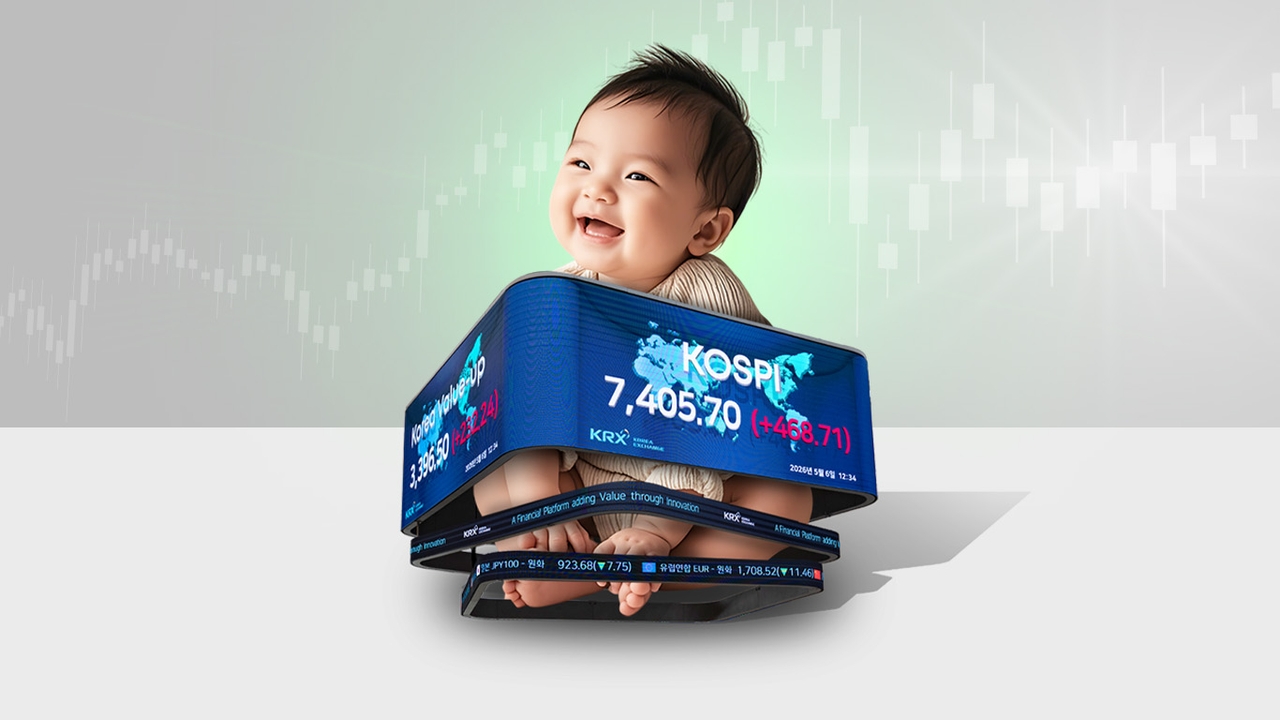
One significant investment trend gaining popularity in South Korea is opening investment accounts for children from birth. New-generation parents are planning their children's finances through stock investments amid the AI boom that has driven strong growth in the South Korean market recently. They believe that starting early allows money to generate returns and grow through the power of compound interest.
Data from Mirae Asset Securities, South Korea's largest securities company by market value, shows that as of June, the number of investment accounts for children under one year old has nearly tripled compared to the same period last year, reaching approximately 15,000 accounts.
Meanwhile, the number of new investment accounts for children under nine years old (excluding duplicate accounts) has increased by nearly 60%, reaching about 185,000 accounts.
The trend of opening accounts for children emerged after the South Korean stock market rose sharply, supported by AI-related stocks, prompting many parents to plan long-term wealth building for their children through stock investments.
However, stock market volatility in South Korea has led many investors to diversify their investments abroad in search of higher returns and growth opportunities.
"The key is not how much you invest, but how early you start investing."
According to a CNBC report, many people in South Korea believe that long-term investing is a better way to build wealth than simply depositing money in savings or fixed deposits. A survey of South Korean parents found that some families said,
"For our children's investment accounts, the time the money stays in the market is more important than the amount invested."
With this mindset, many parents open investment accounts for their children from birth, some starting on the day their baby opens their eyes. Some parents explained, "We want to give the best gift to our child, which is time and the power of compound interest throughout their growth." This is why many choose to open investment accounts immediately after birth.
South Korean parents invest for their children in various ways, including U.S. ETFs that track the S&P 500 index, gradually buying semiconductor stocks from South Korea and the U.S., as well as stocks in AI infrastructure or hardware, believing these sectors have strong long-term growth potential.
Jae-Jun Woo, an economics professor at DePaul University, told CNBC that despite increased market volatility, he believes parents will continue opening investment accounts for their children because stock investments, both domestic and international, are still seen as reliable channels for long-term wealth building. This trend is expected to continue.
He views this phenomenon as reflecting a significant change in South Korean households, which traditionally built wealth mainly through real estate ownership.
A survey by South Korea's Ministry of Information and Statistics found that about 75% of household wealth remains in tangible assets, mostly real estate, while financial assets make up only about 25%.
However, taxes on real estate sales are relatively high. According to South Korea's National Tax Service, property owners who have held real estate for two years or more face progressive capital gains tax rates of 6-45%, but if held for less than two years, tax rates increase to 40-70%.
In contrast, most retail investors do not pay capital gains tax on sales of stocks listed on the South Korean stock exchange unless they qualify as major shareholders.
Another major incentive is the gift tax. South Korean law allows parents to transfer assets or money to minor children up to 20 million won once every 10 years tax-free.
Many parents use this right to transfer money into their children's investment accounts and then buy stocks instead of leaving the money idle. However, for middle-income households, the main motivation for investing for their children is not tax savings but gradually accumulating funds for education or financial security in the future.
KakaoPay Securities, an online securities company under Kakao Corp., announced last month that it plans to give 100,000 won worth of shares to every child born next year to attract new customers from day one of life.
At the same time, the government has reduced barriers to investment access. In 2023, South Korea's financial regulatory agency revised rules to allow parents to open investment accounts for their children via smartphone from home without needing to visit branches for identity verification as in the past.
Opening accounts online removes a major obstacle for South Korean families starting to invest. If processes become even simpler, the number of minor investment accounts will increase further, especially among families who invest small amounts regularly.
However, some believe that such facilitation will mainly increase the number of investors rather than the total invested capital because each family's investment amount ultimately depends on their financial status, market conditions, and tax policies.
Source:CNBC
Follow the Facebook page: Thairath Money at this link -https://www.facebook.com/ThairathMoney